

Your pipeline just missed a 24-hour momentum spike of +0.432 in the finance sector. This is a significant anomaly, especially when you consider the leading language in this context: English, which is lagging by 26.9 hours compared to Italian. It’s not just a minor oversight; it’s a structural gap that could cost you valuable insights and timely decisions. The implications of this are profound—if your model isn’t set up to handle multilingual origins or entity dominance, you risk missing critical sentiment shifts.

English coverage led by 26.9 hours. Italian at T+26.9h. Confidence scores: English 0.85, Spanish 0.85, French 0.85 Source: Pulsebit /sentiment_by_lang.
When your model is only tuned to a single language or region, it means you could be hours behind the curve. In this case, the finance-related sentiment was already trending positively in other languages, yet you were still processing English articles. By the time your pipeline catches up, you may already be losing opportunities, especially with clusters forming around themes like finance, minister, and even religious symbols like rosaries.
Let’s dive into how we can catch these spikes in real-time using our API. We can set up a simple pipeline that filters data based on geographic origin and scores narrative framing. Here’s how you can do it in Python:

Geographic detection output for finance. India leads with 16 articles and sentiment +0.47. Source: Pulsebit /news_recent geographic fields.
import requests
# Define the parameters for the API call
params = {
"topic": "finance",
"score": +0.750,
"confidence": 0.85,
"momentum": +0.432,
"lang": "en" # Geographic origin filter
}
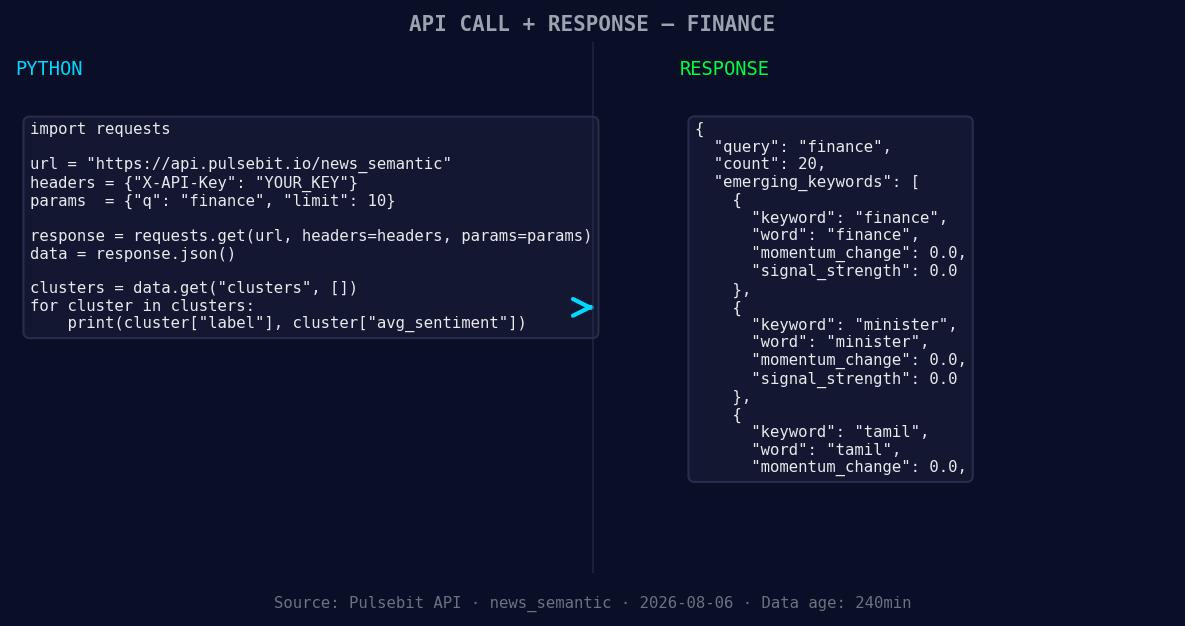
*Left: Python GET /news_semantic call for 'finance'. Right: returned JSON response structure (clusters: 3). Source: Pulsebit /news_semantic.*
# Make the API call to fetch sentiment data
response = requests.get("https://api.pulsebit.com/sentiment", params=params)
data = response.json()
# Output the fetched data for analysis
print(data)
# Now, let's run the cluster reason string back through POST /sentiment
cluster_reason = "Clustered by shared themes: finance, minister, rosary, sign, cross."
sentiment_response = requests.post("https://api.pulsebit.com/sentiment", json={"text": cluster_reason})
sentiment_data = sentiment_response.json()
# Output the sentiment analysis of the cluster reason
print(sentiment_data)
This setup allows us to efficiently pull sentiment data specifically for the finance topic while filtering for the English language. The second part runs the cluster reason through our sentiment endpoint, giving us insights into how the narrative itself is framed. This is crucial for understanding not just the data, but the context behind it.
Now that you have the basics down, let’s explore three specific builds you can implement tonight.
Real-time Alerts on Momentum Spikes: Set a threshold for momentum spikes, say +0.400, and trigger alerts whenever sentiment for finance exceeds this threshold. Use the geo filter to ensure you’re responding to shifts in the relevant language.
Narrative Framing Analysis: Build a component that automatically analyzes narratives around clustered topics. For example, if you see “finance” and “minister” trending, run those through the meta-sentiment loop to gauge whether the framing is positive or negative before acting.
Comparative Analysis Dashboard: Create a dashboard that compares sentiment scores across languages. This will help you visualize when one language is leading, such as English lagging behind Italian in this case, allowing you to adjust your focus dynamically.
If you want to get started with your own builds, check out our documentation at pulsebit.lojenterprise.com/docs. You can copy-paste and run this API call in under 10 minutes, and before you know it, you’ll be catching those momentum spikes before anyone else does.


Top comments (1)
I found the example of using the Pulsebit API to fetch sentiment data for the finance topic while filtering for the English language particularly insightful, as it highlights the importance of considering multilingual origins in sentiment analysis. The code snippet provided demonstrates how to efficiently pull sentiment data and analyze the narrative framing of clustered topics. One potential improvement to this approach could be incorporating additional natural language processing techniques, such as entity recognition or topic modeling, to further enhance the contextual understanding of the sentiment data. Have you explored integrating any such techniques with the Pulsebit API, and if so, what benefits or challenges did you encounter?