

Your Pipeline Is 25.5h Behind: Catching Finance Sentiment Leads with Pulsebit
We've just uncovered a striking anomaly: a 24-hour momentum spike of +0.443 in finance sentiment. This spike isn't just a number; it signifies a shift in sentiment that you might have missed if your pipeline isn't equipped to handle multilingual origin or entity dominance. The leading language for this spike is English, with a dominant press lagging at 25.5 hours behind Italian sources. That’s a significant gap that could leave your analysis stale and your insights irrelevant.

English coverage led by 25.5 hours. Italian at T+25.5h. Confidence scores: English 0.85, French 0.85, Spanish 0.85 Source: Pulsebit /sentiment_by_lang.
Imagine your model missing this crucial shift by more than a day. This is the reality for many developers who rely on pipelines that don’t account for language nuances or regional sentiment disparities. With English press leading the charge while Italian sources lag, your sentiment analysis could be missing critical insights. This is especially true when clusters around key topics like "budget" and "deficit" emerge but aren’t immediately recognized due to language barriers.
Let’s dive into how we can catch this momentum spike with a few lines of Python code. First, we’ll filter our query to focus on English-language content related to finance. Here’s how to do that using our API:
import requests
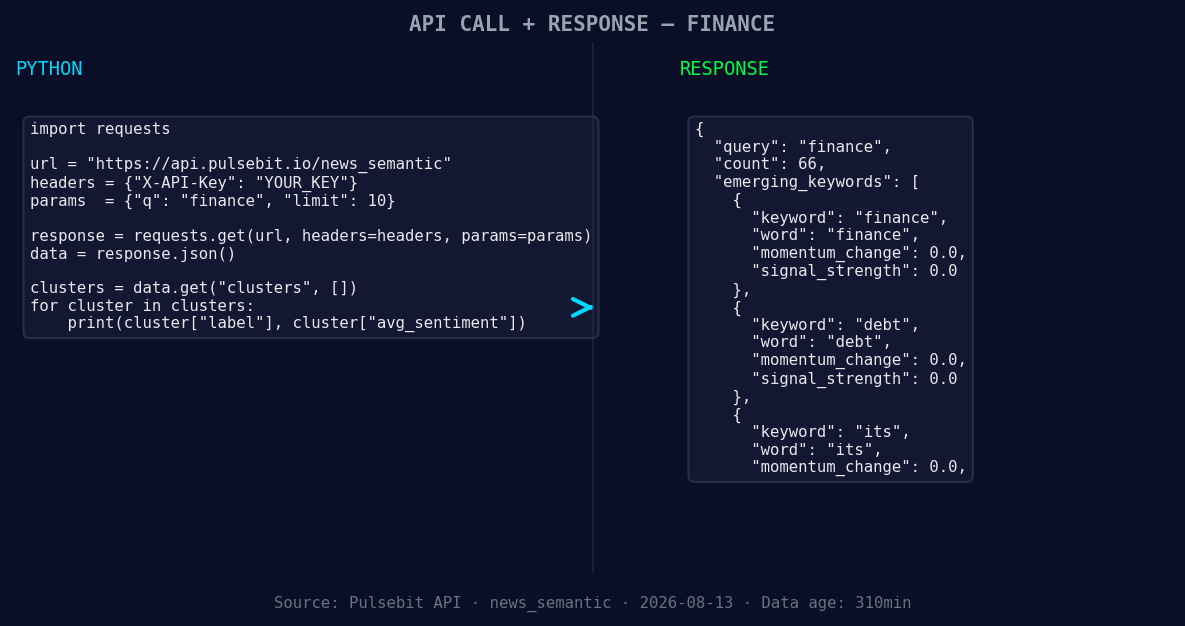
*Left: Python GET /news_semantic call for 'finance'. Right: returned JSON response structure (clusters: 3). Source: Pulsebit /news_semantic.*
url = "https://api.pulsebit.io/sentiment"
params = {
"topic": "finance",
"lang": "en",
"score": -0.012,
"confidence": 0.85,
"momentum": +0.443
}
response = requests.get(url, params=params)
data = response.json()
print(data)
Next, we need to evaluate the narrative framing itself. To do this, we’ll send the cluster reason string back through our sentiment analysis to score its sentiment. This allows us to gauge whether the underlying themes being discussed are indeed positive or negative. Here’s how:
cluster_reason = "Clustered by shared themes: déficit, une, baisse, nouvel, budget."
sentiment_response = requests.post(url, json={"text": cluster_reason})
sentiment_data = sentiment_response.json()
print(sentiment_data)
This process not only captures the sentiment spike but also provides insights into the narrative driving that spike. It's a powerful way to ensure you’re not just seeing numbers but also understanding the stories behind them.
Now that we’ve captured the momentum spike, let’s consider three specific builds you can create with this pattern.
- Geo-Filtered Sentiment Analysis: Set an alert for any finance-related topics that hit a momentum score above +0.3 specifically from English sources. Use the geographic filter to ensure you’re capturing relevant regional insights, as language can often mask underlying sentiment shifts.

Geographic detection output for finance. India leads with 7 articles and sentiment +0.23. Source: Pulsebit /news_recent geographic fields.
Meta-Sentiment Loop: Implement a system that re-evaluates sentiment narratives by continuously feeding back the cluster reason strings into the sentiment analysis. If the sentiment score for narratives drops below a threshold (say -0.1), trigger a deeper investigation into the underlying themes (like debt or deficits).
Forming Themes Dashboard: Create a dashboard that visualizes forming themes, allowing you to see not just the current sentiment but also how it’s evolving over time. Track keywords such as "finance," "debt," and "budget" and set thresholds for when these become significant in your analysis.
With these builds, you can ensure your finance sentiment analysis is always ahead of the curve, capturing shifts as they happen rather than lagging behind.
Ready to get started? Visit pulsebit.lojenterprise.com/docs. You can copy-paste the provided code and run it in under 10 minutes to see this in action. Don’t let your pipeline fall behind!


Top comments (0)