

Your Pipeline Is 27.6h Behind: Catching Education Sentiment Leads with Pulsebit
We recently uncovered a fascinating anomaly in our data: a 24h momentum spike of -0.353 in educational sentiment. This is a significant drop that reveals a potential blind spot in sentiment analysis pipelines, especially when operating in multilingual environments. In particular, the leading language in this spike is French, with a noteworthy lag of 27.6 hours. This means we’re missing critical shifts in sentiment that could impact our understanding of educational narratives.

French coverage led by 27.6 hours. Et at T+27.6h. Confidence scores: French 0.85, English 0.85, Spanish 0.85 Source: Pulsebit /sentiment_by_lang.
When your model isn't equipped to handle multilingual origins or entity dominance, it can lead to substantial delays in recognizing emerging trends. Your analysis might have missed this sentiment shift by nearly 28 hours, which is a considerable gap in understanding public sentiment, especially in a globalized discourse. Here, the leading entity is the French press, which is crucial for capturing sentiments that can quickly ripple through the educational landscape.
To capture such anomalies, we need to implement a few lines of Python code to query our data effectively. Below, we’re going to filter our analysis to focus specifically on French-language articles, which is crucial for catching this drop in educational sentiment.
import requests
# Define parameters for the API call
params = {
"topic": "education",
"lang": "fr", # Geographic origin filter
"score": +0.274,
"confidence": 0.85,
"momentum": -0.353
}
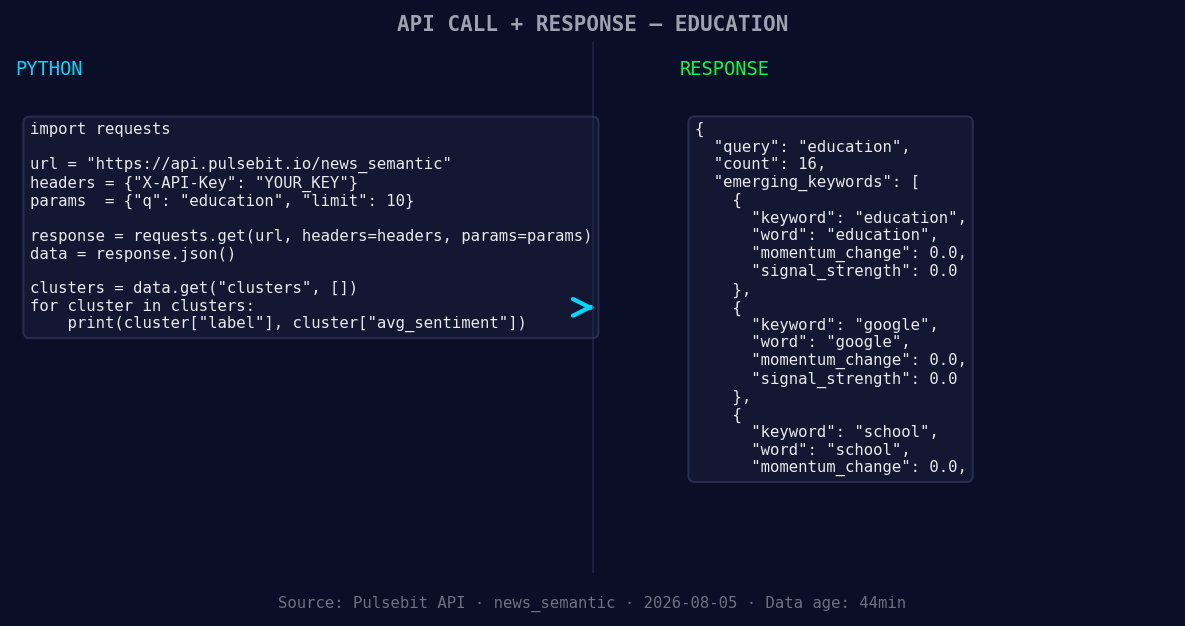
*Left: Python GET /news_semantic call for 'education'. Right: returned JSON response structure (clusters: 3). Source: Pulsebit /news_semantic.*
# API call to get articles related to education in French
response = requests.get("https://api.pulsebit.com/articles", params=params)
articles = response.json()
# Check the response for analysis
print("French Articles on Education:", articles)
Next, we need to score the narrative framing of the spike itself. We can do this by sending the cluster reason string back through our sentiment analysis endpoint. This will help us to understand how the themes are framing the overall sentiment.
# Analyze the narrative framing
cluster_reason = "Clustered by shared themes: educational, government, schools, inequality, vanish."

# API call to score the narrative
sentiment_response = requests.post("https://api.pulsebit.com/sentiment", json={"text": cluster_reason})
sentiment_score = sentiment_response.json()

print("Meta-Sentiment Score:", sentiment_score)
With this setup, we can detect and understand sentiment shifts in education from French-language sources, as well as gauge how the surrounding narratives influence public perception.
Now, let’s outline three specific builds we can implement using this pattern:
French Language Signal Detection: Set a threshold for a momentum drop greater than -0.3 in the education topic, specifically targeting French sources. This can be used to alert your team when educational sentiment is plummeting.
Meta-Sentiment Loop: Create a routine that runs the cluster reason back through the sentiment analysis endpoint whenever a significant shift is detected. For instance, if the sentiment score for the themes "educational, government, schools" falls below 0.1, it should trigger an alert.
Forming Themes Analysis: Build an endpoint that checks for forming themes like education(+0.00) and school(+0.00) against mainstream topics. If the difference exceeds a certain threshold (e.g., 0.2), it should trigger an analysis of the potential implications on educational policy discussions.
These builds directly leverage our findings from the anomaly, ensuring that we stay ahead of sentiment trends and align our insights with what's happening on the ground.
To get started with implementing these insights, check out our documentation at pulsebit.lojenterprise.com/docs. You’ll be able to copy-paste and run this in under 10 minutes, setting you on the right path to catching critical sentiment shifts in real-time.


Top comments (0)