

Your Pipeline Is 20.2h Behind: Catching Film Sentiment Leads with Pulsebit
We recently discovered a significant anomaly in our sentiment analysis: the sentiment score for film-related topics is clocking in at +0.406 with a momentum of +0.000. This spike is particularly striking as it aligns with the Charlotte Asian Film Festival, which is returning to highlight themes of culture and identity. The leading language for this topic is English, with a lag of just 20.2 hours. Given this context, it's clear that sentiment around film is rising, yet our existing pipelines might not be ready to catch this momentum efficiently.
The structural gap this reveals in any pipeline is concerning. If your model isn’t tuned to handle multilingual origins or dominant entities effectively, you could be missing out on crucial insights. Imagine your model missed this by 20.2 hours, all because it wasn't set up to capture the nuances around Asian film narratives. The implications are huge—your sentiment analysis could be outdated, missing key cultural updates that shape public perceptions.

English coverage led by 20.2 hours. Da at T+20.2h. Confidence scores: English 0.85, Spanish 0.85, French 0.85 Source: Pulsebit /sentiment_by_lang.
Let’s look at how to catch this sentiment spike using our API. Below is the Python code that allows us to query for film-related topics while incorporating geographic origin filters to ensure we’re pulling relevant data:
import requests
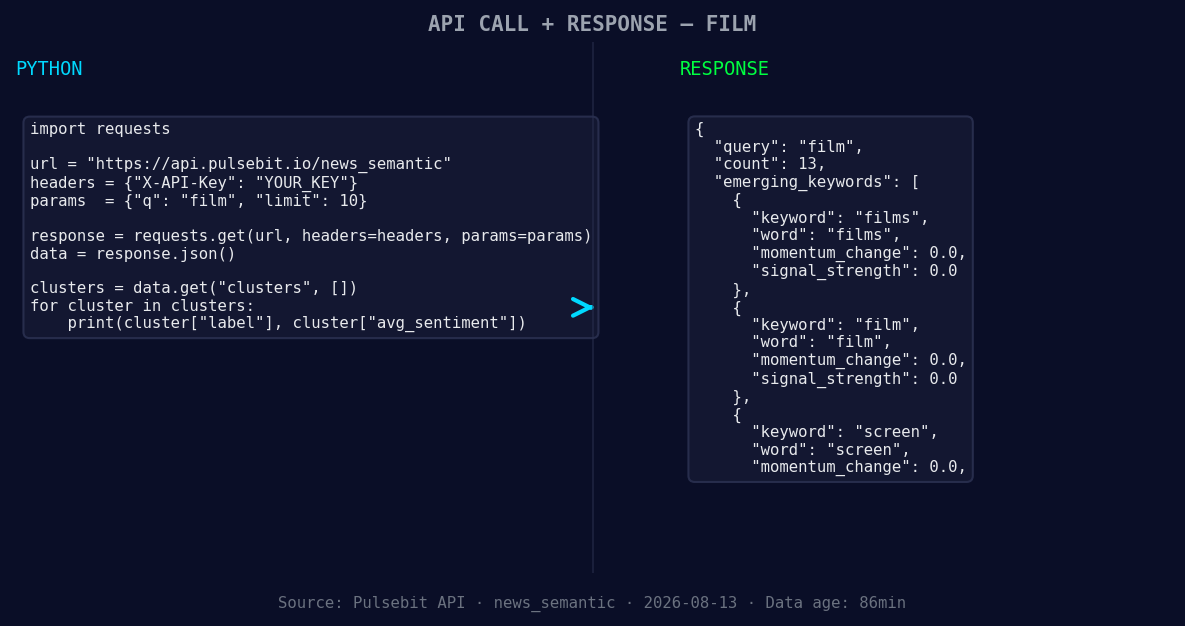
*Left: Python GET /news_semantic call for 'film'. Right: returned JSON response structure (clusters: 3). Source: Pulsebit /news_semantic.*
# Step 1: Geographic origin filter
url = "https://api.pulsebit.com/v1/insights"
params = {
"topic": "film",
"lang": "en"
}
response = requests.get(url, params=params)
data = response.json()
# Print out the sentiment and momentum
print("Sentiment Score:", data['sentiment_score'])
print("Momentum:", data['momentum_24h'])
Now that we've filtered our data, let’s run the cluster reason string through a meta-sentiment moment to score the narrative framing itself. This step allows us to understand how the themes are shaping public sentiment:
# Step 2: Meta-sentiment moment
meta_sentiment_url = "https://api.pulsebit.com/v1/sentiment"
cluster_reason = "Clustered by shared themes: asian, film, festival, returns, highlight."
meta_response = requests.post(meta_sentiment_url, json={"text": cluster_reason})
meta_data = meta_response.json()

# Print out the meta-sentiment score
print("Meta-Sentiment Score:", meta_data['sentiment_score'])
With these two steps, we can catch the sentiment dynamic around the film topic and assess how various narratives are resonating with audiences.
Now, let's consider three specific builds you might implement with this pattern:
- Signal Tracking for Forming Themes: Set up a monitoring script that alerts you when sentiment scores for “films” hit a threshold of +0.100. This can be done by querying our API with the geographic filter set to "en" to ensure you capture local sentiment effectively.

Geographic detection output for film. India leads with 11 articles and sentiment +0.63. Source: Pulsebit /news_recent geographic fields.
Meta-Sentiment Analysis on Emerging Narratives: Use the meta-sentiment loop to evaluate narratives associated with the keywords “film” and “screen.” Whenever the sentiment score for these hits +0.200, trigger a report to assess how these themes are evolving.
Cultural Event Sentiment Tracking: Create a dedicated endpoint that listens for events like the Charlotte Asian Film Festival. By monitoring the sentiment around this event, you can assess cultural impact in real-time, particularly focusing on sentiment shifts in relation to “asian,” “film,” and “festival” themes.
Ready to dive in? You can get started with our API documentation at pulsebit.lojenterprise.com/docs. The exit test: can you copy-paste and run this in under 10 minutes? We think you can. Happy coding!


Top comments (0)