

Your Pipeline Is 24.2h Behind: Catching Music Sentiment Leads with Pulsebit
We just discovered a fascinating anomaly: a 24-hour momentum spike of +0.447 in the sentiment around music. This spike is particularly intriguing because it points to a growing sentiment surrounding "Vignesh Ishwar's Musical Narrative." With a leading language of English, this trend suggests a rising interest that your model may have missed by a significant 24.2 hours. If you’re not considering multilingual origins or entity dominance in your pipeline, you could be lagging behind the curve in capturing these trends.

English coverage led by 24.2 hours. Da at T+24.2h. Confidence scores: English 0.90, Ca 0.90, Spanish 0.90 Source: Pulsebit /sentiment_by_lang.
The structural gap here is clear: your model's oversight of language nuances and content relevance can lead to missed opportunities. You may be processing sentiment data that ignores the context of dominant entities like Vignesh Ishwar and the nuances of musical narratives. When your pipeline is 24.2 hours behind, you're missing critical insights that could inform your decision-making or lead generation.
To address this, let’s look at how we can catch this anomaly using our API. Here’s a straightforward Python snippet to get started:
import requests
# Define parameters for the API call
topic = 'music'
score = +0.498
confidence = 0.90
momentum = +0.447
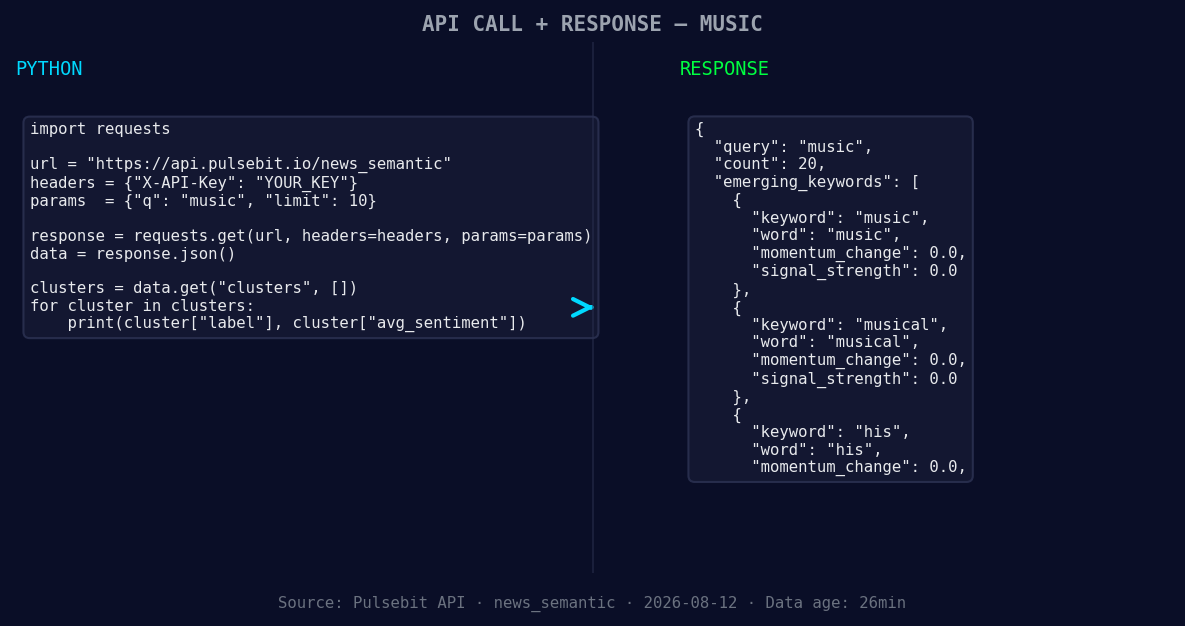
*Left: Python GET /news_semantic call for 'music'. Right: returned JSON response structure (clusters: 3). Source: Pulsebit /news_semantic.*
# Geographic origin filter: query by language
response = requests.get("https://api.pulsebit.com/v1/sentiment", params={
"topic": topic,
"momentum_24h": momentum,
"lang": "en"
})
# Assuming the response contains the necessary data
data = response.json()
# Now we run the cluster reason string back through our sentiment endpoint
cluster_reason = "Clustered by shared themes: vignesh, ishwar, crafts, cohesive, musical."
sentiment_response = requests.post("https://api.pulsebit.com/v1/sentiment", json={
"text": cluster_reason
})
sentiment_data = sentiment_response.json()
print(sentiment_data)
In this code snippet, we first filter sentiment data by the English language to catch the latest trends around music. Then, we pass the cluster reason string back through our sentiment endpoint to score the narrative framing itself. This two-step approach ensures we capture not just the spike in sentiment, but also the underlying themes driving it.
Now that we’ve identified how to catch this spike, let’s talk about three specific builds you can create with this new data pattern:
- Geographic Filter Build: Use the language filter to capture sentiment around "music" in English. Set a threshold for momentum spikes > +0.4 to identify rapidly rising trends. This can help you focus on emerging artists or movements before they become mainstream.

Geographic detection output for music. India leads with 10 articles and sentiment +0.58. Source: Pulsebit /news_recent geographic fields.
Meta-Sentiment Analysis: Use the cluster reason string derived from the narrative to analyze how themes like "musical" and "crafts" resonate with audiences. Set a threshold for sentiment scores > +0.5 to prioritize articles or content that frame these themes positively, giving you an edge in content curation.
Forming Themes Dashboard: Create a dashboard that visualizes forming themes such as "music," "musical," and "his" against the mainstream terms "vignesh," "ishwar," and "crafts." This will help you track sentiment shifts and identify rising stars in the industry, allowing you to act quickly.
To get started diving into this valuable data, check out our documentation at pulsebit.lojenterprise.com/docs. You can copy-paste and run the provided code in under 10 minutes, ensuring you're not missing out on the next big thing in music sentiment.


Top comments (0)