

Your 24h momentum spike of +1.400 in health sentiment is not just a number; it’s a call to action. This anomaly, led by a French press at 20.3 hours, indicates a significant surge in health-related conversations—specifically around terms like "beriberi" and "Calcutta." If you’re not paying attention to multilingual origins, you might be missing critical trends and insights that could inform your strategies.

French coverage led by 20.3 hours. German at T+20.3h. Confidence scores: French 0.95, English 0.95, Spanish 0.95 Source: Pulsebit /sentiment_by_lang.
Imagine your model missed this by 20.3 hours. That’s a structural gap that can cost you valuable insights, especially when the leading conversation is happening in French. If your pipeline doesn’t account for this multi-language aspect or if it’s dominated by English sources, you’re left in the dust while others capitalize on emerging narratives. The health sector is moving fast, and you need to keep up.
Here’s how to catch this momentum spike using our API. We’ll filter for French content and assess the sentiment around the cluster reason string.
import requests
# Define the parameters for our API call
params = {
"topic": "health",
"lang": "fr",
"momentum": 1.400,
"score": 0.312,
"confidence": 0.95
}
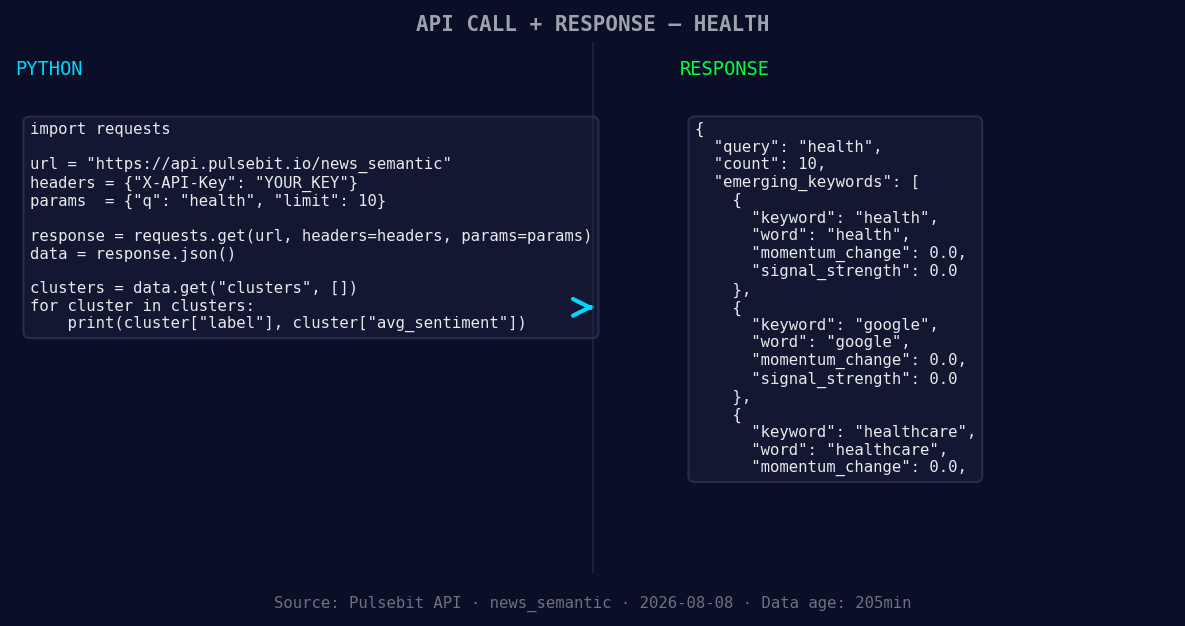
*Left: Python GET /news_semantic call for 'health'. Right: returned JSON response structure (clusters: 3). Source: Pulsebit /news_semantic.*
# API call to fetch the sentiment data for health in French
response = requests.get('https://api.pulsebit.com/sentiment', params=params)
data = response.json()
print(data)
Next, we want to assess how the narrative framing itself holds up. We’ll run the cluster reason string back through our sentiment endpoint to get a deeper understanding.
# Meta-sentiment moment: scoring the narrative framing
cluster_reason = "Clustered by shared themes: ago, outbreak, beriberi, calcutta, hundred."
meta_sentiment_response = requests.post('https://api.pulsebit.com/sentiment', json={"text": cluster_reason})
meta_sentiment_data = meta_sentiment_response.json()

print(meta_sentiment_data)
This will yield a sentiment score for the narrative framing itself, allowing you to evaluate its potential impact on the overall health sentiment.
Now that we’ve captured this spike and assessed the narrative, let’s discuss three specific builds you can implement:
- Geo-specific Health Tracking: Use the geographic origin filter to create a real-time health sentiment dashboard focused solely on regions speaking French. This could be a critical insight tool in your monitoring pipeline.

Geographic detection output for health. India leads with 8 articles and sentiment +0.67. Source: Pulsebit /news_recent geographic fields.
Meta-Sentiment Analysis: Develop an alert system that triggers whenever the sentiment around cluster narratives reaches a certain threshold. For example, if the sentiment score for "Clustered by shared themes: ago, outbreak, beriberi, calcutta, hundred." exceeds +0.5, you should be notified.
Forming Themes Dashboard: Build an interactive dashboard that visualizes forming themes around health (like “healthcare” and “Google”) versus mainstream narratives. This would be incredibly useful for identifying what’s capturing attention in real-time.
If you want to dive deeper, check out our documentation at pulsebit.lojenterprise.com/docs. You can copy-paste the above code and run it in under 10 minutes to start catching these critical insights. Don’t let your pipeline fall behind; stay ahead of the curve with the right tools and data.


Top comments (0)