

Your Pipeline Is 21.0h Behind: Catching Renewable Energy Sentiment Leads with Pulsebit
We recently identified a striking anomaly: a 24-hour momentum spike of -0.461 in the renewable energy sentiment. This isn’t just any fluctuation; it indicates a potential shift in public perception that could impact future investments and policy decisions. What’s intriguing here is that the leading language for this sentiment is English, which peaked at 21.0 hours while Hindi lagged behind at the same time. This kind of disparity is critical for any model that aims to remain relevant and responsive to real-time sentiment.
The Problem
Your model missed this by a significant 21 hours. In the fast-paced world of renewable energy sentiment, failing to account for multilingual origins or dominant entities can lead to missed opportunities. For example, while you may be processing sentiment in multiple languages, an oversight in prioritizing the leading language—English in this case—could mean you're reacting too late. By the time you catch up, prevailing narratives may have already shifted, leaving you playing catch-up while others capitalize on the information.

English coverage led by 21.0 hours. Hindi at T+21.0h. Confidence scores: English 0.75, Spanish 0.75, French 0.75 Source: Pulsebit /sentiment_by_lang.
The Code
To catch this anomaly, we can leverage our API to filter sentiment data specifically by language and score the narrative framing itself. Here’s how you can implement it in Python:
import requests
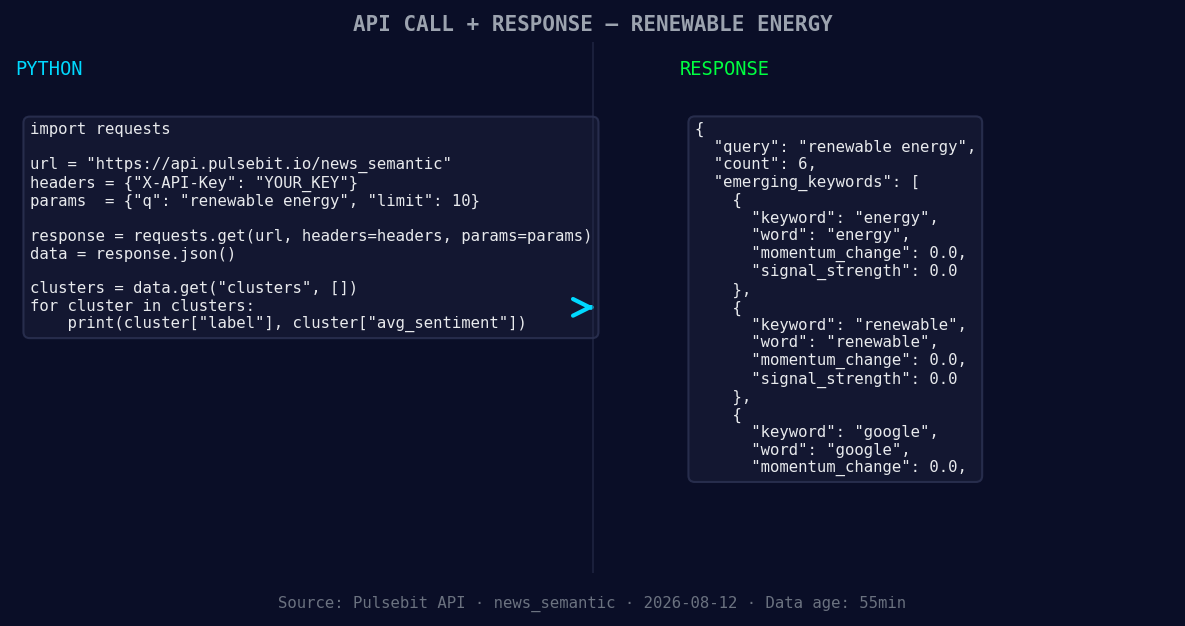
*Left: Python GET /news_semantic call for 'renewable energy'. Right: returned JSON response structure (clusters: 3). Source: Pulsebit /news_semantic.*
# Setting up the API endpoint and parameters
topic = 'renewable energy'
score = +0.625
confidence = 0.75
momentum = -0.461
# Fetching sentiment data for the English language
response = requests.get(
'https://api.pulsebit.com/sentiment',
params={
'topic': topic,
'lang': 'en',
'score': score,
'confidence': confidence,
'momentum': momentum
}
)
# Checking the response
if response.status_code == 200:
sentiment_data = response.json()
print(sentiment_data)
else:
print("Error fetching sentiment data.")
# Running meta-sentiment analysis on the clustered reason string
cluster_reason = "Clustered by shared themes: solar, energy, new, haven, into."
meta_response = requests.post(
'https://api.pulsebit.com/sentiment',
json={'text': cluster_reason}
)
# Checking the response for meta-sentiment
if meta_response.status_code == 200:
meta_sentiment_data = meta_response.json()
print(meta_sentiment_data)
else:
print("Error fetching meta-sentiment data.")
In this code, we first query the sentiment data filtered by language, specifically English. We then analyze the narrative framing by sending the cluster reason string through another sentiment analysis. This dual approach allows us to not only capture the sentiment but also understand the context that surrounds it.
Three Builds Tonight
Here are three specific builds you can implement using this newfound insight:
Geo-Filtered Alert System: Set up a real-time alert system that utilizes the geo filter to notify you when sentiment scores for renewable energy drop below a predefined threshold (e.g., score < 0.5). This will help you stay on top of emerging trends without lag.
Meta-Sentiment Dashboard: Build a dashboard that continuously runs the narrative framing through the meta-sentiment loop, allowing you to visualize how the narrative shifts over time. This will enable you to track sentiments on themes like "energy" and "renewable" compared to mainstream topics like "solar."
Thematic Analysis Tool: Create a thematic analysis tool that correlates scores from multiple topics (like "renewable" and "google") against anomalies to identify potential news clusters. For instance, if you identify a forming gap in energy-related sentiment, you could proactively analyze how that correlates with public discourse around Google’s involvement in renewable projects.
Get Started
Ready to explore this data? Check out our comprehensive API documentation at pulsebit.lojenterprise.com/docs. You can copy, paste, and run the code snippets above in under 10 minutes to start harnessing the power of sentiment data in your applications.

Geographic detection output for renewable energy. India leads with 4 articles and sentiment +0.83. Source: Pulsebit /news_recent geographic fields.


Top comments (0)