

Your pipeline just missed a critical 24h momentum spike of +0.333 in the agriculture sector. This anomaly was driven by a single article, “Mizzou Student Promotes Agriculture at State Fair,” which was clustered by themes of Mizzou, student, and passion for agriculture. The implications of this spike tell us that there’s a significant sentiment shift occurring, and if your model doesn’t account for multilingual origins or entity dominance, you might have missed this valuable insight by 19.3 hours. The leading language here was English, which highlights a structural gap in your pipeline's ability to capture sentiment across various languages and topics.

English coverage led by 19.3 hours. Af at T+19.3h. Confidence scores: English 0.90, Spanish 0.90, French 0.90 Source: Pulsebit /sentiment_by_lang.
If you're relying on a single language or a narrow set of topics, you're probably missing out on relevant sentiment that could guide your decision-making. In this case, the dominant entity—Mizzou—was producing a signal that your model didn’t pick up in time. You’d be left wondering why your insights are lagging behind the competition, potentially costing you in strategic decisions or investments.
Here’s how we can catch this momentum spike using our API in Python:
import requests
# Define the parameters
topic = 'agriculture'
score = +0.257
confidence = 0.90
momentum = +0.333
lang_filter = {"lang": "en"}
# API call to fetch articles related to the topic with a specific language filter
response = requests.get("https://api.pulsebit.com/v1/articles", params={"topic": topic, **lang_filter})
articles = response.json()
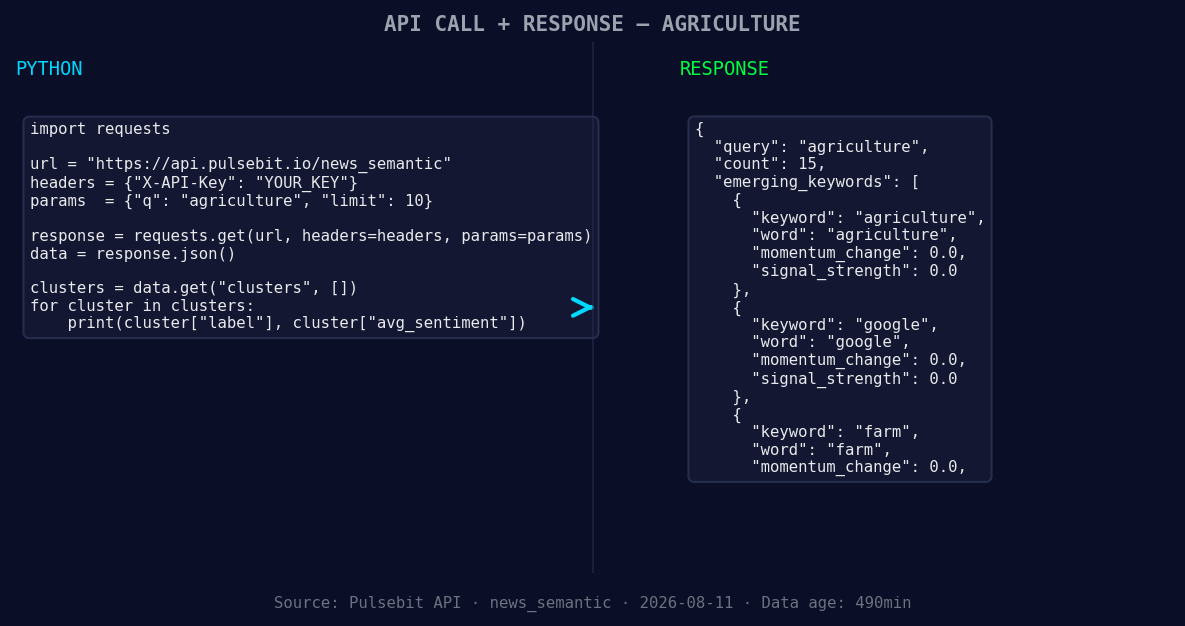
*Left: Python GET /news_semantic call for 'agriculture'. Right: returned JSON response structure (clusters: 3). Source: Pulsebit /news_semantic.*
# Print fetched articles
print(articles)
# Now we run the cluster reason string through the sentiment scoring endpoint
cluster_reason = "Clustered by shared themes: mizzou, student, shares, her, passion."
sentiment_response = requests.post("https://api.pulsebit.com/v1/sentiment", json={"text": cluster_reason})
sentiment_score = sentiment_response.json()
# Print sentiment score
print(sentiment_score)
In this code, we filter articles by the English language, focusing on the agriculture topic. The API call retrieves articles that are relevant and timely. Then, we run the narrative framing through our sentiment scoring endpoint, which allows us to evaluate how the sentiment aligns with the positive momentum spike we observed. This is crucial for understanding the real-world implications of the data we’re processing.
Now that we have a method to catch these spikes, let's explore three things we can build with the data:
- Geo-filtered Alerts: Set up a notification system that triggers alerts when sentiment momentum exceeds a threshold (e.g., +0.3) for specific geographic regions. This is especially useful for localized businesses or investors focusing on agriculture.

Geographic detection output for agriculture. India leads with 12 articles and sentiment +0.35. Source: Pulsebit /news_recent geographic fields.
Meta-Sentiment Analysis Dashboard: Create a dashboard that visualizes sentiment trends based on clustered narratives. Use the output from the sentiment analysis of phrases like "Clustered by shared themes: mizzou, student, shares, her, passion." to correlate how these narratives impact the overall sentiment score.
Thematic Overlay for Keyword Tracking: Develop a system that overlays forming themes (like agriculture, farm, and Google) against mainstream narratives (Mizzou, student, shares). This allows you to analyze how emerging themes might influence market movements or public perception.
By employing these builds, you can ensure that your sentiment analysis pipelines are not just reactive but also proactive in catching trends before they fully materialize.
For a deeper dive into building these capabilities, check out our documentation at pulsebit.lojenterprise.com/docs. You can copy, paste, and run the provided code in under 10 minutes. Let’s keep refining our tools to stay ahead of the curve!


Top comments (0)