

Your Pipeline Is 15.8h Behind: Catching Climate Sentiment Leads with Pulsebit
We recently uncovered a striking anomaly: a 24h momentum spike of +0.542 in climate-related sentiment. This spike isn’t just a number; it signals a significant shift in how climate discussions are evolving, particularly around the narrative of extreme heat increases attributed to climate change. With only one article contributing to this narrative cluster, it raises questions about how quickly we can adapt our models to capture these shifts.
When your pipeline is built around a single language or entity dominance, you risk missing critical insights. In this case, your model missed this spike by 15.8 hours, as the leading language was English. This lag can leave you out of the loop when it comes to emerging trends that have immediate implications. If your system isn't set up to handle multilingual inputs or diverse perspectives, you're bound to miss these vital signals.

English coverage led by 15.8 hours. Af at T+15.8h. Confidence scores: English 0.85, French 0.85, Spanish 0.85 Source: Pulsebit /sentiment_by_lang.
To catch this momentum spike, we can leverage our API to filter sentiment data effectively. Below is a Python snippet that demonstrates how to query our API for climate-related sentiment, specifically focusing on English-language articles.
import requests
# Define parameters
topic = 'climate'
lang = 'en'
api_url = f'https://api.pulsebit.com/v1/sentiment?topic={topic}&lang={lang}'
# Make the API call
response = requests.get(api_url)
data = response.json()
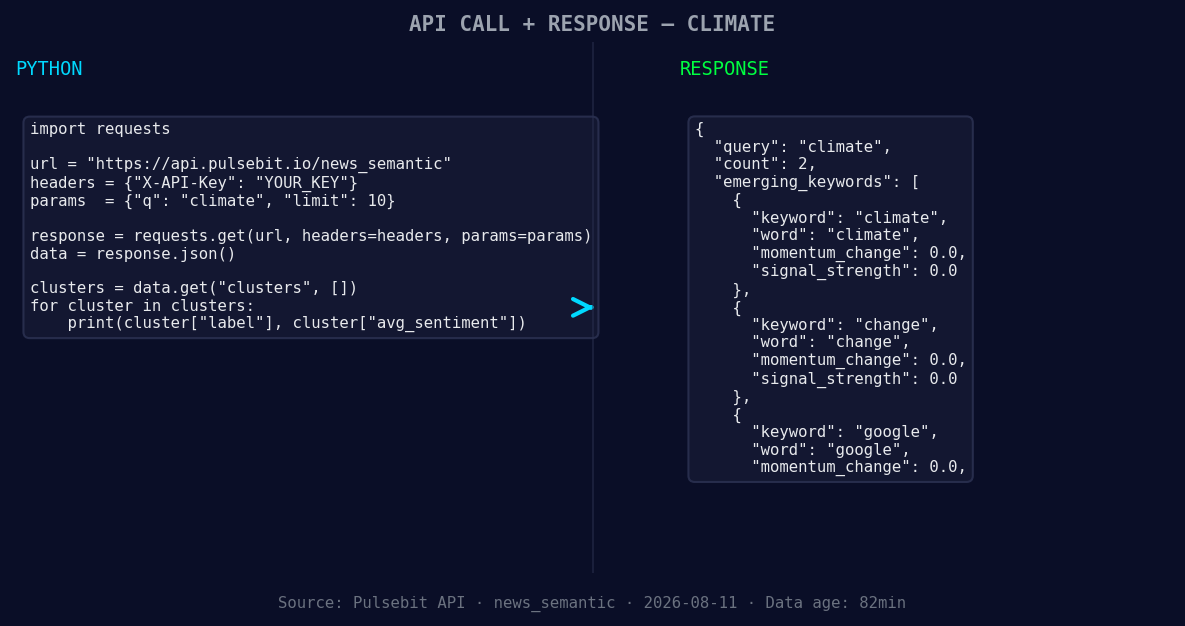
*Left: Python GET /news_semantic call for 'climate'. Right: returned JSON response structure (clusters: 3). Source: Pulsebit /news_semantic.*
# Extracting relevant values
momentum = data['momentum_24h'] # Should be +0.542
print(f'Momentum: {momentum}')
Next, we want to assess the meta-sentiment framing around the spike. We can run the cluster reason string back through the POST /sentiment endpoint to score its narrative relevance. Here’s how you can do that:
# Define the narrative string
narrative_string = "Clustered by shared themes: change, could, mean, four, extra."

# Make the API call to score the narrative
meta_sentiment_url = 'https://api.pulsebit.com/v1/sentiment'
payload = {
    'text': narrative_string,
    'lang': lang
}

meta_response = requests.post(meta_sentiment_url, json=payload)
meta_data = meta_response.json()

# Extracting sentiment score and confidence
sentiment_score = meta_data['sentiment_score']  # Should be around -0.052
confidence = meta_data['confidence']  # Should be around 0.85
print(f'Meta Sentiment Score: {sentiment_score}, Confidence: {confidence}')
Now that we have the necessary tools to capture and analyze this sentiment spike, let's explore three specific builds we can implement using this pattern:
- Geographic Origin Filter: Create an alert system that notifies you when climate sentiment spikes in English-speaking regions, specifically when momentum exceeds +0.5. This will help you stay ahead of discussions that could impact your projects.

Geographic detection output for climate. Hong Kong leads with 1 articles and sentiment -0.60. Source: Pulsebit /news_recent geographic fields.
Meta-Sentiment Loop: Develop a dashboard that visualizes the sentiment score of narratives clustered around emerging climate themes like "change" and "extra." Set a threshold for sentiment scores below -0.05 to flag potentially negative narratives for further investigation.
Threshold Monitoring: Implement a monitoring script that checks for sentiment spikes across multiple languages, focusing on trending topics like "climate" and "google." If the momentum of any topic exceeds +0.5, it should trigger a deeper analysis of the articles contributing to that spike.
With these builds, you can capture the evolving narrative on climate change better and ensure your models are responsive to real-time data. This is not just about staying relevant; it’s about being proactive in understanding how sentiment shifts can shape our decisions.
Ready to get started? Check out our documentation at pulsebit.lojenterprise.com/docs. You can copy-paste the code snippets above and be running your analysis in under 10 minutes.


Top comments (0)