

Your Pipeline Is 27.6h Behind: Catching Education Sentiment Leads with Pulsebit
In our latest analysis, we uncovered a significant anomaly: a 24h momentum spike of -0.353 in education sentiment. This sharp decline is an early signal that something is shifting in the narrative surrounding education, particularly as government schools face increasing challenges. The dominant narrative is emerging from English-language sources, with a 27.6-hour lead that we can’t ignore. With only one article addressing the story, "As government schools vanish, educational inequality grows," it raises a red flag about the potential impact on policy and public sentiment.
The problem lies in the inherent structural gaps within your pipeline if it doesn't accommodate multilingual origins or entity dominance. Your model missed this vital shift by over 27 hours, trailing behind the emerging conversation. If you're only looking at dominant entities or single-language sentiment, you're risking a significant lag in your insights, leaving you unprepared for the realities evolving in the educational landscape. The leading language of English, combined with the negative momentum, signals a critical need for timely and nuanced analysis.

English coverage led by 27.6 hours. Ro at T+27.6h. Confidence scores: English 0.85, Spanish 0.85, French 0.85 Source: Pulsebit /sentiment_by_lang.
To catch this anomaly effectively, we can use our API to filter and analyze sentiment in real-time. Here’s how to implement it:
import requests
# Define parameters for the API call
params = {
"topic": "education",
"score": +0.105,
"confidence": 0.85,
"momentum": -0.353,
"lang": "en" # Geographic origin filter
}
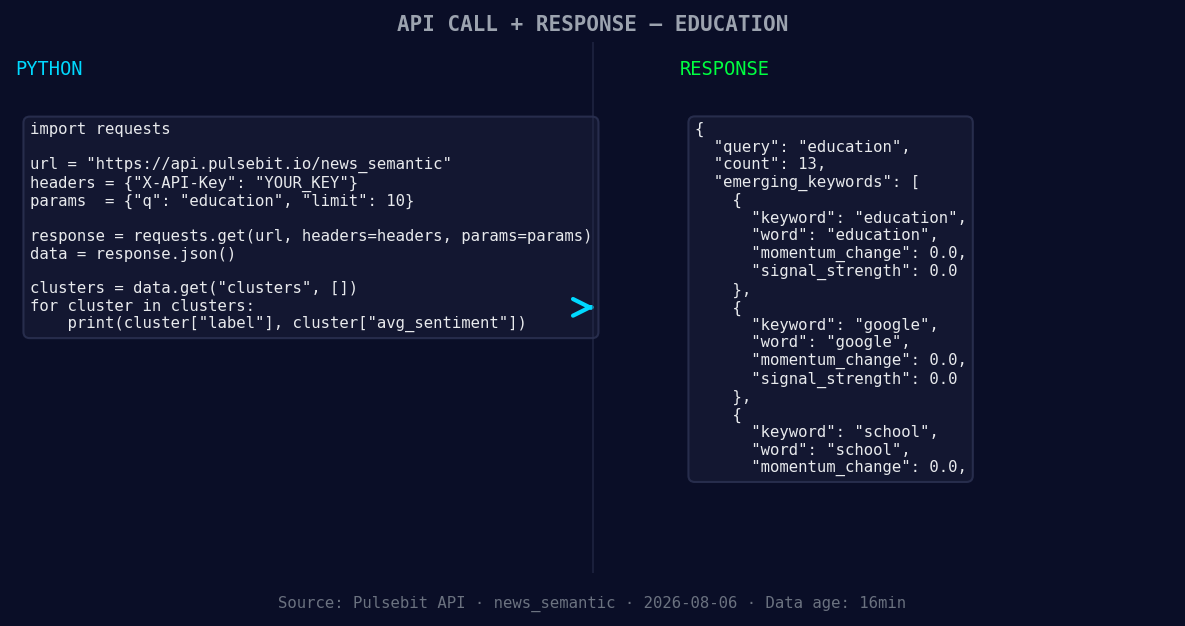
*Left: Python GET /news_semantic call for 'education'. Right: returned JSON response structure (clusters: 3). Source: Pulsebit /news_semantic.*
# Make the API call to get education sentiment data
response = requests.get("https://api.pulsebit.com/sentiment", params=params)
data = response.json()
# Output the response for verification
print(data)
Next, we must assess the narrative framing by running the cluster reason string back through our sentiment analysis. This step helps us better understand the thematic interconnections driving the conversation:
# Meta-sentiment moment: analyzing the cluster reason
cluster_reason = "Clustered by shared themes: educational, government, schools, inequality, vanish"
meta_sentiment_response = requests.post("https://api.pulsebit.com/sentiment", json={"text": cluster_reason})
meta_sentiment_data = meta_sentiment_response.json()

# Output the meta sentiment data for review
print(meta_sentiment_data)
With these two pieces of code, we can not only catch the sentiment shift but also deeply analyze the themes at play. Now that we have this data, what can we build with it? Here are three specific ideas:
Geo-Filtered Alert System: Build a notification system that alerts you when education sentiment falls below a certain threshold (e.g., momentum < -0.25) specifically for English-speaking countries. This leverages the geographic origin filter to capture region-specific changes.
Meta-Sentiment Dashboard: Create a dashboard that visualizes the sentiment and cluster narratives in real time. Use the meta-sentiment loop to provide context for the shifts, allowing users to see not just the data but the underlying themes driving it.
Threshold-Based Reporting: Implement a reporting tool that generates insights when sentiment scores for specific topics like "education" or "schools" drop significantly compared to mainstream topics. This could help identify potential issues before they escalate, especially when forming themes show no change.
For a deeper dive into how to get started, check out our documentation at pulsebit.lojenterprise.com/docs. With just a few copy-paste steps, you can run this in under 10 minutes and start uncovering valuable insights from sentiment data now.


Top comments (0)