

Your Pipeline Is 25.4h Behind: Catching Regulation Sentiment Leads with Pulsebit
We just observed a striking anomaly: a 24-hour momentum spike of +0.296 related to the topic of regulation. This spike emerged predominantly from English press, which was leading by 25.4 hours compared to the Italian counterparts with no lag. This finding highlights significant momentum in sentiment around regulation that could be pivotal for our analyses and applications.
But what does this mean for your data pipeline? If your system isn’t equipped to handle multilingual origins or entity dominance, you’re missing out on crucial insights. In this instance, your model missed the sentiment shift by 25.4 hours, which can dramatically affect your trading strategies or decision-making processes. The leading language, English, is driving this sentiment, leaving potential gaps if you’re not pulling in data from across various languages or regional perspectives.

English coverage led by 25.4 hours. Italian at T+25.4h. Confidence scores: English 0.95, French 0.95, Spanish 0.95 Source: Pulsebit /sentiment_by_lang.
Let’s dive into how we can catch this spike using our API. Below is a straightforward Python snippet that filters for the topic "regulation" and uses the language parameter.
import requests
# Define the parameters for the API call
params = {
"topic": "regulation",
"lang": "en",
"momentum": +0.296,
"score": +0.250,
"confidence": 0.95
}
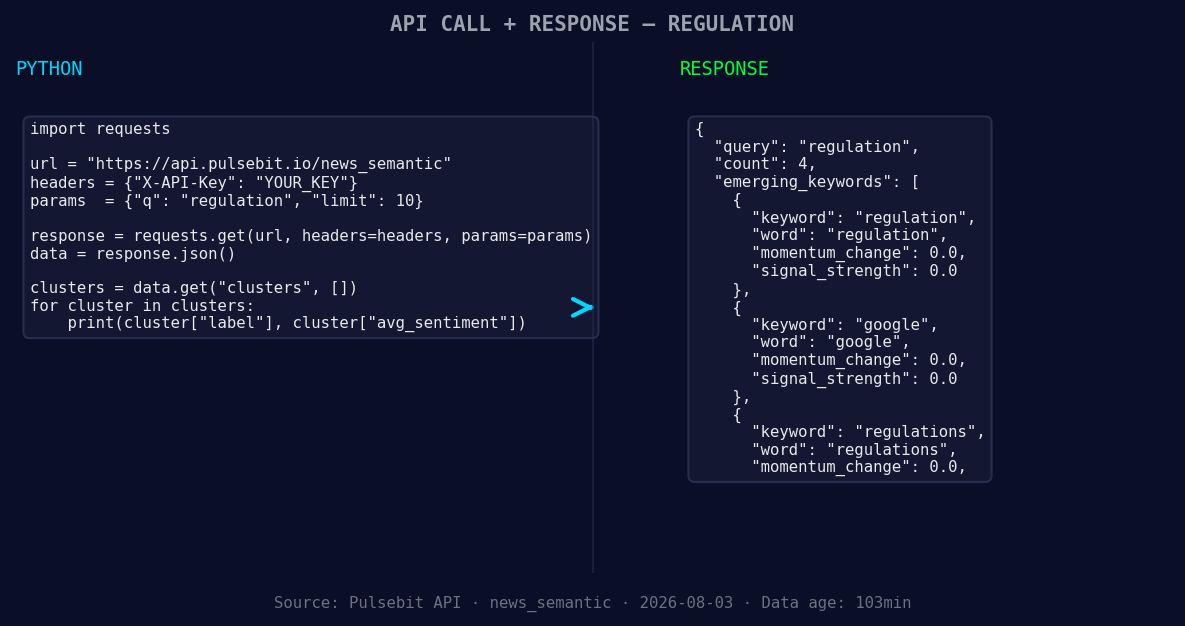
*Left: Python GET /news_semantic call for 'regulation'. Right: returned JSON response structure (clusters: 3). Source: Pulsebit /news_semantic.*
# Make the API request to get the relevant articles
response = requests.get("https://api.pulsebit.com/articles", params=params)
articles = response.json()
# Print the articles for inspection
print(articles)
Next, we want to assess the sentiment of the narrative framing to ensure that we’re accurately interpreting the cluster reason string. This can be done using our sentiment scoring endpoint:
# Cluster reason string
reason_string = "Clustered by shared themes: regulation, therapy, may, help, reduce."

# Make a POST request to score the narrative framing
sentiment_response = requests.post("https://api.pulsebit.com/sentiment", json={"text": reason_string})
sentiment_score = sentiment_response.json()

# Output the sentiment score
print(sentiment_score)
Now that we have our framework set up, let’s discuss three specific builds we can implement based on this pattern:
- Geographic Origin Filter: Use the geo filter to track sentiment trends in different languages. Set a threshold for momentum, such as +0.250, to identify spikes that may indicate emerging trends in regulation across English and Italian articles, allowing you to act on them faster.

Geographic detection output for regulation. Hong Kong leads with 2 articles and sentiment +0.00. Source: Pulsebit /news_recent geographic fields.
Meta-Sentiment Loop: Integrate the meta-sentiment loop to analyze how themes like "regulation," "therapy," and "help" are being framed in the media. Use a threshold of +0.250 for sentiment scores to focus on narratives gaining traction, ensuring you’re aware of how these themes shape public perception.
Forming Themes Analysis: Set up an endpoint to analyze forming themes like "regulation" (+0.00) and "google" (+0.00) against mainstream narratives. Use a cluster strength metric to determine when to prioritize further investigation into emerging stories that could impact your strategies.
Getting started with this is straightforward. You can find more details on our API at pulsebit.lojenterprise.com/docs. With just a few lines of code, you can set up your environment to catch these insights and run them in under 10 minutes. Let's stay ahead of the curve and leverage these momentum spikes!


Top comments (0)