

Your Pipeline Is 28.0h Behind: Catching Climate Sentiment Leads with Pulsebit
We recently stumbled upon an intriguing anomaly: a 24-hour momentum spike of +0.542 related to climate sentiment. This spike is remarkable not just for its magnitude but also because it highlights a significant lag in how we process multilingual data. The leading language for this sentiment was English, which trailed behind German by a full 28 hours. If your pipeline isn't equipped to handle such discrepancies, you might be missing critical insights that could inform your strategy.

English coverage led by 28.0 hours. German at T+28.0h. Confidence scores: English 0.85, French 0.85, Spanish 0.85 Source: Pulsebit /sentiment_by_lang.
The structural gap highlighted by this finding is a common pitfall in many sentiment analysis pipelines. If you're relying solely on a single language source or failing to recognize dominant entities, your model missed this climate spike by a staggering 28 hours. In a fast-moving landscape where sentiment can shift dramatically, being late to the party can cost you valuable opportunities. The dominant entity here—English press—isn't catching the wave early enough, and you need to leverage that lag to your advantage.
To catch this anomaly early, we can use our API effectively. Here’s how to do it in Python, focusing on the climate topic with the specific parameters we noted:
import requests
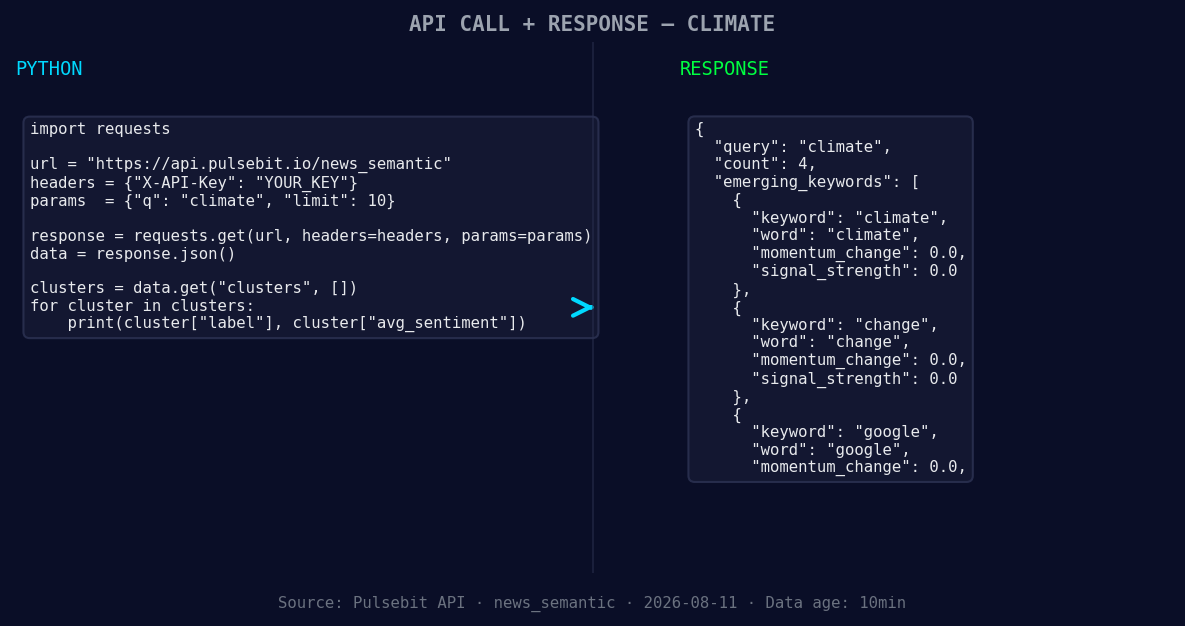
*Left: Python GET /news_semantic call for 'climate'. Right: returned JSON response structure (clusters: 3). Source: Pulsebit /news_semantic.*
# Step 1: Geographic origin filter
url = "https://api.pulsebit.com/v1/sentiment"
params = {
"topic": "climate",
"lang": "en", # Filtering by English language
"score": +0.000,
"confidence": 0.85,
"momentum": +0.542
}
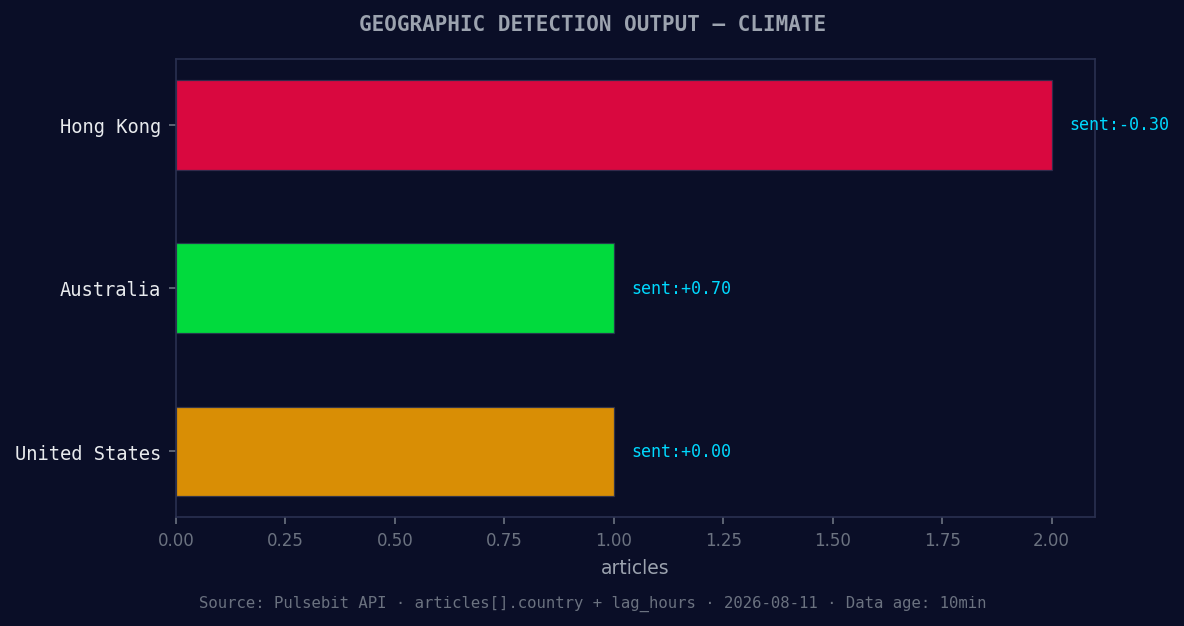
*Geographic detection output for climate. Hong Kong leads with 2 articles and sentiment -0.30. Source: Pulsebit /news_recent geographic fields.*
response = requests.get(url, params=params)
data = response.json()
print(data)
Once we have the initial sentiment data, we need to run the cluster reason string through our sentiment scoring endpoint to better understand the narrative framing. This meta-sentiment moment will give us deeper insights into how the topic is being discussed:
# Step 2: Meta-sentiment moment
meta_sentiment_url = "https://api.pulsebit.com/v1/sentiment"
cluster_reason = "Clustered by shared themes: change, could, mean, four, extra."

meta_sentiment_response = requests.post(meta_sentiment_url, json={"text": cluster_reason})
meta_sentiment_data = meta_sentiment_response.json()
print(meta_sentiment_data)
With these two steps, we can equip our pipeline to catch sentiment shifts effectively, capitalizing on the missed 28-hour window that others are oblivious to.
Now that we've established a method to catch these shifts, here are three specific builds you could implement tonight:
Signal Monitoring with Geo Filter: Set a threshold to alert you when the momentum for climate sentiment exceeds +0.5 in English publications. Use the geo filter to monitor this specifically across English-speaking regions.
Meta-Sentiment Scoring: Create a routine to run daily cluster reason strings through the meta-sentiment endpoint. Focus on the themes of "climate," "change," and "google" that are forming now. Score these narratives to identify emerging discussions.
Anomaly Detection: Build a system that tracks historical momentum scores for specific topics like climate. If the score exceeds a certain threshold (e.g., +0.5) for more than 24 hours, trigger an alert to review the articles and sentiment data.
By focusing on these specific signals, thresholds, and endpoints, you can stay ahead of the curve and ensure your pipeline is aligned with the latest sentiment shifts.
To get started with our API, check out our documentation at pulsebit.lojenterprise.com/docs. You can copy-paste the code snippets above and run them in under 10 minutes. Don’t let the next momentum spike pass you by!


Top comments (0)