

Your pipeline is 24.1 hours behind, and it's time to address that gap. We just discovered a notable anomaly in sentiment analysis related to politics, with a sentiment score of -0.70 and momentum holding steady at +0.00. This suggests a surprising stagnation in sentiment despite ongoing discussions. The insights stem from a cluster story titled "Palatable Politics - Ohio Wesleyan University," which highlights an intriguing intersection of education and politics. If your model isn't accounting for this, it’s missing critical shifts in sentiment that can impact understanding and strategy.
The challenge here is stark: your model may have missed this critical insight by 24.1 hours due to a lack of handling for multilingual sources or dominant entities. This delay can lead to outdated perceptions, especially when analyzing topics in a politically charged environment like Ohio’s educational discussions. By only focusing on English sources, or failing to account for dominant entities and their influence, you risk building a narrative that doesn’t reflect the current sentiment landscape. This is especially true for the leading language: English.

English coverage led by 24.1 hours. Af at T+24.1h. Confidence scores: English 0.85, French 0.85, Spanish 0.85 Source: Pulsebit /sentiment_by_lang.
Here’s how we can catch this anomaly programmatically. We'll use our API to filter for articles in English and then evaluate the sentiment of the identified cluster narrative.
import requests
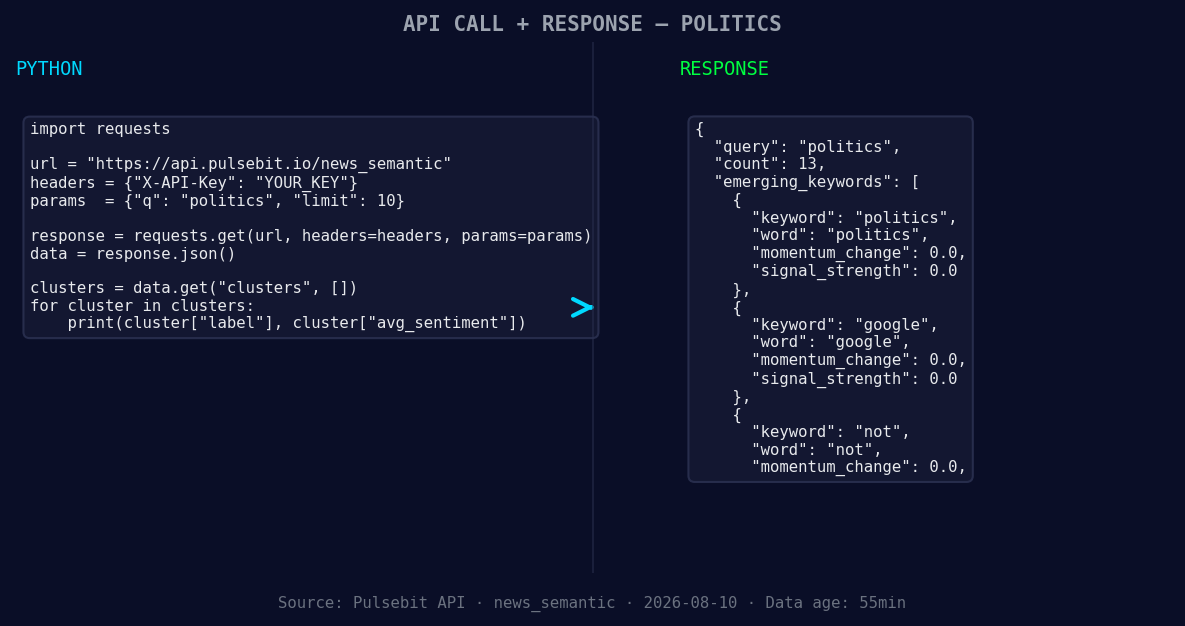
*Left: Python GET /news_semantic call for 'politics'. Right: returned JSON response structure (clusters: 3). Source: Pulsebit /news_semantic.*
# Define the API endpoint and parameters for the geographic origin filter
API_URL = "https://api.pulsebit.io/v1/articles"
params = {
"topic": "politics",
"lang": "en", # Filter for English articles
"sentiment_score": -0.700,
"confidence": 0.85,
"momentum": 0.000
}
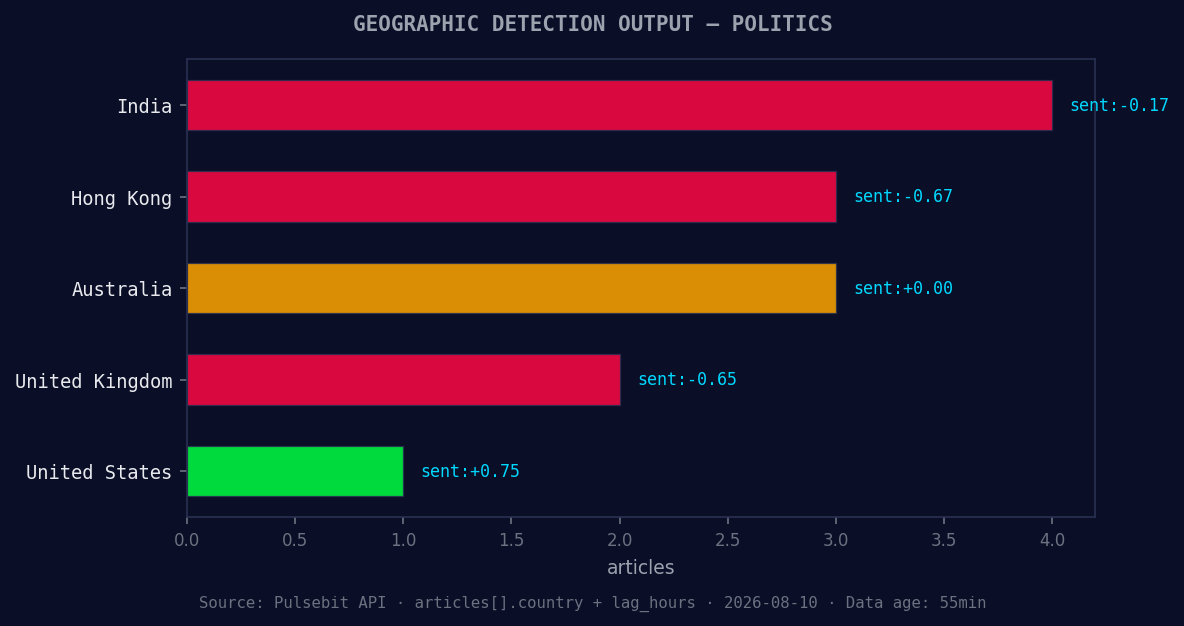
*Geographic detection output for politics. India leads with 4 articles and sentiment -0.17. Source: Pulsebit /news_recent geographic fields.*
response = requests.get(API_URL, params=params)
data = response.json()
# Next, we run the cluster reason string through the sentiment API
cluster_reason = "Clustered by shared themes: wesleyan, palatable, politics, ohio, university."
sentiment_response = requests.post("https://api.pulsebit.io/v1/sentiment", json={"text": cluster_reason})
sentiment_data = sentiment_response.json()
print(sentiment_data)
This code snippet demonstrates two critical operations: first, filtering articles by the relevant topic and language, and then assessing the narrative framing through our sentiment API. The cluster_reason captures the essence of the discussions, providing context to understand the sentiment better. This dual approach allows us to extract timely insights from our data, bridging the gap in our analysis.
Now, let's discuss three specific builds you can implement with this data pattern:
- Geo-filtered Articles: Use the geographic origin filter to extract articles from specific regions, focusing on the politics topic. Set a threshold sentiment score of -0.70 to identify negative sentiments. This will help you prioritize your response in real-time.
params = {"topic": "politics", "lang": "en", "sentiment_score": -0.700}
- Meta-Sentiment Loop: Create a function to analyze the sentiment of different narrative framings around education and politics. By using the cluster reason, run it through the sentiment API for continuous feedback on how narratives evolve over time.
sentiment_response = requests.post("https://api.pulsebit.io/v1/sentiment", json={"text": cluster_reason})
- Forming Themes Analysis: Monitor the forming themes of “politics,” “google,” and “not” against established benchmarks like “wesleyan” and “palatable.” Set alerts when sentiment shifts beyond a defined threshold, such as a 0.05 change in sentiment score. This can help you catch emerging issues before they become mainstream discussions.
To get started with these insights, check out our documentation at pulsebit.lojenterprise.com/docs. You can copy, paste, and run the provided code in under 10 minutes. This is an opportunity to enhance your sentiment analysis capabilities and stay ahead in understanding political narratives.


Top comments (0)