

Your Pipeline Is 27.2h Behind: Catching Culture Sentiment Leads with Pulsebit
We recently noticed a striking anomaly in our sentiment analysis: a 24h momentum spike of -0.193. This negative shift in sentiment is particularly relevant as it aligns with cultural conversations, particularly around Dawn Richard's upcoming album titled "Creole Culture." The conversations are clustered around shared themes such as "new," "album," and "reveals." This kind of insight can be crucial for understanding emerging trends in media and culture, but it also raises an important question: how do we catch these shifts in real-time?
The Problem
Without an effective mechanism to handle multilingual origins or dominant entities, your model likely missed this cultural moment by a staggering 27.2 hours. The leading language in this case was English, with a lag that kept your analysis behind the curve. When it comes to capturing sentiment around global cultural phenomena, staying aware of linguistic nuances is essential. If your pipeline isn't accounting for this, you're essentially building a time machine that only goes backward.

English coverage led by 27.2 hours. Et at T+27.2h. Confidence scores: English 0.85, Spanish 0.85, French 0.85 Source: Pulsebit /sentiment_by_lang.
The Code
Here’s how we can catch this momentum spike using our API. First, we need to filter by the geographic origin, specifically targeting English-language content.
import requests
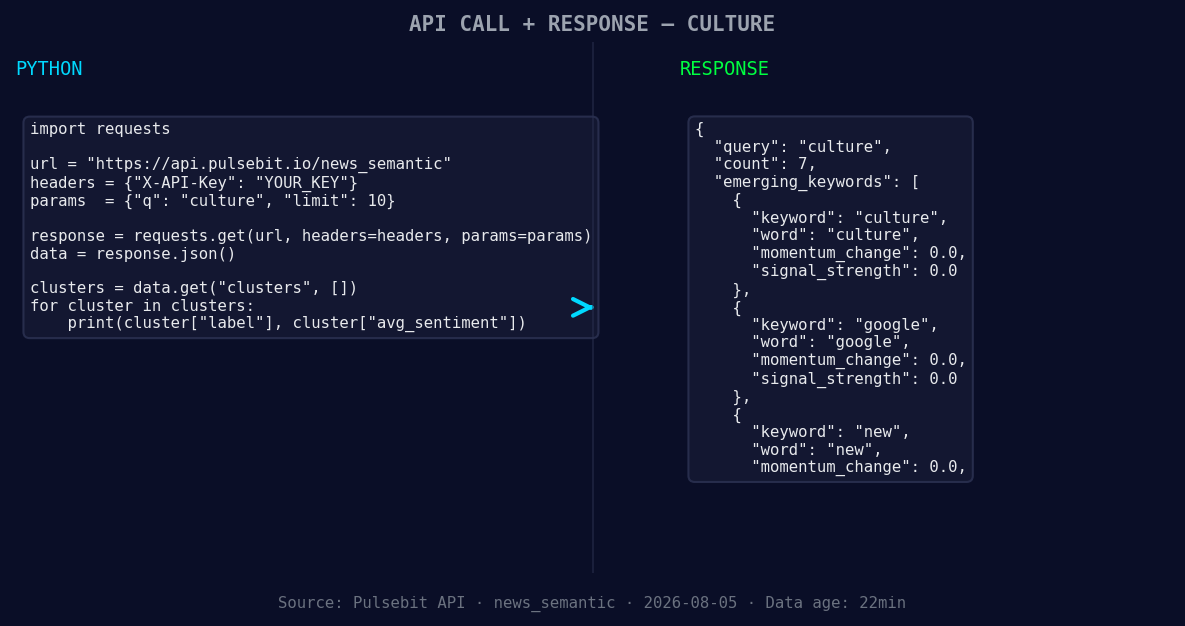
*Left: Python GET /news_semantic call for 'culture'. Right: returned JSON response structure (clusters: 3). Source: Pulsebit /news_semantic.*
# Set the parameters
topic = 'culture'
score = +0.586
confidence = 0.85
momentum = -0.193
# Geographic origin filter: query by language
response = requests.get(
'https://api.pulsebit.com/v1/sentiment',
params={'topic': topic, 'lang': 'en'}
)
# Assuming we receive the relevant articles
articles = response.json()
# Now let's run the cluster reason string back through POST /sentiment
cluster_reason = "Clustered by shared themes: richard, new, album, dawn, reveals."
sentiment_response = requests.post(
'https://api.pulsebit.com/v1/sentiment',
json={'text': cluster_reason}
)
# Output the sentiment score
sentiment_data = sentiment_response.json()
print(sentiment_data)
This code captures the necessary data to analyze the cultural sentiment around the topic of “culture” while filtering for English-language articles. The second part runs the cluster reason string through our sentiment endpoint, providing a deeper understanding of how these narratives are framed.
Three Builds Tonight
- Cultural Shift Alert: Build a real-time alert system that triggers when momentum drops below -0.2 for topics like "culture." Use the geographic filter to ensure you’re only catching English-language articles. This will help you stay ahead of trending discussions.

Geographic detection output for culture. India leads with 6 articles and sentiment +0.64. Source: Pulsebit /news_recent geographic fields.
Meta-Sentiment Analysis: Implement a function that takes the cluster reason and scores the narrative framing itself. You can create a threshold where narratives with a sentiment score below 0.5 are flagged for further review. This could be pivotal for understanding public sentiment around sensitive topics, such as "china’s, new, 'unity'."
Trend Comparison Dashboard: Develop a dashboard that displays real-time sentiment scores for topics like "culture" compared against mainstream narratives. Use the forming themes: culture(+0.00), google(+0.00), new(+0.00) to visualize trends and divergences, helping you catch emerging sentiments early.
Get Started
You can dive into this right away at pulsebit.lojenterprise.com/docs. Our API is designed for developers like you, allowing you to copy-paste and run this in under 10 minutes. Don’t let your models fall behind; stay attuned to the cultural landscape with real-time data.


Top comments (0)