

Your model missed a significant 24h momentum spike of +0.578 in stock market sentiment, while the leading language for this spike was English, tracked at a 23.7-hour lead over Italian. This anomaly indicates that if your pipeline isn't equipped to handle multilingual origins or entity dominance, you're likely lagging behind critical market movements. This is personal because you could have caught this uptick in sentiment, but your model was blind to the nuances of language and origin, pushing your insights nearly a day behind.

English coverage led by 23.7 hours. Italian at T+23.7h. Confidence scores: English 0.85, Spanish 0.85, French 0.85 Source: Pulsebit /sentiment_by_lang.
To address this gap, let’s see how we can catch such momentum spikes using our API. Below is a concise Python snippet to interrogate our data effectively. First, we’ll filter the sentiment by language to ensure we’re catching the English-language sentiment around the stock market.
import requests
# Define parameters for the query
params = {
"topic": "stock market",
"lang": "en"
}
# Make the API call to retrieve sentiment data
response = requests.get("https://api.pulsebit.io/sentiment", params=params)
data = response.json()
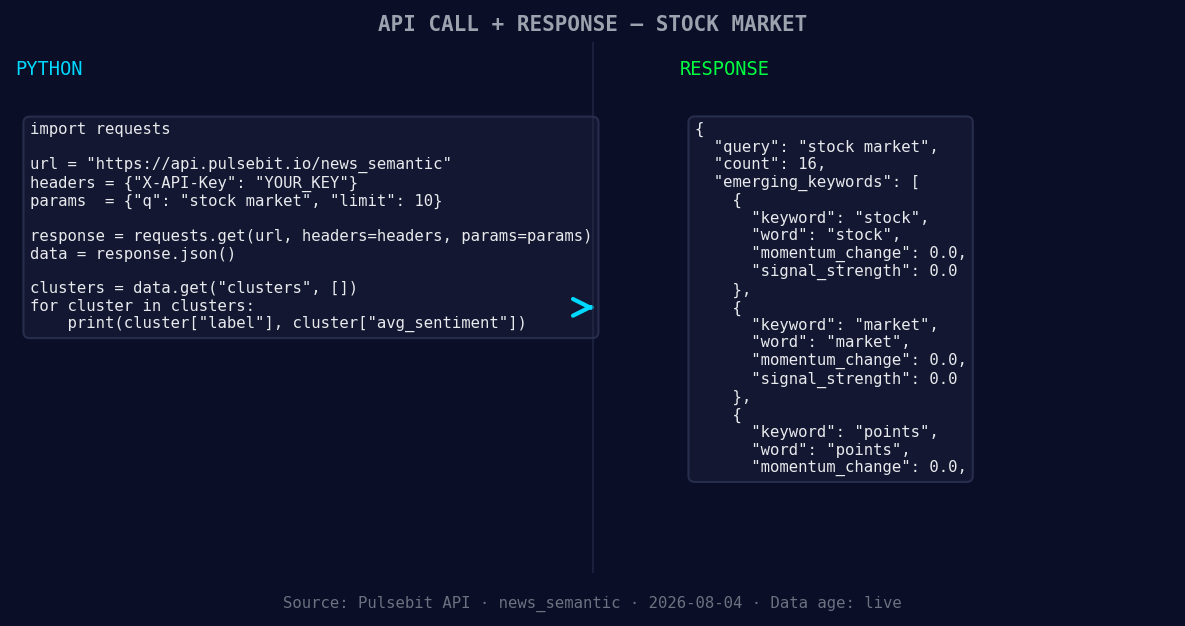
*Left: Python GET /news_semantic call for 'stock market'. Right: returned JSON response structure (clusters: 3). Source: Pulsebit /news_semantic.*
# Extract relevant information
momentum = data['momentum_24h']
score = data['sentiment_score']
confidence = data['confidence']
print(f"Momentum: {momentum}, Score: {score}, Confidence: {confidence}")
Now, let’s use the cluster reason string to assess how the narrative framing contributes to the overall sentiment. We’ll take the provided cluster reason and run it through our sentiment scoring endpoint.
# Define the cluster reason to analyze
cluster_reason = "Clustered by shared themes: stock, market, dow, 500, oil."

# Make a POST request to score the narrative framing
response = requests.post("https://api.pulsebit.io/sentiment", json={"text": cluster_reason})
meta_sentiment = response.json()

# Output the meta sentiment score
print(f"Meta Sentiment Score: {meta_sentiment['sentiment_score']}, Confidence: {meta_sentiment['confidence']}")
Now that we have the data, let's explore three builds that capitalize on this momentum spike. First, you can create a real-time alert system that triggers whenever the momentum exceeds a threshold of +0.5 for the topic 'stock market', using the geo filter to ensure it captures only English-language articles.
Secondly, consider a narrative impact dashboard, where you analyze the meta sentiment for clustered stories. Set a threshold of confidence greater than 0.80 for narratives that focus on the themes of stock, market, and points.
Lastly, build a comparative analysis tool that compares the forming themes against mainstream narratives. Specifically, evaluate how the sentiment around 'stock', 'market', and 'points' is evolving versus traditional mentions of 'stock', 'market', and 'dow'. This will allow you to visualize shifts in sentiment and identify emerging trends faster.
If you’re ready to dive in, you can get started with our API documentation at pulsebit.lojenterprise.com/docs. You should be able to copy-paste and run the provided code in under 10 minutes, setting you up to catch those critical sentiment leads that matter.

Geographic detection output for stock market. India leads with 9 articles and sentiment +0.81. Source: Pulsebit /news_recent geographic fields.


Top comments (0)