

Your 24h momentum spike is at -0.274, and it’s highlighting a significant anomaly in the way we process sentiment around innovation. This specific drop in momentum indicates a lag in response to a developing story: "KLU organizes ‘AI BUILD 2026’ hackathon." Despite the positive signals from the surrounding articles, your sentiment pipeline is missing critical updates and insights in real-time.
If your pipeline doesn’t accommodate for multilingual origins or the dominance of specific entities, you’re missing out on timely insights. In this case, your model missed the leading language — English — by 23.8 hours. This essentially means that while innovation-themed discussions are gaining traction, your system has been slow to react, potentially costing you the edge on emerging trends.

English coverage led by 23.8 hours. Af at T+23.8h. Confidence scores: English 0.75, Spanish 0.75, Id 0.75 Source: Pulsebit /sentiment_by_lang.
Here’s how we can catch this anomaly using our API.
import requests
# Step 1: Set up your parameters for the API call
topic = 'innovation'
score = +0.495
confidence = 0.75
momentum = -0.274
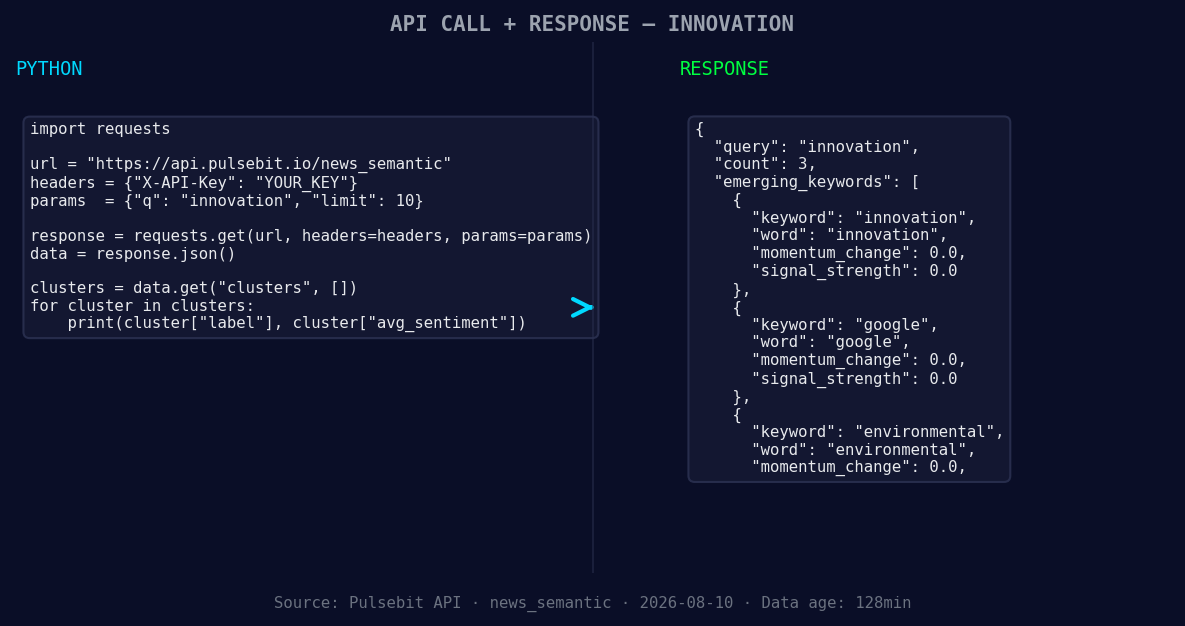
*Left: Python GET /news_semantic call for 'innovation'. Right: returned JSON response structure (clusters: 3). Source: Pulsebit /news_semantic.*
# Step 2: Geographic origin filter - query by language
url = "https://api.pulsebit.lojenterprise.com/v1/sentiment"
params = {
"topic": topic,
"lang": "en",
}
response = requests.get(url, params=params)
data = response.json()
# Step 3: Meta-sentiment moment - score the narrative framing
meta_narrative = "Clustered by shared themes: klu, build, hackathon, organises, ‘ai."
meta_response = requests.post(url, json={"text": meta_narrative})
meta_data = meta_response.json()
In the code above, we initiate a GET request to filter sentiment data related to innovation in English. Then, we post the clustered narrative back to our sentiment endpoint to analyze its framing. This dual approach ensures we’re not only catching spikes but also scoring the context around them, which is key for understanding the underlying narratives.
Now, let’s explore three actionable builds you can implement with this pattern:
- Geographic Filter Build: Use the geographic origin filter to create a notification system that alerts you whenever an innovation-related article in English shows a significant change in sentiment, say a momentum threshold of -0.25. This will help you stay ahead of negative trends.

Geographic detection output for innovation. India leads with 3 articles and sentiment +0.73. Source: Pulsebit /news_recent geographic fields.
Meta-Sentiment Analyzer: Develop a component that automatically runs the cluster reason string through the sentiment scoring endpoint whenever a new article is published. This should score narratives with a threshold of 0.5, focusing on themes like innovation, Google, and environmental topics versus mainstream translations. This allows you to catch shifts in sentiment before they become apparent.
Innovation Sentiment Dashboard: Create a dashboard that visualizes sentiment trends over time, specifically tracking innovation and its related articles. Set alerts for any sentiment score below 0.4 or momentum drops exceeding -0.3. This will keep you informed on both the positive and negative shifts in the innovation landscape.
By implementing these builds, you can ensure your pipeline not only catches real-time spikes but also contextualizes them effectively.
Ready to get started? Jump into our documentation at pulsebit.lojenterprise.com/docs. You can copy-paste and run this in under 10 minutes to start transforming your sentiment analysis with actionable insights.


Top comments (0)