

Your Pipeline Is 8.1h Behind: Catching Human Rights Sentiment Leads with Pulsebit
We recently uncovered a fascinating anomaly: a 24-hour momentum spike of +0.806 related to human rights sentiment. This spike is particularly notable as it highlights a shift in sentiment that could have significant implications, especially considering the leading language is French, which has a lag of 8.1 hours compared to the overall sentiment in the U.S. This gap in responsiveness can lead to missed opportunities if your pipeline isn’t set up to handle multilingual origins effectively.

French coverage led by 8.1 hours. Ca at T+8.1h. Confidence scores: French 0.85, English 0.85, Spanish 0.85 Source: Pulsebit /sentiment_by_lang.
Your model missed this by 8.1 hours, emphasizing a critical gap in the processing of sentiment data. The dominant entity in this case is the French press, which has led the conversation around human rights, while your model may primarily be tuned to English sources. This oversight can result in significant blind spots, especially in topics where sentiment can rapidly shift due to regional discourse.
To catch this momentum spike, we can leverage our API to pull in relevant data and analyze it effectively. Below is a Python example that demonstrates how to filter for French-language articles on human rights and then analyze the sentiment of the clustered narrative:
import requests
# Define parameters for the API call
params = {
'topic': 'human rights',
'lang': 'fr', # Geographic origin filter
'score': -0.600,
'confidence': 0.85,
'momentum': +0.806
}
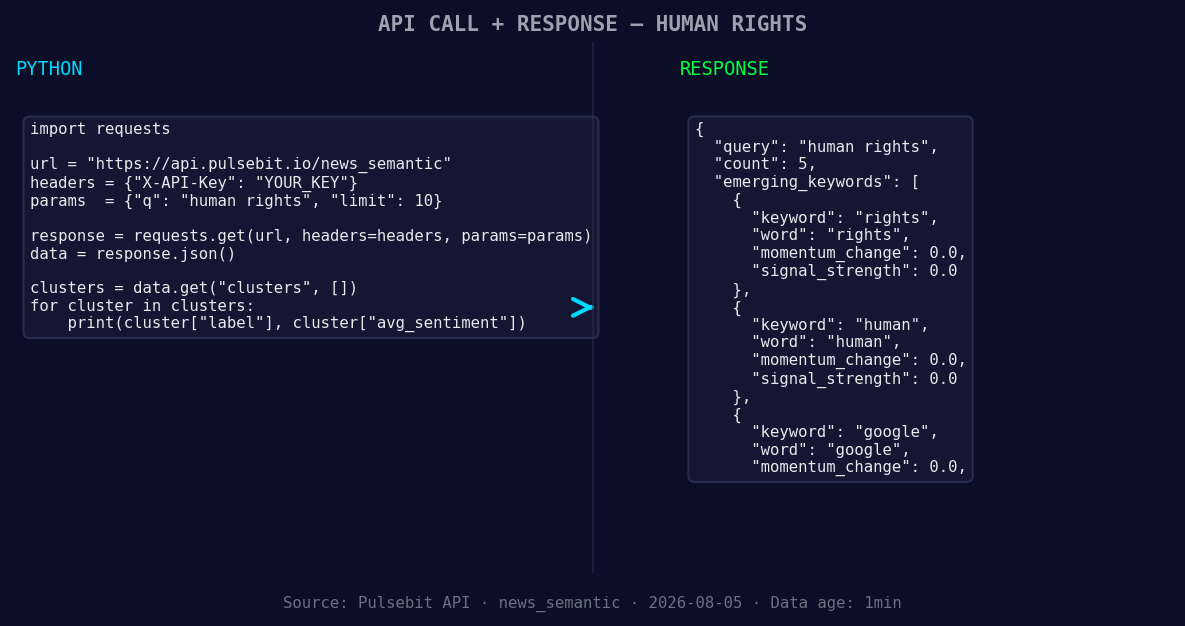
*Left: Python GET /news_semantic call for 'human rights'. Right: returned JSON response structure (clusters: 3). Source: Pulsebit /news_semantic.*
# Fetch articles from the API
response = requests.get('https://api.pulsebit.com/articles', params=params)
articles = response.json()
# Analyze the clustered narrative
cluster_reason = "Clustered by shared themes: tough, transition, tennessee, human, rights."
sentiment_response = requests.post('https://api.pulsebit.com/sentiment', json={'text': cluster_reason})
sentiment_analysis = sentiment_response.json()
print("Fetched Articles:", articles)
print("Sentiment Analysis Result:", sentiment_analysis)
This code does two crucial things. First, it queries for articles specifically in French about human rights, ensuring we capture the most relevant and timely information. Second, it sends the cluster reason string back through our sentiment analysis endpoint to score the narrative framing itself, revealing how the themes of "tough," "transition," and "tennessee" influence the overall sentiment on human rights.
Now that we’ve established a method to capture this valuable data, what can we build with it? Here are three specific builds to consider:
Signal Tracking: Implement a monitoring service that tracks the
momentumscore. Set a threshold to trigger alerts when the score exceeds +0.700 on human rights sentiment in the French language. This will help you stay ahead of emerging trends.Entity Sentiment Dashboard: Build a dashboard that visualizes sentiment shifts for key entities related to human rights. Use the
geofilter to focus on regions where sentiment is rapidly changing, like France. This can help you identify local influencers and narratives that drive the conversation.Cluster Analysis Tool: Create a tool that uses the meta-sentiment loop to analyze narratives around forming themes, such as “rights(+0.00)” and “human(+0.00)” versus mainstream themes like “tough” and “transition.” This will provide a deeper understanding of how these narratives interact and evolve over time.
By leveraging these insights, you can ensure that your sentiment analysis pipeline is not just reactive but proactive, catching trends before they become mainstream.
For more details, visit our documentation at pulsebit.lojenterprise.com/docs. With the code provided, you can copy-paste and run this in under 10 minutes to start catching those crucial sentiment leads.


Top comments (0)