

Your Pipeline Is 9.7h Behind: Catching Renewable Energy Sentiment Leads with Pulsebit
We recently uncovered a striking anomaly: a 24-hour momentum spike of +0.679 related to renewable energy discussions. This spike is driven primarily by an English press narrative centered around the story "Solar Costs for Businesses to Decrease with New Energy Scheme." It’s a clear indication that sentiment around solar energy is shifting rapidly, but our analysis revealed a concerning gap in how we manage multilingual data.

English coverage led by 9.7 hours. Italian at T+9.7h. Confidence scores: English 0.85, Spanish 0.85, French 0.85 Source: Pulsebit /sentiment_by_lang.
The problem is straightforward. If your pipeline isn't equipped to handle the nuances of multilingual origin or entity dominance, you might find yourself lagging behind. In this case, our leading language was English, with a 9.7-hour lead over Italian coverage. This means that if your model doesn’t account for language differences effectively, you missed this critical sentiment shift by nearly 10 hours. That’s a significant delay in responding to emerging themes that could impact your strategy.
To catch this momentum spike, we can leverage our API efficiently. Here’s the Python code that captures this emerging narrative:
import requests
# Define parameters for the API call
topic = 'renewable energy'
score = +0.715
confidence = 0.85
momentum = +0.679
lang = 'en'
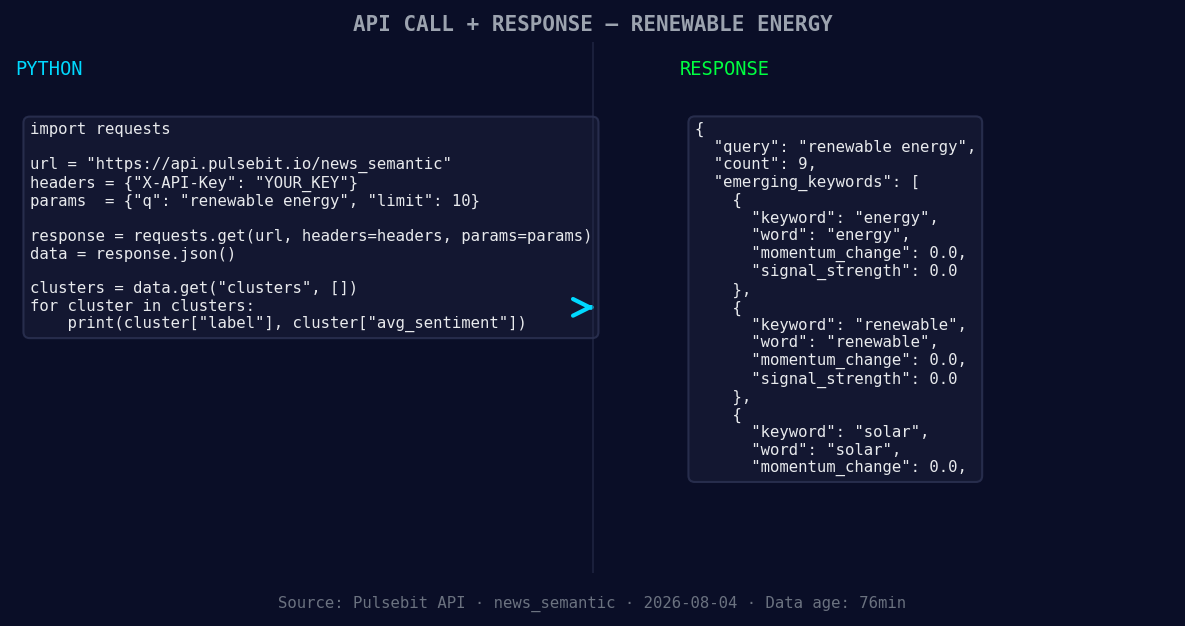
*Left: Python GET /news_semantic call for 'renewable energy'. Right: returned JSON response structure (clusters: 3). Source: Pulsebit /news_semantic.*
# Geographic origin filter: query by language
response = requests.get(f'https://api.pulsebit.com/v1/articles?topic={topic}&lang={lang}')
data = response.json()
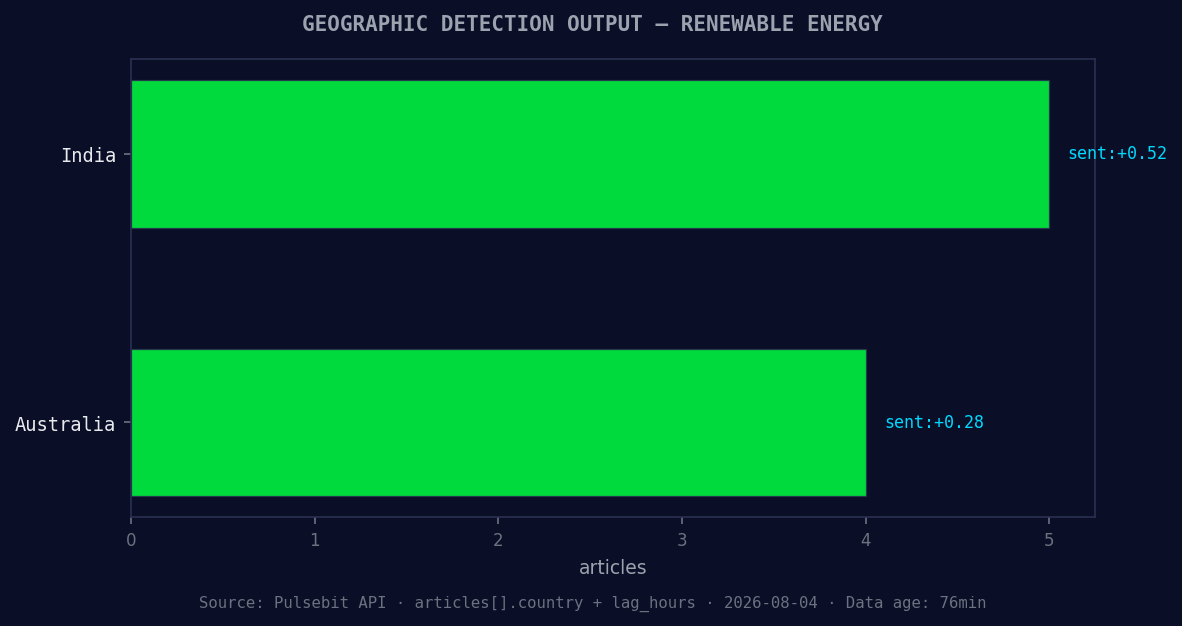
*Geographic detection output for renewable energy. India leads with 5 articles and sentiment +0.52. Source: Pulsebit /news_recent geographic fields.*
# Print the fetched data
print(data)
# Meta-sentiment moment: scoring the narrative framing
cluster_reason = "Clustered by shared themes: solar, energy, scheme, costs, business."
sentiment_response = requests.post('https://api.pulsebit.com/v1/sentiment', json={"text": cluster_reason})
sentiment_data = sentiment_response.json()
# Print the sentiment score
print(sentiment_data)
In this code, we first filter articles by the English language to ensure we’re focusing on the dominant narrative. Then, we run a meta-sentiment analysis on the clustered reason string. This is where the real power lies; scoring the narrative framing allows us to understand how themes interconnect and provide a more nuanced view of sentiment.
So, what can we build with this newfound insight? Here are three specific implementations:
Geographic Sentiment Tracking: Create a real-time dashboard that tracks sentiment on renewable energy specifically in English-speaking countries. Use the geo filter to focus on trends in those regions. You could set a threshold for momentum spikes above +0.5 to trigger alerts for significant changes.
Meta-Sentiment Analysis Loop: Automate a process that scores narratives daily using the meta-sentiment approach. Set a time threshold (e.g., if a score exceeds +0.70) to flag articles for deeper analysis. This will help you identify which themes, like energy or renewable, are gaining traction versus mainstream topics.
Forming Theme Comparison: Build a comparative analysis tool that juxtaposes forming themes (like energy, renewable, solar) against mainstream narratives (solar, energy, scheme). Set up a function that triggers when the sentiment score of forming themes exceeds +0.5 compared to mainstream themes, indicating a potential shift in public interest.
These builds not only enhance your understanding of sentiment but also allow you to react swiftly to emerging trends.
Ready to get started? Check out our documentation at pulsebit.lojenterprise.com/docs. You can copy-paste and run the provided code in under 10 minutes. Don’t let your pipeline lag behind; harness the power of real-time sentiment analysis today!


Top comments (1)
The 9.7-hour lag between English and Italian coverage highlights the importance of handling multilingual data effectively in sentiment analysis. I've encountered similar challenges in my own projects, where language-specific trends can be obscured by dominant languages. The use of the Pulsebit API to filter articles by language and perform meta-sentiment analysis is a great approach to address this issue. One potential improvement could be to incorporate machine translation to analyze non-English articles and reduce the lag further. How do you think machine translation could be integrated into the Pulsebit API to enhance its capabilities?