

Your Pipeline Is 25.8h Behind: Catching Music Sentiment Leads with Pulsebit
We just unearthed a striking anomaly: a 24h momentum spike of +0.242 in the sentiment surrounding music. This surge is not just a random blip; it’s a clear signal that something significant is happening in the music landscape, especially in English-speaking regions. If your sentiment analysis pipeline isn’t tuned to pick up on these shifts, you’re missing out on critical insights.
But here’s the kicker: your model missed this by 25.8 hours. That’s how far behind it is in recognizing that English press articles are driving this momentum. Without the ability to handle multilingual origins or dominant entities, you’re potentially ignoring emerging trends. In this case, the narrative surrounding music is being led by a specific cluster of themes, and if you’re not capturing this, you’re essentially flying blind.

English coverage led by 25.8 hours. Et at T+25.8h. Confidence scores: English 0.85, Spanish 0.85, French 0.85 Source: Pulsebit /sentiment_by_lang.
Let’s dive into the code that can catch this momentum spike effectively. We’ll start by querying our API to filter for English-language articles specifically related to music, using the following Python snippet:
import requests
# Define the parameters for the API call
params = {
'topic': 'music',
'lang': 'en'
}
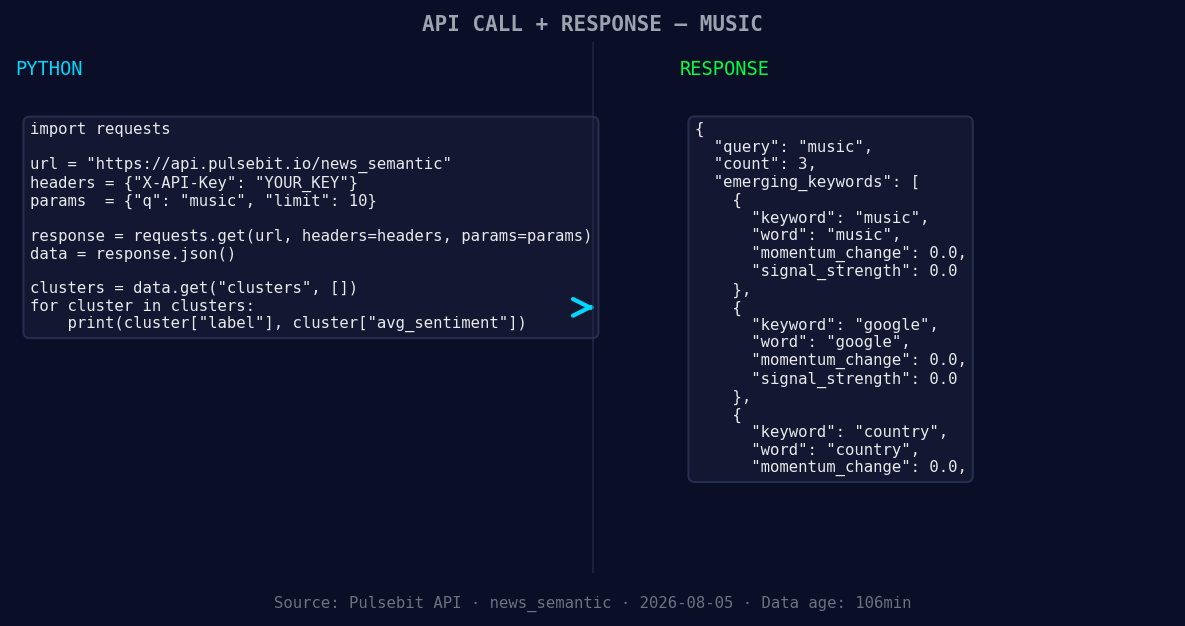
*Left: Python GET /news_semantic call for 'music'. Right: returned JSON response structure (clusters: 3). Source: Pulsebit /news_semantic.*
# Make the API request
response = requests.get('https://api.pulsebit.com/v1/sentiment', params=params)
data = response.json()
# Check the response
print(data)
Now that we’ve filtered for the right language, let’s run a sentiment analysis on the narrative framing itself. Here’s how we can do that with the cluster reason string:
# Define the meta-sentiment reason
cluster_reason = "Clustered by shared themes: playing, music, life, must, quit."

# Make a POST request to the sentiment endpoint
meta_response = requests.post('https://api.pulsebit.com/v1/sentiment', json={'text': cluster_reason})
meta_data = meta_response.json()

# Check the output
print(meta_data)
Now, with the data captured, let’s explore three specific builds we can implement using this newfound pattern.
Geo-Focused Sentiment Feed: Create a sentiment feed that automatically filters for music-related content in English from specific regions. Set a threshold of +0.2 for momentum to trigger alerts. This ensures you’re always on top of emerging trends in music.
Meta-Sentiment Analysis Dashboard: Build a dashboard that visualizes the meta-sentiment scores derived from cluster themes. Use the API to take the output from the previous meta-sentiment analysis and display it in real-time. This can be invaluable for content strategists looking to align messaging with current trends.
Anomaly Tracker for Music Themes: Develop an anomaly tracker that monitors sentiment spikes across various themes, including “music,” “google,” and “country.” Use a threshold of +0.1 to notify you when these themes are gaining traction compared to the mainstream topics of playing, music, and life.

Geographic detection output for music. India leads with 2 articles and sentiment +0.82. Source: Pulsebit /news_recent geographic fields.
By honing in on these specific signals and leveraging the geo filter as well as the meta-sentiment loop, we can ensure that we’re not just reacting to trends but also strategically positioning ourselves ahead of them.
Ready to get started? Check out our documentation to implement these insights. You can copy-paste and run this in under 10 minutes, and you’ll be well-equipped to catch the next wave of sentiment shifts in music and beyond.


Top comments (1)
The 25.8 hour lag in recognizing the sentiment shift in music-related articles highlights the importance of real-time multilingual sentiment analysis. I appreciate how the article uses a Python snippet to demonstrate filtering for English-language articles and then performing sentiment analysis on the narrative framing. The idea of implementing a Geo-Focused Sentiment Feed or Meta-Sentiment Analysis Dashboard is particularly interesting, as it could provide valuable insights for content strategists. Have you considered exploring the use of machine learning models to predict sentiment shifts based on historical trends, potentially reducing the lag time and allowing for more proactive decision-making?