

Your pipeline just missed a critical nuance: a 24h momentum spike of +1.054 in human rights sentiment. This spike highlights an emerging narrative led predominantly by English press articles, which have a 12.3-hour lead time over German sources. The sentiment is tied to a cluster of articles focused on "Adivasi-Dalit groups to hold rights declaration," underscoring an important human rights movement that is gaining traction. If you’re not capturing this shift, you’re effectively sidelining crucial developments in the social landscape.
The underlying problem here is the structural gap in your pipeline when it comes to handling multilingual content. Your model missed this momentum spike by 12.3 hours simply because it wasn’t optimized for different language origins or the dominance of specific entities. When sentiment in a language you're not monitoring surges, you risk being blindsided by developments that could have implications for your strategy or decisions. Ignoring this gap means you're working with outdated information, leaving you one step behind.

English coverage led by 12.3 hours. German at T+12.3h. Confidence scores: English 0.85, Spanish 0.85, French 0.85 Source: Pulsebit /sentiment_by_lang.
To catch these nuances, let's leverage our API effectively. Here’s how you can capture the spike in human rights sentiment programmatically:
import requests
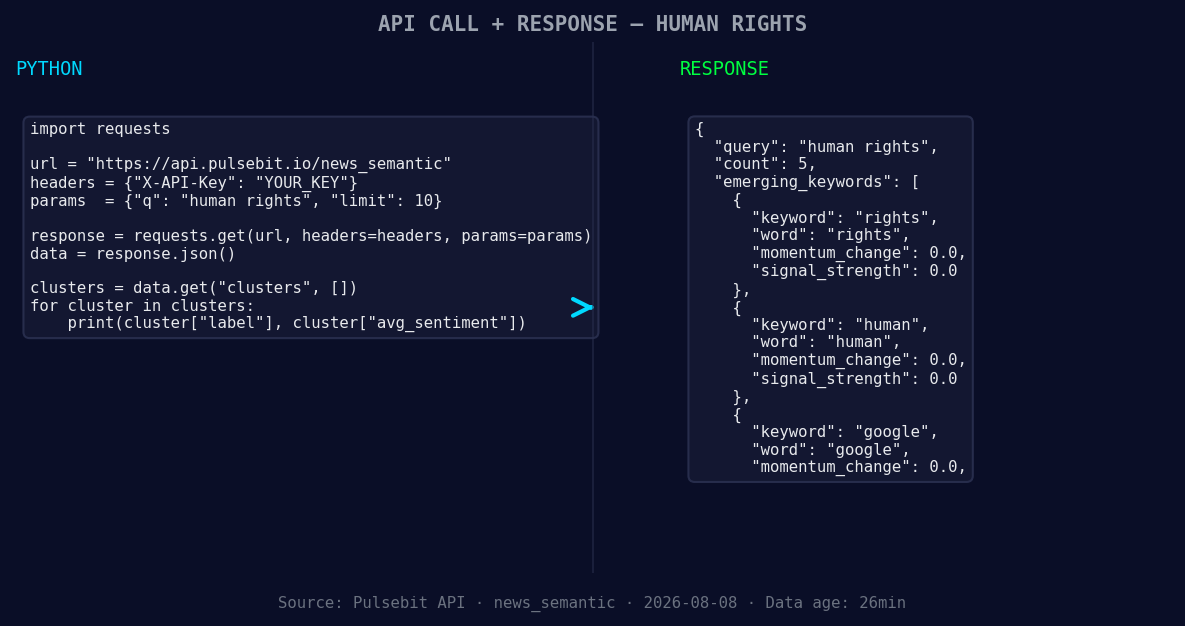
*Left: Python GET /news_semantic call for 'human rights'. Right: returned JSON response structure (clusters: 3). Source: Pulsebit /news_semantic.*
# Define parameters for the query
topic = 'human rights'
score = +0.350
confidence = 0.85
momentum = +1.054
# Geographic origin filter: querying English language articles
response = requests.get(
'https://api.pulsebit.com/v1/articles',
params={
'lang': 'en',
'topic': topic
}
)
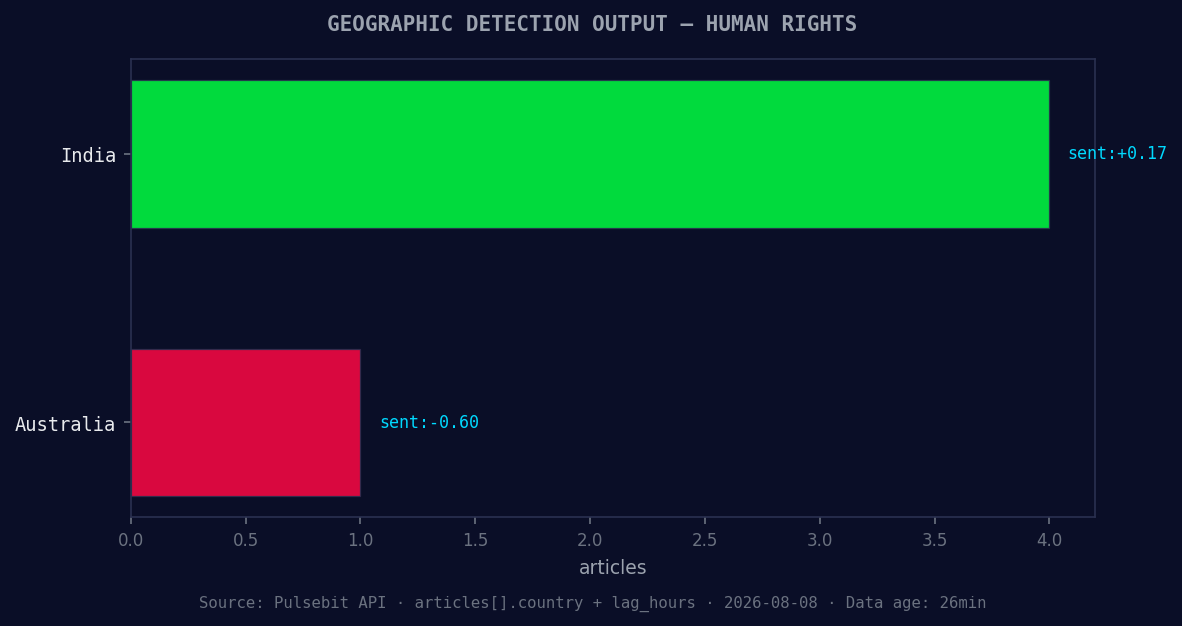
*Geographic detection output for human rights. India leads with 4 articles and sentiment +0.17. Source: Pulsebit /news_recent geographic fields.*
# Check for successful response
if response.status_code == 200:
articles = response.json()
else:
print("Error fetching articles")
# Meta-sentiment moment: analyze cluster reason string
cluster_reason = "Clustered by shared themes: rights, muthanga, adivasi-dalit, groups, hold."
sentiment_response = requests.post(
'https://api.pulsebit.com/v1/sentiment',
json={'text': cluster_reason}
)
if sentiment_response.status_code == 200:
sentiment_analysis = sentiment_response.json()
else:
print("Error analyzing sentiment")
Here, we start by querying for English-language articles that mention "human rights," capturing the sentiment and context surrounding this topic. Then, we analyze the cluster reason string to understand how the narrative is framed, which is crucial for gauging the public sentiment accurately.
Now, let’s explore three specific builds you can create from this pattern:
Geo-filtered Spike Detector: Set a threshold for momentum spikes—anything above +1.0. Use the geographic origin filter to ensure you're only capturing articles in English. This could help you stay on top of critical social movements that are gaining recognition.
Meta-Sentiment Analyzer: Implement a function that scores the cluster reason strings for different themes. For instance, you can run the sentiment analysis for "rights," "human," and "google" to see which narratives are forming against mainstream sentiments like "rights," "muthanga," and "adivasi-dalit." This helps you understand the evolving discourse.
Dynamic Alert System: Build an alert system that triggers notifications when momentum scores exceed a certain threshold for key topics like "human rights." This can help you pivot your focus quickly based on emerging societal trends.
By utilizing our API, you can create robust systems that not only catch these vital shifts but also provide you with actionable insights. For more detailed information, check out our documentation. You can copy-paste and run this code in under 10 minutes to start harnessing the power of sentiment analysis in real time.


Top comments (0)