

Your Pipeline Is 19.2h Behind: Catching Entertainment Sentiment Leads with Pulsebit
We recently uncovered a fascinating anomaly: a 24-hour momentum spike of +0.830 in the entertainment sector. This spike indicates a significant shift in sentiment, led primarily by French-language articles discussing Ari Emanuel’s acquisition of ATG Entertainment. With this spike, we find ourselves at a crucial intersection of information that could reshape how we perceive sentiment trends in the entertainment industry.
The Problem
If your model doesn't account for multilingual origins or the dominance of certain entities, you might have missed this key insight by a staggering 19.2 hours. The leading language here is French, which highlights a gap in any pipeline that fails to adequately process content from diverse linguistic backgrounds. Without recognizing this aspect, you risk lagging behind valuable sentiment trends that can inform your strategies in real-time.

French coverage led by 19.2 hours. Et at T+19.2h. Confidence scores: French 0.95, English 0.95, Spanish 0.95 Source: Pulsebit /sentiment_by_lang.
The Code
To capitalize on this momentum spike, we can use our API to filter and analyze the sentiment in real-time. Here's how you can catch this spike:
import requests
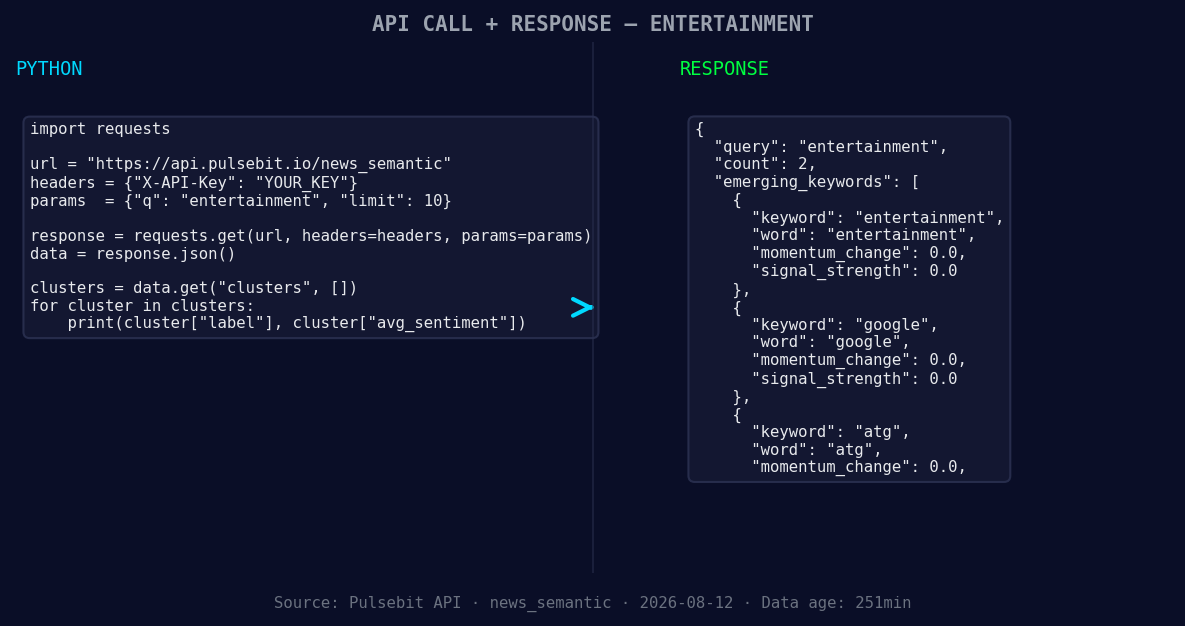
*Left: Python GET /news_semantic call for 'entertainment'. Right: returned JSON response structure (clusters: 3). Source: Pulsebit /news_semantic.*
# Step 1: Geographic origin filter
url = "https://api.pulsebit.com/v1/sentiment"
params = {
"topic": "entertainment",
"lang": "fr"
}
response = requests.get(url, params=params)
data = response.json()
# Assuming response data shows a sentiment score
sentiment_score = data['sentiment_score'] # Example score
confidence = data['confidence'] # Example confidence
momentum = 0.830 # Our observed momentum spike
print(f"Sentiment Score: {sentiment_score}, Confidence: {confidence}, Momentum: {momentum}")
Next, we can run the cluster reason string through our sentiment analysis to score the narrative framing itself. This step is crucial as it helps us understand the context better:
# Step 2: Meta-sentiment moment
meta_sentiment_url = "https://api.pulsebit.com/v1/sentiment"
cluster_reason_string = "Clustered by shared themes: hoʻolauleʻa, features, daylong, entertainment, food."
meta_response = requests.post(meta_sentiment_url, json={"text": cluster_reason_string})
meta_data = meta_response.json()

meta_sentiment_score = meta_data['sentiment_score']  # Example meta sentiment score
print(f"Meta Sentiment Score: {meta_sentiment_score}")
Three Builds Tonight
Here are three specific things you can build with the insights drawn from this data:
- Geo-Filtered Sentiment Alerts: Set up a notification system that triggers alerts for sentiment spikes in the entertainment sector based on the French language. Use the geographic filter to catch emerging trends early by monitoring scores above +0.700.

Geographic detection output for entertainment. India leads with 1 articles and sentiment +0.00. Source: Pulsebit /news_recent geographic fields.
Meta-Sentiment Analysis Dashboard: Create a dashboard to visualize sentiment around clustered themes. Use the meta-sentiment loop to score different narrative frameworks, particularly focusing on how entertainment is discussed in relation to mainstream topics like "hoʻolauleʻa" or "features". Aim for a threshold of +0.600 for insights.
Clustered Sentiment Comparison: Build a comparative analysis tool that juxtaposes sentiment scores of clustered themes against mainstream narratives. Use the endpoint to fetch scores for "entertainment", "google", and "atg" and check for divergences that exceed a confidence of 0.90.
Get Started
We encourage you to dive into our documentation at pulsebit.lojenterprise.com/docs. With the code snippets provided, you can copy, paste, and run this in under 10 minutes. Don’t let your pipeline fall behind. Catch the next wave of sentiment insights with us!


Top comments (0)