

Your pipeline is 16.2h behind, with a sentiment score of +0.052 and a momentum of +0.050. This anomaly reveals a critical opportunity for us to catch world sentiment that your model might have missed. The data indicates a rising sentiment on the topic of "world," particularly in the context of geopolitical dynamics surrounding Ethiopia's Bishoftu airport project. It’s important to take note of this shift, especially if you're relying on a pipeline that doesn't account for multilingual origins or entity dominance.

English coverage led by 16.2 hours. Da at T+16.2h. Confidence scores: English 0.85, Spanish 0.85, French 0.85 Source: Pulsebit /sentiment_by_lang.
When your model fails to incorporate multilingual data or overlook dominant entities, it can miss significant sentiments like this one by over 16 hours. You may think you're capturing the most relevant signals, but when the leading language is English and the dominant entity is Ethiopia's Bishoftu airport project, you could be left behind. This gap can lead to missed insights that could influence your strategies and decisions.
Here’s a Python snippet that can help you catch this anomaly using our API:
import requests
# Step 1: Query by language/country
response = requests.get(
"https://api.pulsebit.com/sentiment",
params={
"topic": "world",
"lang": "en",
"score": +0.052,
"confidence": 0.85,
"momentum": +0.050
}
)
data = response.json()
print(data)
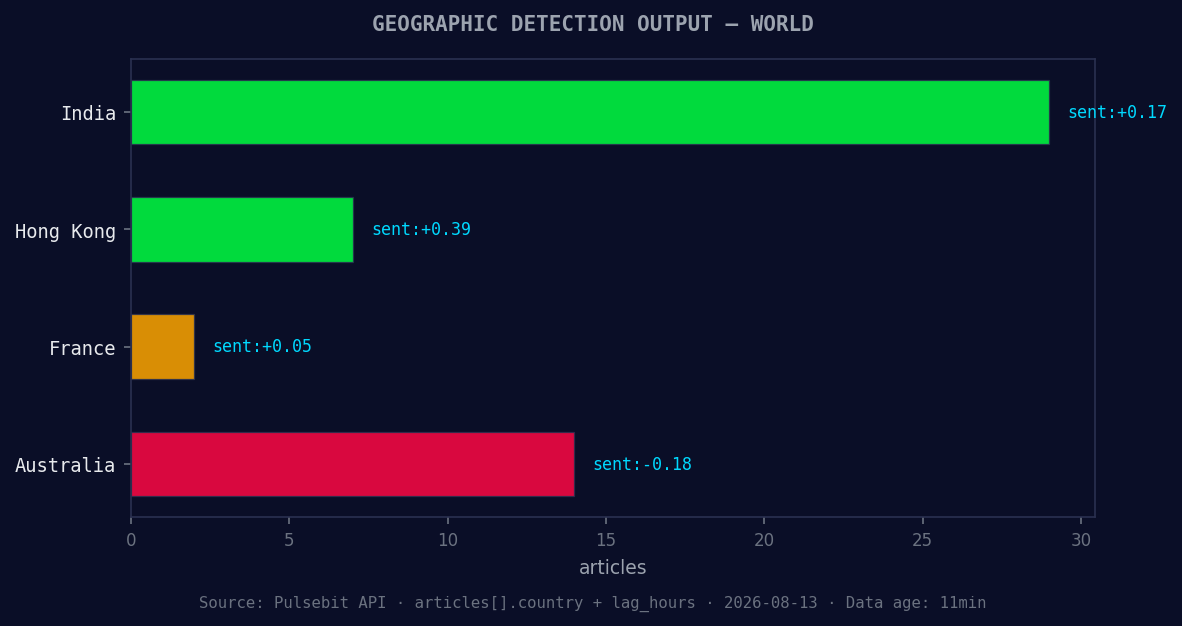
*Geographic detection output for world. India leads with 29 articles and sentiment +0.17. Source: Pulsebit /news_recent geographic fields.*
# Step 2: Meta-sentiment moment
meta_response = requests.post(
"https://api.pulsebit.com/sentiment",
json={
"text": "Clustered by shared themes: ethiopia’s, bishoftu, airport, project, has."
}
)
meta_data = meta_response.json()
print(meta_data)
In the first part, we filter sentiments based on the English language by setting the lang parameter. This allows us to ensure we're focused on the most relevant geographical context. The second part runs a meta-sentiment analysis on the cluster reason string, capturing the contextual framing of the narrative.
Now, let's discuss three specific builds you can create using this pattern:
-
Geo-Filtered Sentiment Score: Set a signal threshold to flag any sentiment related to "world" that exceeds +0.05, ensuring your model captures emerging trends quickly. Use the previously mentioned API call with the
langset to "en" to hone in on critical themes.

Left: Python GET /news_semantic call for 'world'. Right: returned JSON response structure (clusters: 3). Source: Pulsebit /news_semantic.
Meta-Sentiment Analysis Loop: Implement a continuous loop that assesses the framing of your articles by analyzing the cluster reasons over time. If you see a sentiment score above +0.05 for "has" or "into," you can trigger alerts or deeper dives into those themes.
Comparative Analysis Dashboard: Build a dashboard that visualizes the forming themes like "world(+0.00)," "has(+0.00)," and "into(+0.00)" against mainstream narratives such as "ethiopia’s," "bishoftu," and "airport." Use our API to pull this data and create clear visualizations that highlight the gaps in your existing models.
You can get started with our API right away. Check out our documentation at pulsebit.lojenterprise.com/docs. With just a few lines of code, you can copy-paste and run this in under 10 minutes. Don’t let your pipeline lag behind—act on these insights now.


Top comments (0)