

Your Pipeline Is 19.9h Behind: Catching Climate Sentiment Leads with Pulsebit
We recently uncovered a fascinating anomaly: a 24h momentum spike of +0.542 regarding climate sentiment. This spike suggests that conversations around climate change are gaining traction, particularly in English media, which has led the charge with a 19.9-hour peak. This isn't just a statistic; it's a clear signal that something significant is happening, and if you’re not tuned into these conversations, you’re missing out.
The Problem
This spike highlights a critical structural gap in sentiment pipelines that don’t accommodate multilingual origins or recognize dominant entities. Your model missed this by nearly 20 hours. The leading language was English, and the implications are broad. If your system is slow to process or analyze diverse data sources, you'll lag behind crucial developments, especially in rapidly evolving topics like climate change.

English coverage led by 19.9 hours. Af at T+19.9h. Confidence scores: English 0.85, Spanish 0.85, French 0.85 Source: Pulsebit /sentiment_by_lang.
The Code
To catch this momentum spike effectively, we can leverage our API to filter by language and analyze sentiment. Here’s how you can implement this in Python:
import requests
# Set parameters
topic = 'climate'
score = -0.020
confidence = 0.85
momentum = +0.542
# Step 1: Geographic origin filter
response = requests.get("https://api.pulsebit.com/sentiment", params={
"topic": topic,
"lang": "en",
"score": score,
"confidence": confidence,
"momentum": momentum
})
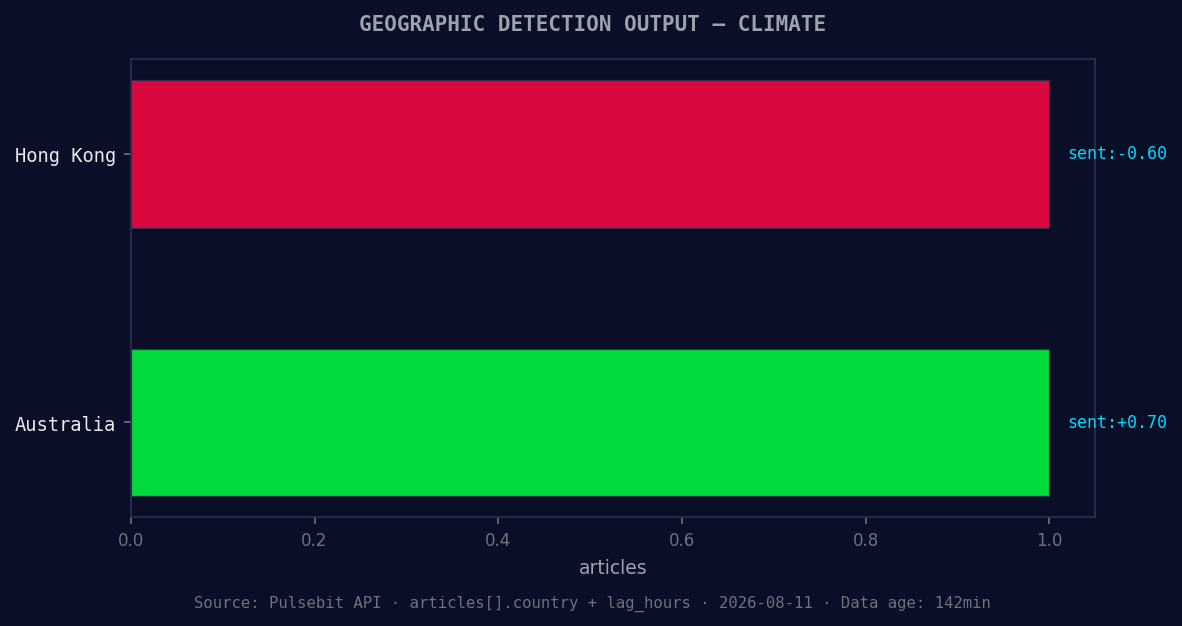
*Geographic detection output for climate. Hong Kong leads with 1 articles and sentiment -0.60. Source: Pulsebit /news_recent geographic fields.*
data = response.json()
print(data)
# Step 2: Meta-sentiment moment
cluster_reason = "Clustered by shared themes: change, could, mean, four, extra."
meta_response = requests.post("https://api.pulsebit.com/sentiment", json={"text": cluster_reason})
meta_data = meta_response.json()
print(meta_data)
The first API call filters sentiment data based on the English language, which is essential since that’s where the momentum is currently strongest. The second call runs the cluster reason string back through our sentiment endpoint to score the narrative framing itself. This dual approach helps us understand not just the data, but the context surrounding it.

Left: Python GET /news_semantic call for 'climate'. Right: returned JSON response structure (clusters: 3). Source: Pulsebit /news_semantic.
Three Builds Tonight
Geo Filtered Alert: Create an alert system that triggers notifications when sentiment momentum for 'climate' exceeds a specified threshold (e.g., +0.5) in English. This keeps you informed of sudden shifts.
Meta-Sentiment Analysis: Build a feature that analyzes the cluster reason string using the POST /sentiment endpoint. Set a threshold where the narrative score must exceed a certain level (e.g., > 0.1) before it’s flagged for deeper analysis.
Sentiment Comparison Dashboard: Develop a dashboard that compares the forming themes of 'climate', 'change', and 'google' against mainstream narratives. Use the metrics from the API to visualize how sentiment is evolving over time and across different clusters.
Get Started
Dive into our documentation at pulsebit.lojenterprise.com/docs. With just a few lines of code, you can replicate this analysis and start leveraging real-time sentiment data in under 10 minutes. Don’t let your pipeline leave you behind — catch the trends before they become mainstream.


Top comments (0)