

Your Pipeline Is 24.1h Behind: Catching Healthcare Sentiment Leads with Pulsebit
We recently stumbled upon a striking anomaly: a 24-hour momentum spike of -0.302 in the healthcare sector. This negative momentum indicates a significant shift in sentiment that you might have missed if your pipeline isn’t tuned to handle multilingual origin or entity dominance. What’s even more intriguing is that this spike was led by French-language coverage, suggesting that your model is lagging by approximately 24.1 hours, missing out on critical sentiment shifts.

French coverage led by 24.1 hours. Da at T+24.1h. Confidence scores: French 0.85, English 0.85, Spanish 0.85 Source: Pulsebit /sentiment_by_lang.
The Problem
This situation highlights a structural gap in any sentiment pipeline that doesn't accommodate multilingual data or dominant entities. Imagine your model processing sentiment for the healthcare topic, only to find that it’s running off outdated information. With the leading language being French and the recent spike primarily stemming from that context, your model missed this critical insight by 24.1 hours. This isn't just a minor oversight; it can lead to flawed strategies based on stale data.
The Code
To catch this anomaly programmatically, we can leverage our API to filter by geographic origin and assess sentiment. Here’s how to do it in Python:

Geographic detection output for healthcare. India leads with 3 articles and sentiment +0.52. Source: Pulsebit /news_recent geographic fields.
import requests
# Define the parameters for the API call
params = {
"topic": "healthcare",
"lang": "fr", # Filter for French articles
"score": +0.061,
"confidence": 0.85,
"momentum": -0.302
}
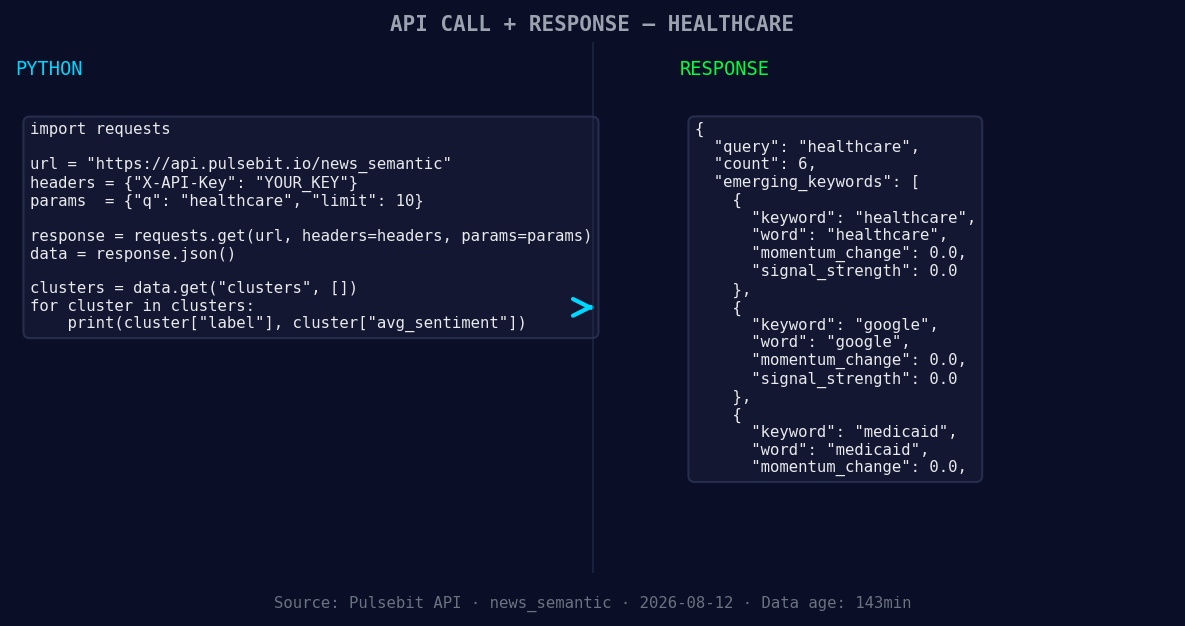
*Left: Python GET /news_semantic call for 'healthcare'. Right: returned JSON response structure (clusters: 3). Source: Pulsebit /news_semantic.*
# API call to fetch articles with the specified parameters
response = requests.get("https://api.pulsebit.com/articles", params=params)
# Check if the request was successful
if response.status_code == 200:
articles = response.json()
print("Fetched articles:", articles)
else:
print("Error fetching articles:", response.status_code)
# Now, let's score the cluster narrative through the sentiment endpoint
cluster_reason = "Clustered by shared themes: state, guidelines, advance, medical, directives."
sentiment_response = requests.post("https://api.pulsebit.com/sentiment", json={"text": cluster_reason})
if sentiment_response.status_code == 200:
sentiment_score = sentiment_response.json()
print("Meta-sentiment score:", sentiment_score)
else:
print("Error scoring sentiment:", sentiment_response.status_code)
Here, we first filter articles by the French language using the lang parameter. Next, we send the narrative framing through our sentiment analysis endpoint to get a score that can help us understand the context surrounding this cluster.
Three Builds Tonight
Geo Filter on Healthcare: Set a threshold of momentum less than -0.25 to catch rapid sentiment shifts specifically in French articles. This will help you monitor sentiment changes in regions where healthcare policies are evolving quickly.
Meta-Sentiment Loop: Create a daily job that retrieves cluster narratives like "Clustered by shared themes: state, guidelines, advance, medical, directives." and scores them for sentiment. This will add a layer of understanding around why certain topics are trending.
Forming Themes Tracker: Build a signal that tracks forming themes like healthcare(+0.00), google(+0.00), and medicaid(+0.00) against mainstream narratives. Use a threshold of confidence above 0.80 to ensure that you’re capturing only reliable signals.
Get Started
You can dive into our API at pulsebit.lojenterprise.com/docs. With the code provided, you can copy-paste and run this in under 10 minutes. Don’t let your pipeline lag behind; stay ahead of sentiment shifts!


Top comments (0)