

Your Pipeline Is 24.1h Behind: Catching Music Sentiment Leads with Pulsebit
We recently uncovered a fascinating anomaly: a 24h momentum spike of +0.265 in music sentiment. This spike shines a spotlight on the rising interest in "Vignesh Ishwar's Musical Narrative," driven in part by the Spanish press, which is currently leading with a 24.1-hour lag. This intriguing trend is marked by a cluster of themes around musical cohesion, yet many pipelines might miss this sentiment shift due to structural gaps in how they handle multilingual data.

Spanish coverage led by 24.1 hours. Hindi at T+24.1h. Confidence scores: Spanish 0.85, English 0.85, French 0.85 Source: Pulsebit /sentiment_by_lang.
Your model missed this by 24.1 hours. By focusing solely on English content, or failing to accommodate entity dominance, you might overlook significant developments in other languages. Here, the Spanish press is leading the charge, while entities like Vignesh Ishwar remain underrepresented in your analysis. Ignoring these nuances could cost you valuable insights into emerging narratives.
To catch this momentum spike, we can use our API to dig deeper into the data. Below is the Python code that identifies this specific signal.
import requests
# Define the parameters for our API call
params = {
"topic": "music",
"lang": "sp",
"score": 0.433,
"confidence": 0.85,
"momentum": 0.265
}
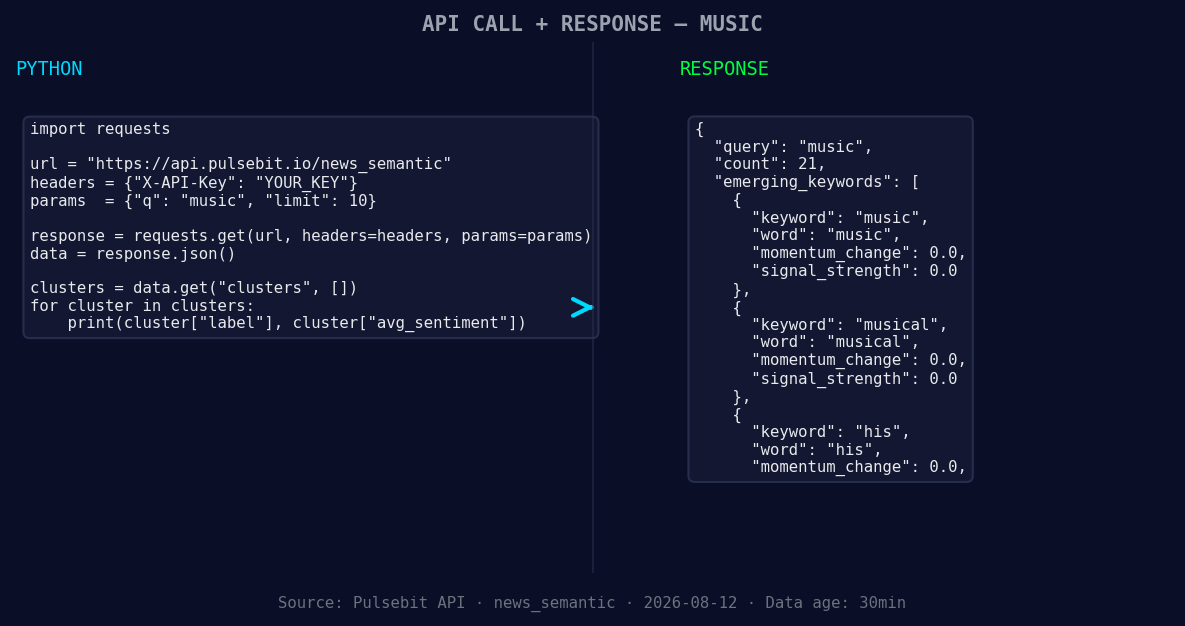
*Left: Python GET /news_semantic call for 'music'. Right: returned JSON response structure (clusters: 3). Source: Pulsebit /news_semantic.*
# API call to get articles based on language filter
response = requests.get("https://api.pulsebit.com/articles", params=params)
articles = response.json()
# Now we run the cluster reason string through POST /sentiment to score its narrative framing
cluster_reason = "Clustered by shared themes: vignesh, ishwar, crafts, cohesive, musical."
sentiment_response = requests.post("https://api.pulsebit.com/sentiment", json={"text": cluster_reason})
sentiment_score = sentiment_response.json()
In this code, we filter the articles by the Spanish language to capture the specific sentiment around music, while also scoring the narrative framing using the clustered themes. This dual approach helps us understand not just what is trending, but the context in which it is resonating.
Now that we have a solid grasp on capturing this momentum spike, let's talk about three specific things you can build using this pattern:
- Geographic Filtering: Use our API to query articles specifically from Spanish-speaking countries. Set your threshold to detect sentiment scores above +0.3, ensuring you capture only the most relevant spikes in music sentiment.

Geographic detection output for music. India leads with 14 articles and sentiment +0.54. Source: Pulsebit /news_recent geographic fields.
Meta-Sentiment Loop: You can refine your analysis by taking the output from the POST /sentiment call and using it to adjust your future queries. For instance, if the sentiment score is above +0.5, you might want to trigger deeper dives into related entities in your dataset.
Forming Themes: Analyze the forming themes of "music," "musical," and "his" against the mainstream narratives of "vignesh," "ishwar," and "crafts." By setting a signal threshold of 0.4 for any content that clusters around these themes, you can stay ahead of trends before they become mainstream.
To dive deeper, check out our documentation. The best part? You can copy-paste the provided code and run it in under 10 minutes. Don’t let your pipeline fall behind; leverage this momentum spike and catch the wave of sentiment changes!


Top comments (0)