

Your models likely missed this critical insight: a 24h momentum spike of +0.806 in discussions around human rights. This anomaly isn't just a number; it’s a signal that something significant is happening, particularly as we've observed it rising in the context of English-language press coverage. The implications of this spike could be profound, but if your pipeline isn't equipped to handle multilingual origins or recognize entity dominance, you might be missing out on real-time sentiment shifts that could inform your strategies.

English coverage led by 10.1 hours. Ca at T+10.1h. Confidence scores: English 0.85, French 0.85, Spanish 0.85 Source: Pulsebit /sentiment_by_lang.
Without the ability to process diverse language inputs or react to localized narratives, your pipeline could be lagging behind by a staggering 10.1 hours. That’s how long it took for the leading discussions around human rights to surface, leaving you to play catch-up on vital shifts in sentiment. If your model is solely focused on English or a narrow set of topics, you won’t be able to identify emerging conversations that shape public perception. The leading language here is English, but the broader context is crucial for actionable insights.
Here’s how we can catch this anomaly using our API. First, we need to filter the data to focus on the relevant geographic origin—specifically, English-speaking regions. We can do this by querying our API with the language parameter set to "en":

Geographic detection output for human rights. India leads with 3 articles and sentiment +0.03. Source: Pulsebit /news_recent geographic fields.
import requests
# Define the parameters for the API call
params = {
"topic": "human rights",
"score": -0.600,
"confidence": 0.85,
"momentum": 0.806,
"lang": "en" # Geographic origin filter
}
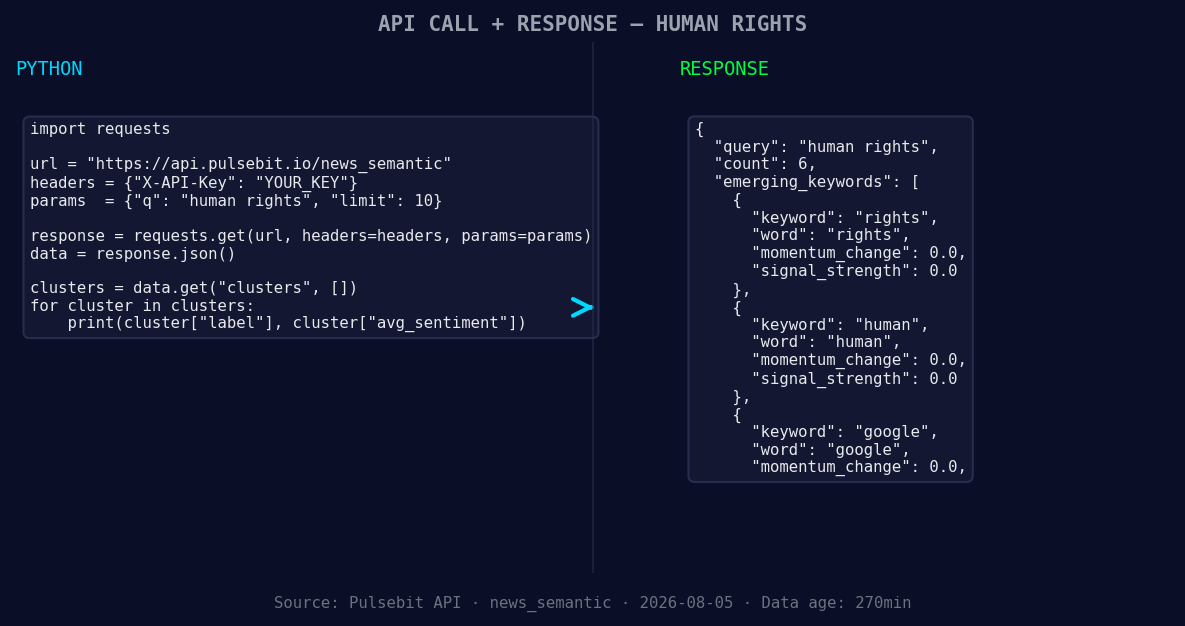
*Left: Python GET /news_semantic call for 'human rights'. Right: returned JSON response structure (clusters: 3). Source: Pulsebit /news_semantic.*
# Make the API call
response = requests.get("https://api.pulsebit.com/articles", params=params)
articles = response.json()
print(articles)
Next, we need to run the cluster reason string through our sentiment scoring to assess how the narrative is being framed. Here’s how we do that with our meta-sentiment moment:
# Prepare the cluster reason for sentiment analysis
cluster_reason = "Clustered by shared themes: tough, transition, tennessee, human, rights."

# Make the API call for sentiment analysis
sentiment_response = requests.post("https://api.pulsebit.com/sentiment", json={"text": cluster_reason})
sentiment_analysis = sentiment_response.json()
print(sentiment_analysis)
This two-step approach allows us to capture not just the spike itself, but also the nuanced framing of the conversation around it. It’s essential to monitor how issues of rights, human dignity, and societal transitions are being discussed in real-time.
Now, let’s talk about three specific builds we can implement based on this pattern. First, set a signal threshold of +0.800 for monitoring spikes in human rights discussions. Whenever this threshold is surpassed, trigger alerts to your data pipeline. Second, leverage the geographic origin filter to focus on English-speaking regions, ensuring you don’t miss localized discussions that could impact sentiment. Finally, use the meta-sentiment loop to continuously score the narrative framing surrounding human rights, specifically targeting themes like "rights" and "human" while comparing them against mainstream discussions on "tough," "transition," and "Tennessee." This will give you a clearer picture of the overall sentiment landscape.
By implementing these strategies, you enhance your awareness of shifting sentiments and ensure your responses are timely and informed.
To get started, visit our documentation at pulsebit.lojenterprise.com/docs. With the code provided, you'll be able to copy-paste and run it in under 10 minutes, putting you ahead of any lag in sentiment analysis. Let's not let another critical insight slip through the cracks.


Top comments (0)