

Your Pipeline Is 24.9h Behind: Catching Finance Sentiment Leads with Pulsebit
We recently stumbled upon a fascinating anomaly: a 24-hour momentum spike of +0.432 in finance sentiment. This finding is not just a number; it reveals a significant shift in how the finance narrative is being shaped, particularly as it relates to the recent article titled "Finance Minister carries rosary, make sign of the cross." With English press leading the charge at a 24.9-hour mark, this data point is critical for anyone tracking sentiment in finance and related themes.
The Problem
If your pipeline isn't equipped to handle multilingual origins or the dominance of certain entities, you likely missed this momentum shift by nearly 25 hours. The leading language in this sentiment surge is English, and the spike is heavily influenced by a specific narrative involving a finance minister. Without recognizing the language and the cultural context, your model would be operating on outdated information, risking your decision-making capabilities and insights.

English coverage led by 24.9 hours. Italian at T+24.9h. Confidence scores: English 0.85, Spanish 0.85, Nl 0.85 Source: Pulsebit /sentiment_by_lang.
The Code
Let’s dive into how we can catch this momentum spike using our API. First, we need to filter the results by geographic origin, specifically querying for English-language articles related to finance. Here’s how we can do that in Python:

Geographic detection output for finance. India leads with 16 articles and sentiment +0.47. Source: Pulsebit /news_recent geographic fields.
import requests
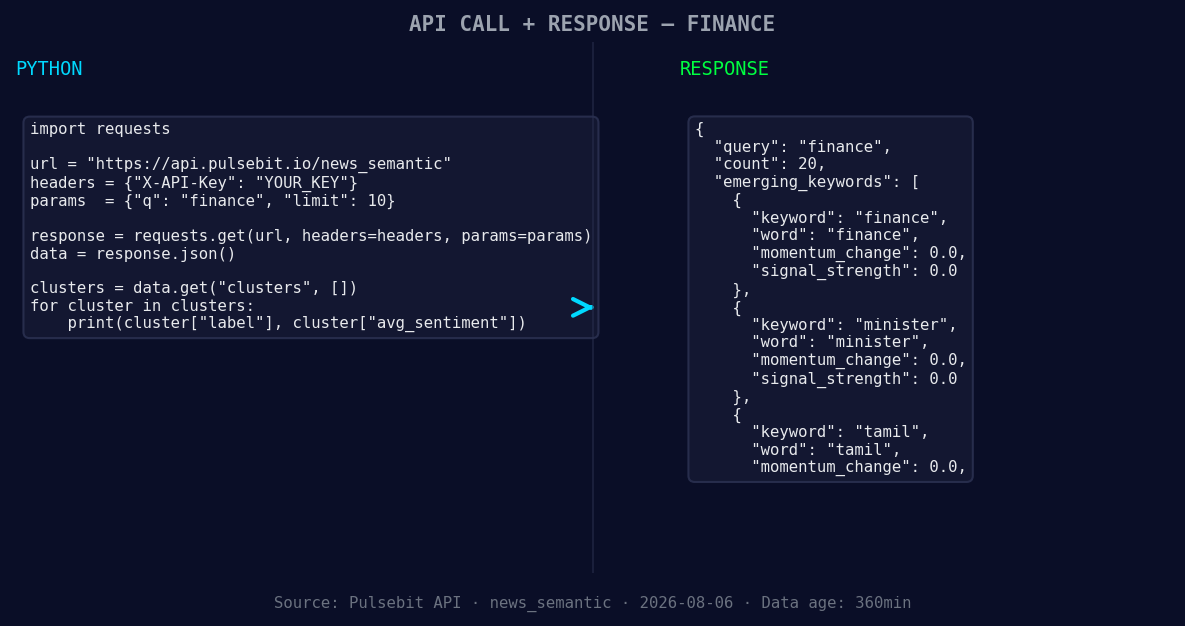
*Left: Python GET /news_semantic call for 'finance'. Right: returned JSON response structure (clusters: 3). Source: Pulsebit /news_semantic.*
# API endpoint for fetching articles
url = "https://api.pulsebit.com/v1/articles"
params = {
"topic": "finance",
"lang": "en",
"limit": 100
}
response = requests.get(url, params=params)
data = response.json()
# Now, we will check for the sentiment of the cluster reason
cluster_reason = "Clustered by shared themes: finance, minister, rosary, sign, cross."
sentiment_url = "https://api.pulsebit.com/v1/sentiment"
sentiment_response = requests.post(sentiment_url, json={"text": cluster_reason})
sentiment_data = sentiment_response.json()
# Outputting the sentiment score
print(f"Sentiment Score: {sentiment_data['sentiment_score']}, Confidence: {sentiment_data['confidence']}")
In this code snippet, we first query for English-language articles on finance. We limit the results to ensure we’re targeting the most relevant content. Next, we take the cluster reason string and run it through our sentiment analysis endpoint. This dual approach allows us to create a more comprehensive view of the situation, capturing both the articles and the narrative framing itself.
Three Builds Tonight
With this pattern in mind, here are three specific builds you can implement:
Geo Filter for Finance Sentiment: Set a threshold to alert you whenever there’s a 24-hour momentum spike over +0.4 in the finance category, specifically filtering for English articles. This will keep you ahead of emerging trends.
Meta-Sentiment Loop: Integrate a loop that captures sentiments of the cluster reasons in real-time. For instance, if you detect a narrative emerging around the finance minister, trigger an evaluation of the related themes (like "finance, minister, rosary") to gauge overall sentiment shifts.
Forming Gap Detection: Set up a monitoring system that flags when a forming gap appears in the data — for example, when "finance" and "minister" have a score of +0.00 while mainstream narratives are more engaged. This can signal potential stories that are gaining traction but not yet fully recognized in the wider narrative.
Get Started
Ready to start diving into your own sentiment analysis? Check out our documentation at pulsebit.lojenterprise.com/docs. You can copy-paste and run the provided code in under 10 minutes, putting you on the fast track to catching those critical sentiment shifts.


Top comments (0)