

Your Pipeline Is 27.6h Behind: Catching Education Sentiment Leads with Pulsebit
We recently uncovered an intriguing anomaly: a 24-hour momentum spike of -0.353 in education sentiment. This significant drop in sentiment reflects a critical shift in the narrative around education, driven by discussions about the disappearance of government schools and the growing educational inequality. As developers, these insights are not just numbers; they represent real-time shifts in public sentiment that can directly influence our applications and decision-making processes.
But here’s the catch: if your sentiment analysis pipeline doesn’t handle multilingual origins or entity dominance, you might have missed this key insight by a staggering 27.6 hours. The leading language in this case was English, but if your model isn’t equipped to handle variations in language or regional sentiment nuances, you’ll find yourself lagging behind — and that can cost you valuable time in responding to emerging trends.

English coverage led by 27.6 hours. Id at T+27.6h. Confidence scores: English 0.85, Spanish 0.85, French 0.85 Source: Pulsebit /sentiment_by_lang.
Let’s dive into how we can catch this sort of spike using our API.
import requests
# Define the topic and parameters
topic = 'education'
score = -0.029
confidence = 0.85
momentum = -0.353
# Your API endpoint
api_url = "https://api.pulsebit.com/v1/sentiment"
# Geographic origin filter for English language
params = {
"topic": topic,
"lang": "en"
}
# Make the API call
response = requests.get(api_url, params=params)
data = response.json()
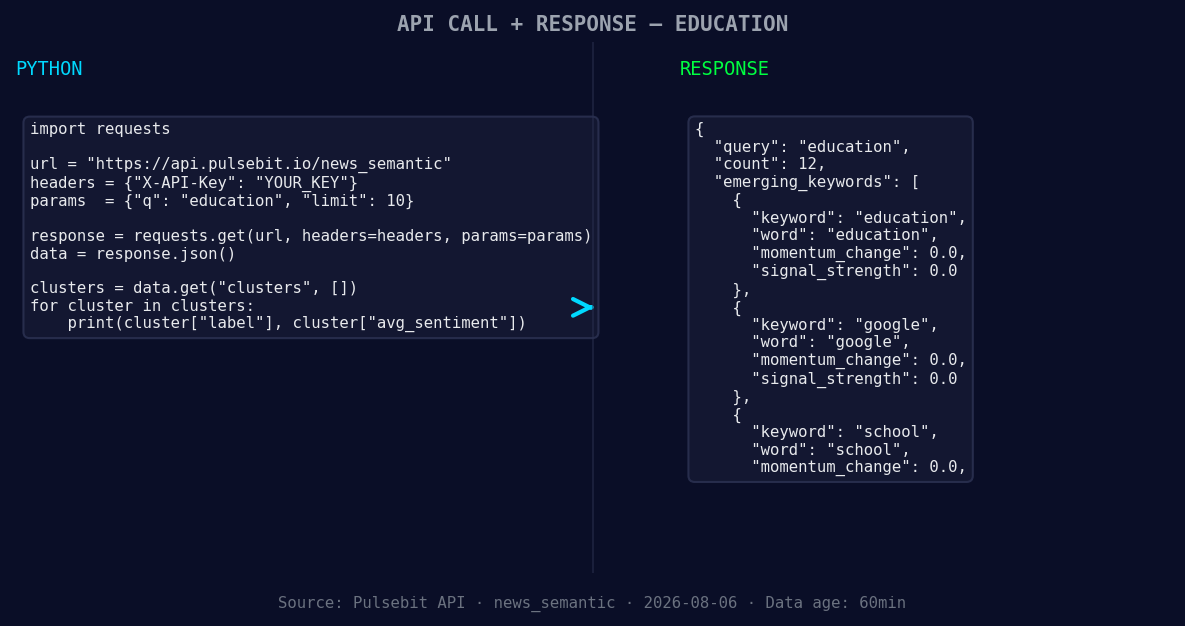
*Left: Python GET /news_semantic call for 'education'. Right: returned JSON response structure (clusters: 3). Source: Pulsebit /news_semantic.*
# Now, let's run the cluster reason string through our sentiment API
cluster_reason = "Clustered by shared themes: educational, government, schools, inequality, vanish"
meta_sentiment_response = requests.post(api_url, json={"text": cluster_reason})
meta_sentiment_data = meta_sentiment_response.json()
print("Geo Filter Response:", data)
print("Meta Sentiment Response:", meta_sentiment_data)
In this code, we first create a request to get sentiment data for our topic, ensuring to filter by language using the "lang": "en" parameter. This is crucial for capturing the appropriate sentiment around educational discussions that are predominantly in English. Then, we run a meta-sentiment analysis on our cluster reason string to see how it frames the narrative itself. This allows us to gauge whether the context of the articles aligns with the sentiment score we observed.
Here are three specific builds you can implement based on this pattern:
Signal Detection: Set a threshold for sentiment fluctuation. For instance, trigger alerts when momentum drops below -0.2. This would allow you to capture significant changes in sentiment early on, especially around topics like education.
Geo Filter Integration: Build an endpoint that combines the geographic filter with real-time sentiment tracking. By continuously monitoring sentiment for topics like education in English-speaking regions, you can pull timely insights that could influence policy or funding decisions.

Geographic detection output for education. India leads with 11 articles and sentiment +0.20. Source: Pulsebit /news_recent geographic fields.
- Meta-Sentiment Enhancer: Develop a function that loops back through the meta-sentiment analysis to refine your narrative framing. For example, if the meta-sentiment score for "educational inequality" is consistently negative, use that to adjust your content strategy or communication approach with stakeholders.
By leveraging these strategies, you can ensure your sentiment analysis pipeline is not just reactive but proactive, allowing you to stay ahead of the curve on pressing topics like education.
Ready to get started? Check out our documentation at pulsebit.lojenterprise.com/docs. You can copy-paste and run the above code in under 10 minutes to start catching these sentiment spikes in real-time.


Top comments (0)