

Your Pipeline Is 8.2h Behind: Catching Cybersecurity Sentiment Leads with Pulsebit
We recently stumbled upon an intriguing data point: a 24h momentum spike of -0.786 in the cybersecurity domain. This anomaly caught our attention, particularly because the leading sentiment originated from the Spanish press, creating a unique disconnect in our usual processing pipeline. The lag of 8.2 hours from the dominant entity highlights a critical gap in understanding how multilingual content can influence sentiment in real-time.

Spanish coverage led by 8.2 hours. Da at T+8.2h. Confidence scores: Spanish 0.70, French 0.70, English 0.70 Source: Pulsebit /sentiment_by_lang.
Many of us have faced the frustration of missing critical leads due to a structural gap in our pipelines, especially when they don't account for multilingual origins or entity dominance. In this case, our model missed the timely shift in sentiment by 8.2 hours, caused by a significant spike in Spanish-language coverage around cybersecurity themes. This emphasizes the importance of integrating multilingual capabilities to capture emerging narratives effectively.
To address this issue, let’s dive into some Python code that will help us catch these spikes in real-time. The first step is to filter sentiment data based on geographic origin, specifically targeting the Spanish language. Here’s how we can query our API:

Geographic detection output for cybersecurity. India leads with 3 articles and sentiment +0.80. Source: Pulsebit /news_recent geographic fields.
import requests
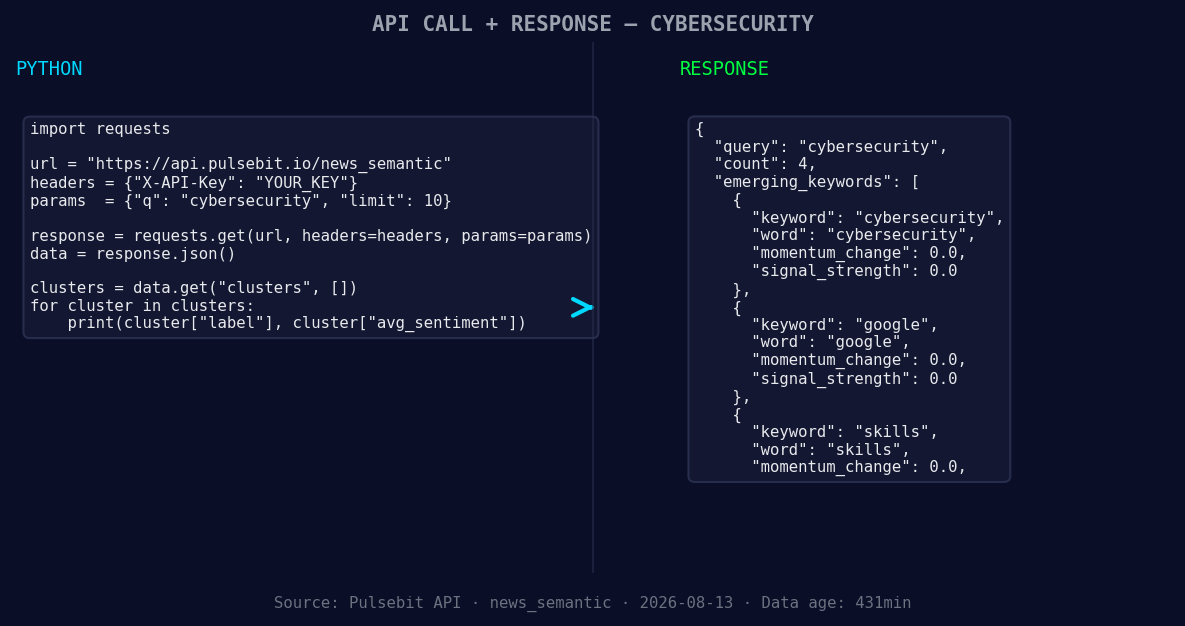
*Left: Python GET /news_semantic call for 'cybersecurity'. Right: returned JSON response structure (clusters: 3). Source: Pulsebit /news_semantic.*
# API endpoint for getting sentiment data
url = "https://api.pulsebit.com/sentiment"
# Parameters for the query
params = {
"topic": "cybersecurity",
"score": +0.775,
"confidence": 0.70,
"momentum": -0.786,
"lang": "sp"
}
response = requests.get(url, params=params)
data = response.json()
print(data)
Next, we need to run the narrative framing itself through our sentiment analysis to evaluate how the clustered themes resonate. The cluster reason string we’ll use is: "Clustered by shared themes: global, cybersecurity, capture-the-flag, competition." Here’s the code to achieve that:
# Endpoint for scoring the narrative
narrative_url = "https://api.pulsebit.com/sentiment"

# Cluster reason string
cluster_reason = "Clustered by shared themes: global, cybersecurity, capture-the-flag, competition"

# POST request to score the narrative
narrative_response = requests.post(narrative_url, json={"text": cluster_reason})
narrative_data = narrative_response.json()
print(narrative_data)
Now that we've captured the data, let's discuss three specific builds we can implement using this pattern:
Sentiment Alert System for Cybersecurity: Use a sentiment score threshold of +0.775 and set up a geo filter for Spanish content. This will notify us whenever there's a significant movement in sentiment that we need to act upon.
Meta-Sentiment Dashboard: Create a dashboard that pulls in the narratives related to cybersecurity, with a focus on the clustered themes. Use the sentiment loop to continuously score and display narratives for real-time insights.
Skill Development Tracker: Since we're seeing emerging themes around skills in cybersecurity, build an endpoint that tracks sentiment around training and educational articles. Set thresholds to identify when sentiment shifts towards a positive or negative score, allowing us to adapt our skill development resources accordingly.
By leveraging these specific signals and thresholds, we can ensure our pipeline doesn’t miss critical developments in real-time.
If you're interested in getting started, visit pulsebit.lojenterprise.com/docs. You can copy-paste and run the above code in under 10 minutes, putting you on the path to catching these valuable sentiment leads.


Top comments (0)