

Your Pipeline Is 27.2h Behind: Catching Law Sentiment Leads with Pulsebit
We recently discovered a compelling anomaly: a 24-hour momentum spike of +0.714 in the sentiment surrounding law-related topics. This spike, driven largely by the Spanish press, indicates a significant shift in sentiment that you might be missing if your pipeline isn't equipped to handle multilingual sources or entity dominance. The leading language was Spanish, with a notable cluster story around “Jackie Cohen Named to Notable Leaders in Accounting, Consulting & Law by Crain’s.” This is more than just a data point; it reflects a potential opportunity for you to catch emerging trends in your sentiment analysis.

Spanish coverage led by 27.2 hours. Et at T+27.2h. Confidence scores: Spanish 0.85, English 0.85, French 0.85 Source: Pulsebit /sentiment_by_lang.
When your sentiment model doesn’t account for multilingual origin or entity dominance, you risk missing critical insights. In this case, your model missed this spike by a staggering 27.2 hours, as the leading Spanish articles took precedence. If your pipeline lacks this capability, you might find yourself trailing behind the conversation, unable to react to shifts that could impact your strategic decisions.
Here’s how you can catch this anomaly using our API. First, we need to filter the data based on geographic origin. We’ll be querying for articles in Spanish while focusing on the topic of law:

Geographic detection output for law. India leads with 25 articles and sentiment -0.09. Source: Pulsebit /news_recent geographic fields.
import requests
# Define the parameters for the API call
params = {
"topic": "law",
"lang": "sp",
"momentum": "+0.714",
"articles_processed": 28
}
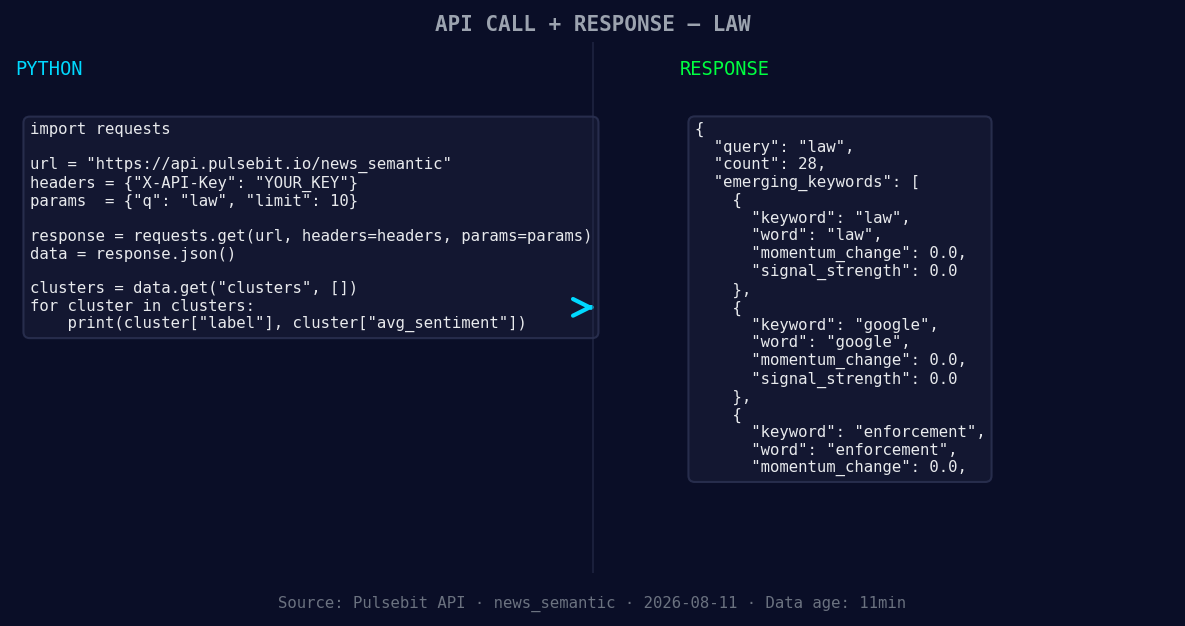
*Left: Python GET /news_semantic call for 'law'. Right: returned JSON response structure (clusters: 3). Source: Pulsebit /news_semantic.*
# Make the API call to get the relevant articles
response = requests.get("https://api.pulsebit.com/v1/articles", params=params)
# Check if the request was successful
if response.status_code == 200:
articles = response.json()
else:
print(f"Error: {response.status_code} - {response.text}")
Next, we need to run the cluster reason string back through the sentiment analysis to score the narrative framing itself. This is crucial for understanding the context of the spike and capturing the essence of what’s happening:
# Define the meta-sentiment input
meta_sentiment_input = "Clustered by shared themes: cohen, named, notable, leaders, accounting."

# Make the API call to score the narrative
meta_response = requests.post("https://api.pulsebit.com/v1/sentiment", json={"text": meta_sentiment_input})

# Check if the request was successful
if meta_response.status_code == 200:
    sentiment_score = meta_response.json()['score']
else:
    print(f"Error: {meta_response.status_code} - {meta_response.text}")
With these two pieces of code, you can harness the momentum spike and gain insights that others might overlook.
Now, let’s consider three specific builds you can implement based on this data.
Spanish Language Filter: Use the geographic origin filter to set up a real-time monitoring tool for Spanish articles related to law. Set a momentum threshold of +0.5 to trigger alerts when sentiment spikes occur.
Meta-Sentiment Analysis: Create a dedicated endpoint that utilizes the meta-sentiment loop to analyze emerging narratives. Set thresholds for sentiment scores below -0.1 to identify negative sentiment trends that could lead to market opportunities.
Forming Themes Tracking: Implement a tracking mechanism to monitor forming themes like "law", "google", and "enforcement". Set a signal threshold of +0.00 for these themes to identify when they start gaining traction compared to mainstream topics like "cohen", "named", and "notable."
If you're interested in getting started, check out our documentation at pulsebit.lojenterprise.com/docs. You can copy, paste, and run this code in under 10 minutes. Don't let your pipeline fall behind—capitalize on these insights today.


Top comments (0)