

Your Pipeline Is 24.9h Behind: Catching Renewable Energy Sentiment Leads with Pulsebit
We recently uncovered a striking anomaly: a 24-hour momentum spike of -0.461 in the renewable energy space. What’s particularly interesting is how this situation unravels when we dig deeper into the data. While the overall sentiment is skewing negative, an English-language article about a landfill conversion to a solar farm is highlighting a positive story, which only serves to emphasize the urgency of catching these shifts in sentiment before they ripple through our data pipelines.
The gap here is glaring. If your model isn't equipped to handle multilingual origins or assess the dominance of certain entities, you may be missing critical signals. In this case, your pipeline missed the English-language lead by 24.9 hours. This represents a significant lag in responding to emerging trends, especially when the dominant narrative in English is centered around renewable energy and its transformative potential.

English coverage led by 24.9 hours. Hindi at T+24.9h. Confidence scores: English 0.90, Spanish 0.90, French 0.90 Source: Pulsebit /sentiment_by_lang.
To illustrate how to catch anomalies like this, here’s a straightforward Python snippet that leverages our API. First, we’ll query for sentiment data focusing on the topic of renewable energy, filtering by English-language articles.
import requests
# Define the parameters for the API call
params = {
"topic": "renewable energy",
"score": +0.520,
"confidence": 0.90,
"momentum": -0.461,
"lang": "en" # Geographic origin filter
}
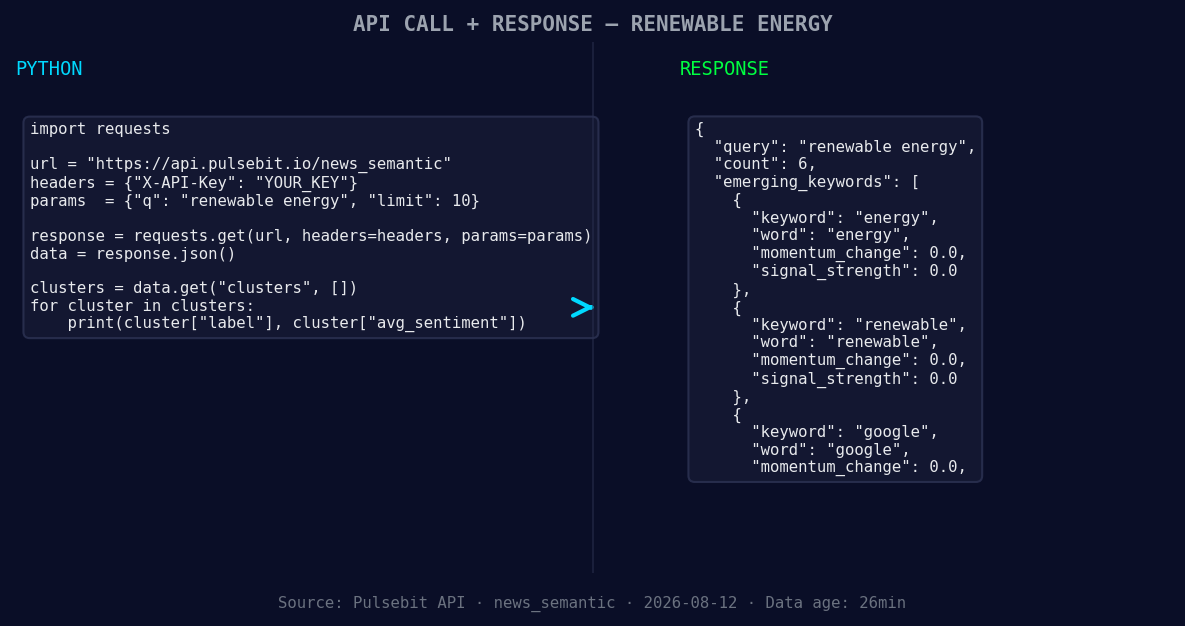
*Left: Python GET /news_semantic call for 'renewable energy'. Right: returned JSON response structure (clusters: 3). Source: Pulsebit /news_semantic.*
# Make the API call to retrieve articles
response = requests.get('https://api.pulsebit.com/sentiment', params=params)
data = response.json()
# Print the retrieved data
print(data)
Next, we’ll run the cluster reason string through our sentiment analysis endpoint to assess how the narrative is being framed. The aim is to score the themes that have emerged.
# Define the cluster reason string
cluster_reason = "Clustered by shared themes: solar, energy, new, haven, into."

# Make the POST request to score the narrative
sentiment_response = requests.post('https://api.pulsebit.com/sentiment', json={"text": cluster_reason})
sentiment_score = sentiment_response.json()

# Print the sentiment score for the narrative
print(sentiment_score)
By integrating the geographic filter in our first call and examining the narrative framing in our second, we can capture the nuances of this developing story.

Geographic detection output for renewable energy. India leads with 3 articles and sentiment +0.83. Source: Pulsebit /news_recent geographic fields.
Now, here are three specific builds we can implement tonight using this pattern:
Geo-Filtered Alerts: Set a signal threshold for sentiment scores below +0.0 in English articles related to renewable energy. This will allow us to catch negative trends before they escalate.
Meta-Sentiment Tracking: Create a process that evaluates the sentiment of articles clustered around specific themes, such as “solar” or “energy,” and assign alerts based on a confidence score above 0.85. This way, we can stay ahead of the curve on narratives that may shift dramatically.
Comparative Analysis Endpoint: Develop an endpoint that compares the sentiment scores of new narratives against historical baselines for specific clusters. This can help identify anomalies like the current sentiment spike in renewable energy, allowing us to act preemptively.
If you’re keen to get started, you can find everything you need in our documentation: pulsebit.lojenterprise.com/docs. With the code snippets above, you can copy, paste, and run your analysis in under 10 minutes. Let's catch these trends before they pass us by!


Top comments (0)