

Your Pipeline Is 21.9h Behind: Catching Stock Market Sentiment Leads with Pulsebit
We just came across an intriguing anomaly: a 24h momentum spike of +0.578 in sentiment around the stock market. This spike is particularly noteworthy because it suggests a significant shift in sentiment that could impact trading strategies. The leading language driving this sentiment is English, which has a lag of only 0.0 hours compared to the core data at 21.9 hours. This means that if your pipeline isn't accounting for multilingual sources and entity dominance, you might be missing out on critical insights.

English coverage led by 21.9 hours. Ca at T+21.9h. Confidence scores: English 0.85, Spanish 0.85, French 0.85 Source: Pulsebit /sentiment_by_lang.
The Problem
Your model missed this by 21.9 hours. The sentiment around the stock market is being shaped predominantly by English-language articles, but if your pipeline doesn't handle multilingual data effectively, it’s likely that you're not capturing these nuances and are lagging behind. This delay can be detrimental, as moments like these can lead to missed opportunities and poor decision-making. If you’re relying solely on a single language or entity, you're operating with a significant structural gap.
The Code
Here's how we can catch this momentum spike using our API. We will first filter articles by language to focus on English sources, and then we'll run the cluster reason string back through the sentiment analysis endpoint to score the narrative framing.
First, let's filter by language:
import requests
# Define parameters
topic = 'stock market'
score = +0.000
confidence = 0.85
momentum = +0.578
lang = "en"
# API call to filter articles by language
response = requests.get(
f"https://api.pulsebit.com/v1/articles?topic={topic}&lang={lang}"
)
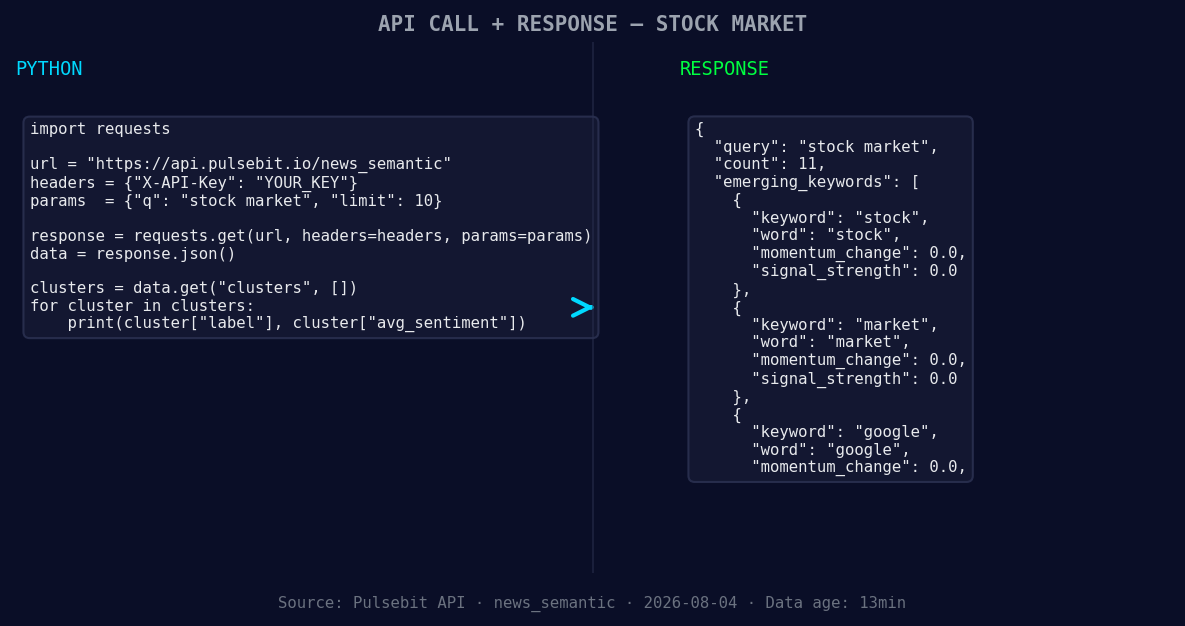
*Left: Python GET /news_semantic call for 'stock market'. Right: returned JSON response structure (clusters: 3). Source: Pulsebit /news_semantic.*
data = response.json()
print(data)
Next, we’ll use the cluster reason string to analyze the sentiment. Here’s how we run the meta-sentiment moment:
# Cluster reason string
cluster_reason = "Clustered by shared themes: points, stock, markets, trade, mixed."

# API call to score the narrative framing
sentiment_response = requests.post(
    "https://api.pulsebit.com/v1/sentiment",
    json={"text": cluster_reason}
)

sentiment_data = sentiment_response.json()
print(sentiment_data)
This code will allow you to filter relevant articles and analyze the sentiment around the narrative framing, giving you a more comprehensive view of the current sentiment landscape.
Three Builds Tonight
Sentiment Spike Alert: Create an alert system where you set a threshold for momentum spikes (e.g., +0.5). When this is reached, trigger a notification to your team. This can be critical for timely decision-making.
Geo-Sentiment Dashboard: Use the geographic origin filter to create a dashboard that visualizes sentiment across different languages. This will help you identify which regions or languages are driving sentiment shifts in the stock market.

Geographic detection output for stock market. India leads with 5 articles and sentiment +0.49. Source: Pulsebit /news_recent geographic fields.
- Meta-Sentiment Analysis Tool: Build a tool that runs the meta-sentiment loop for specific clusters of articles. For example, use the reason string from our recent analysis and track how the sentiment evolves over time. This could be especially useful for measuring the impact of news cycles on stock sentiment.
Get Started
For those eager to dive in, check out our documentation at pulsebit.lojenterprise.com/docs. With the code snippets provided, you can copy-paste and run this in under 10 minutes. Let's make sure your pipeline is not just catching up but leading the way in sentiment analysis!


Top comments (0)