

Your pipeline is 26.9h behind. We’ve just uncovered a 24h momentum spike of +0.625, which highlights a significant shift in sentiment. The leading language in the press is English, trailing by 26.9 hours behind the Central Asian narratives. This gap exposes a critical oversight for any sentiment analysis pipeline that doesn’t account for multilingual origins or entity dominance, especially when stories like "HCLTech named among the world's most sustainable companies by TIME magazine" start trending.

English coverage led by 26.9 hours. Ca at T+26.9h. Confidence scores: English 0.85, French 0.85, Spanish 0.85 Source: Pulsebit /sentiment_by_lang.
Your model missed this shift by 26.9 hours, which is a glaring oversight given the prominence of HCLTech in the current discourse. When your pipeline fails to recognize the nuances of multilingual data, you risk missing out on impactful stories that can influence trends. In this case, the narrative surrounding HCLTech could have been leveraged earlier if your sentiment analysis had been more agile in capturing emerging signals from diverse sources.
Here’s how we can catch this momentum spike using our API. We’ll start by filtering for English language content related to the topic “world” with a score of +0.119 and a confidence of 0.85:
import requests
# Define the API endpoint and parameters
url = "https://api.pulsebit.io/v1/sentiment"
params = {
"topic": "world",
"score": 0.119,
"confidence": 0.85,
"momentum": 0.625,
"lang": "en" # Geographic origin filter
}
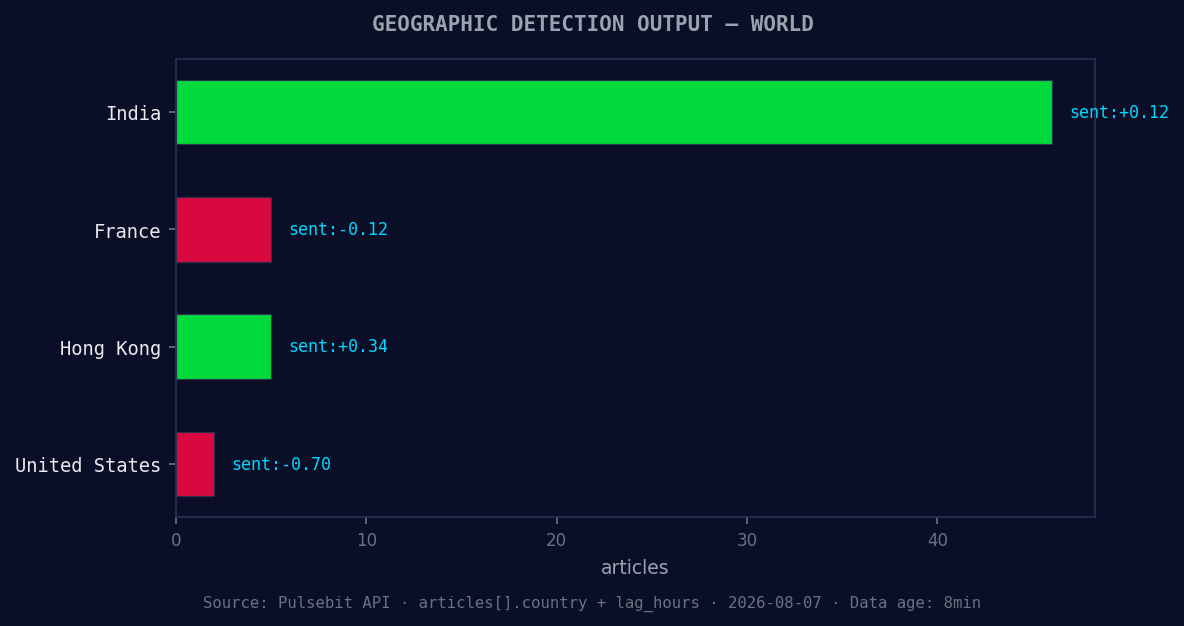
*Geographic detection output for world. India leads with 46 articles and sentiment +0.12. Source: Pulsebit /news_recent geographic fields.*
# Make the API call
response = requests.get(url, params=params)
data = response.json()
print(data)

Left: Python GET /news_semantic call for 'world'. Right: returned JSON response structure (clusters: 3). Source: Pulsebit /news_semantic.
Next, we’ll run the cluster reason string back through our sentiment analysis to evaluate the narrative framing. The input string is: "Clustered by shared themes: hcltech, named, among, world's, most."
# Define the cluster reason string
cluster_reason = "Clustered by shared themes: hcltech, named, among, world's, most."

# Make the POST request to analyze the sentiment of the cluster reason
response = requests.post(url, json={"text": cluster_reason})
meta_sentiment = response.json()
print(meta_sentiment)
This approach allows us to capture not only the raw sentiment but also the meta-narrative that’s forming around the topic, giving you a comprehensive view of how the conversation is evolving.
Now, let’s talk about three specific builds you can implement tonight using this newfound insight:
Geo-filtered Alert System: Create an alert system that triggers when the momentum score exceeds a threshold of +0.5 for English articles related to "world." This allows you to react promptly to shifts in sentiment that might be regionally significant.
Meta-Sentiment Dashboard: Build a dashboard that visualizes the sentiment scores of clustered narratives. For instance, if the string "Clustered by shared themes: hcltech, named, among, world's, most." scores above +0.1, it could indicate a trending topic worth investigating further.
Forming Themes Watchlist: Set up a watchlist for emerging themes. For instance, if you notice forming themes like “world(+0.00), has(+0.00), china(+0.00)” against mainstream narratives, you can trigger a deeper analysis to understand why these topics are gaining traction.
We encourage you to dive into our documentation at pulsebit.lojenterprise.com/docs. With these snippets, you can copy-paste and run this in under 10 minutes, setting you up to catch those critical sentiment shifts before they become mainstream. Catching up with the world of sentiment is now just a few lines of code away!


Top comments (0)