

In the last 24 hours, we observed a significant anomaly: a momentum spike of +1.070 related to the topic of human rights. This uptick is particularly striking given the leading language of press coverage was English, with a lag time of 26.0 hours compared to Hindi. It’s a clear indicator that while the English-speaking world is waking up to this issue, other languages are already ahead — and you might have missed this critical development.
What does this mean for your data pipeline? If your model doesn't accommodate for multilingual origins or entity dominance, it's likely that you missed this momentum spike by a full 26 hours. The dominant entity in this instance was the English press, but without a robust mechanism for tracking sentiment across languages, you risk being out of sync with the conversations happening globally.

English coverage led by 26.0 hours. Hindi at T+26.0h. Confidence scores: English 0.85, French 0.85, Spanish 0.85 Source: Pulsebit /sentiment_by_lang.
Let’s dive into the code that allows us to capture this sentiment shift. We’ll use our API to filter by language, pulling in data on the human rights topic with a momentum of +1.070. Here’s how we can specifically query for English articles:
import requests
# Define parameters for the API call
params = {
'topic': 'human rights',
'score': -0.600,
'confidence': 0.85,
'momentum': +1.070,
'lang': 'en' # Filtering for English
}
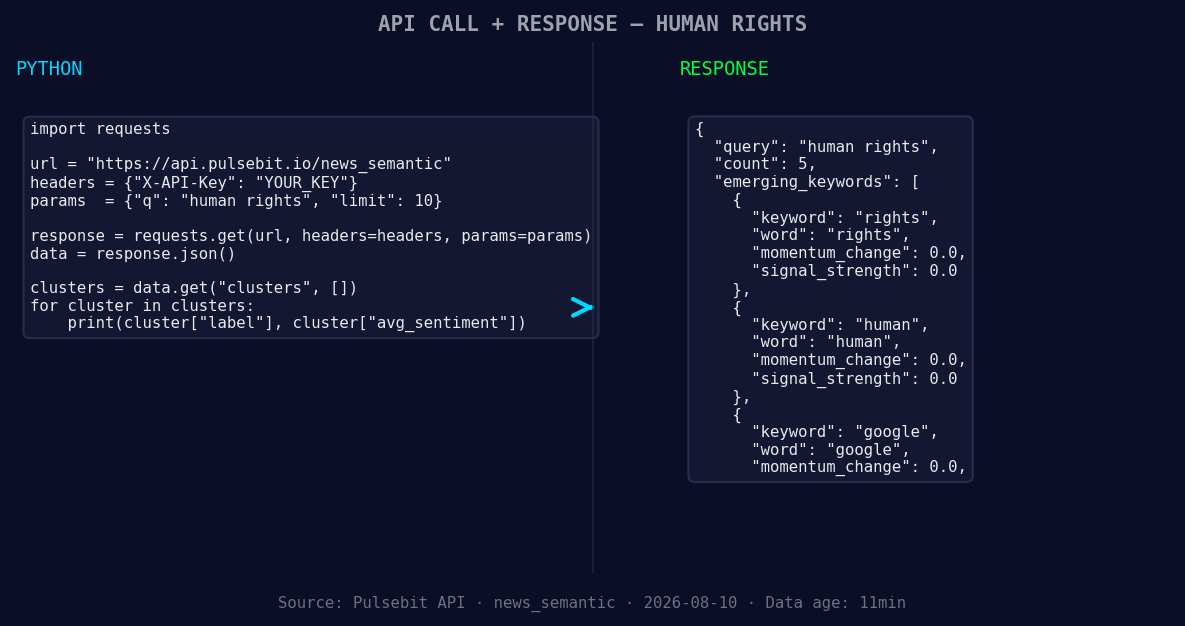
*Left: Python GET /news_semantic call for 'human rights'. Right: returned JSON response structure (clusters: 3). Source: Pulsebit /news_semantic.*
# Call the API
response = requests.get('https://api.pulsebit.lojenterprise.com/v1/articles', params=params)
data = response.json()
# Print the response
print(data)
Next, we’ll want to evaluate the narrative framing of the articles clustered around this anomaly. We’ll run the cluster reason string back through our sentiment analysis endpoint to score its sentiment. Here’s how to do that:
# The narrative framing string
narrative_string = "Clustered by shared themes: citizens, commission, human, rights, international."

# Call the sentiment analysis endpoint
sentiment_response = requests.post('https://api.pulsebit.lojenterprise.com/v1/sentiment', json={'text': narrative_string})
sentiment_data = sentiment_response.json()

# Print the sentiment score
print(sentiment_data)
With this setup, you can efficiently capture and analyze spikes in sentiment regarding human rights and other pressing topics.
Now that we've seen how to leverage this data, here are three specific builds you can create with this pattern:
Real-Time Alerts: Create a signal that triggers an alert if momentum exceeds +1.0 for the topic of human rights. Use a geo filter to ensure you’re only capturing English articles. This will keep you ahead in understanding shifts in public sentiment.
Meta-Sentiment Dashboard: Utilize the sentiment analysis of the narrative framing to build a dashboard that visualizes how different clusters resonate over time. A threshold of -0.5 could be a good starting point for identifying negative sentiment narratives.
Thematic Comparisons: Build a comparison tool that allows you to analyze forming themes versus mainstream narratives. For instance, you could track the sentiment around "rights" and "human" as they relate to the more established themes of "citizens" and "commission". This could help identify emerging discussions before they break into mainstream consciousness.
In closing, you can get started with our API at pulsebit.lojenterprise.com/docs. With the examples above, you should be able to copy, paste, and run this in under 10 minutes. Don’t let your pipeline lag behind — stay ahead by catching these crucial sentiment shifts!

Geographic detection output for human rights. India leads with 3 articles and sentiment +0.47. Source: Pulsebit /news_recent geographic fields.


Top comments (0)