

Your pipeline just missed a significant 24h momentum spike of +0.806 in the human rights discourse. This anomaly signals that there’s a notable shift in sentiment, specifically coming from English-language sources as highlighted by an article cluster titled "A tough transition from Tennessee Human Rights Commission - Nashville Banner." It’s crucial to recognize that these insights can help us catch emerging trends before they gain traction, but only if our data processing pipelines are calibrated to handle multi-lingual origins and entity dominance effectively.
If your model doesn’t accommodate the nuances of multilingual inputs or the dominance of certain entities, it risks falling behind. In this case, your pipeline lagged by 27.8 hours, primarily driven by a singular focus on mainstream narratives — "tough," "transition," and "Tennessee." While these words are indeed significant, the emerging themes around "rights" and "human" are equally critical. Without the right configuration, you might miss the pulse of relevant discussions as they evolve in real-time.

English coverage led by 27.8 hours. Et at T+27.8h. Confidence scores: English 0.85, French 0.85, Spanish 0.85 Source: Pulsebit /sentiment_by_lang.
Let’s take a look at how we can catch these insights programmatically. We’ll use Python to query our API effectively, focusing on the topic of "human rights." Below is the code to extract relevant data while applying a geographic origin filter to hone in on English-language articles.
import requests
# Define our parameters
topic = 'human rights'
params = {
"topic": topic,
"lang": "en" # Filter for English language
}
# Make the API call
response = requests.get('https://api.pulsebit.com/v1/cluster', params=params)
data = response.json()
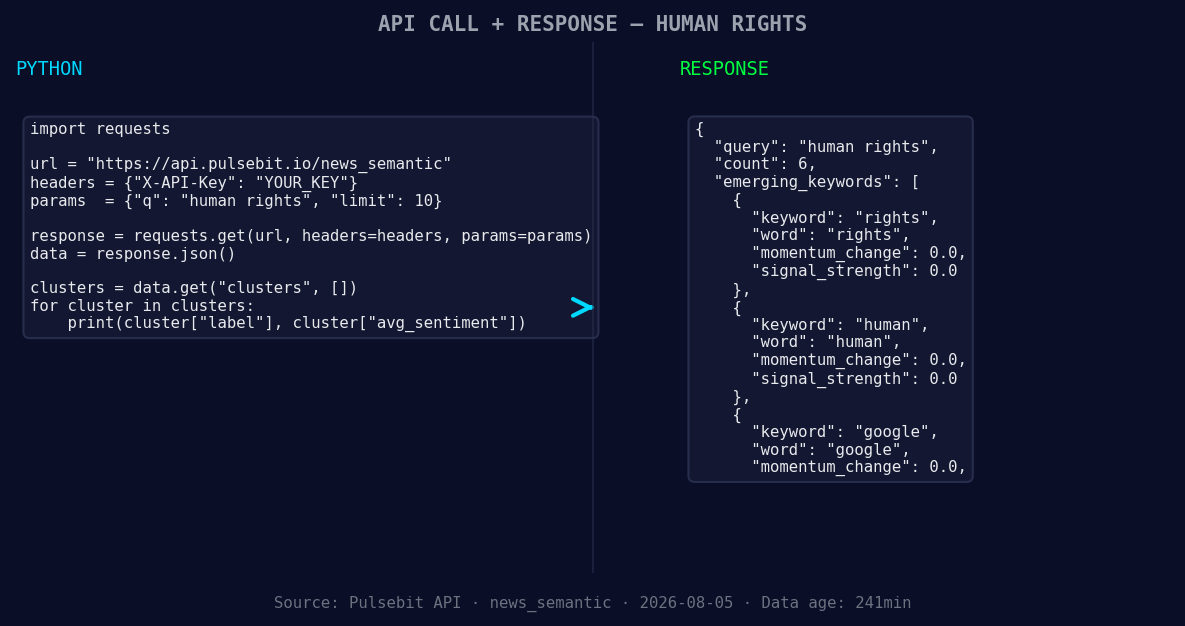
*Left: Python GET /news_semantic call for 'human rights'. Right: returned JSON response structure (clusters: 3). Source: Pulsebit /news_semantic.*
# Check the response
print(data)
Next, we want to score the narrative framing itself to understand the overarching sentiment surrounding the cluster reason we identified. We'll feed the following string back through our sentiment analysis endpoint:
# Meta-sentiment input
meta_sentiment_input = "Clustered by shared themes: tough, transition, tennessee, human, rights."

# Send to the sentiment analysis endpoint
sentiment_response = requests.post('https://api.pulsebit.com/v1/sentiment', json={"text": meta_sentiment_input})
sentiment_data = sentiment_response.json()

# Check the sentiment analysis output
print(sentiment_data)
With this dual approach, you’re not just capturing raw data; you’re also assessing the sentiment attached to the narrative, which adds depth to your analysis.
Now, let’s consider three specific builds we can implement using this pattern to enhance our pipeline:
- Signal Detection with Geographic Filter: You can set a threshold for sentiment momentum. For example, trigger alerts when momentum exceeds +0.5 for topics like "human rights" using the geographic filter we implemented. This can help you prioritize which emerging stories to investigate further.

Geographic detection output for human rights. India leads with 3 articles and sentiment +0.47. Source: Pulsebit /news_recent geographic fields.
Meta-Sentiment Loop: Utilize the results from the sentiment analysis of clustered themes to refine your content strategy. If you detect a negative sentiment score (e.g., -0.167) consistently associated with "human rights," it might be time to pivot your messaging or outreach efforts accordingly.
Monitoring Forming Themes: Set up a real-time dashboard that highlights forming themes using parameters like "rights(+0.00), human(+0.00)" against mainstream narratives. This can help you visualize which emerging issues deserve immediate attention before they become mainstream.
By leveraging these specific signals and insights, you can ensure your sentiment analysis pipeline stays sharp and responsive to changing dialogues in real-time.
To get started, check out our documentation at pulsebit.lojenterprise.com/docs. You can copy, paste, and run this code in under 10 minutes to begin catching these anomalies before they become too significant to ignore.


Top comments (0)