

Your pipeline is 27.7h behind: catching education sentiment leads with Pulsebit
We’ve just uncovered a fascinating anomaly: a 24h momentum spike of -0.353 related to the topic of education. This spike could indicate a significant shift in sentiment that is being largely overlooked, particularly when we consider that English press coverage of this topic is lagging behind by nearly 28 hours compared to Italian sources. The implications for our sentiment analysis models are profound, especially if your pipeline isn’t equipped to handle multilingual data or recognize entity dominance.

English coverage led by 27.7 hours. Italian at T+27.7h. Confidence scores: English 0.85, French 0.85, Spanish 0.85 Source: Pulsebit /sentiment_by_lang.
The structural gap in your pipeline is glaring. If your model isn't set up to accommodate the nuances of multilingual sentiment, you may have missed this spike by a staggering 27.7 hours. The leading language—English—presents a skewed view of the sentiment landscape, while Italian sources may be picking up on emerging themes earlier. This misalignment can lead to critical misinterpretations, especially when discussing important issues like educational inequality and the vanishing of government schools.
To catch this anomaly, we can leverage our API to query sentiment data effectively. Below is a Python snippet that demonstrates how to filter the data by language while also scoring the narrative framing around our identified cluster reason.
import requests
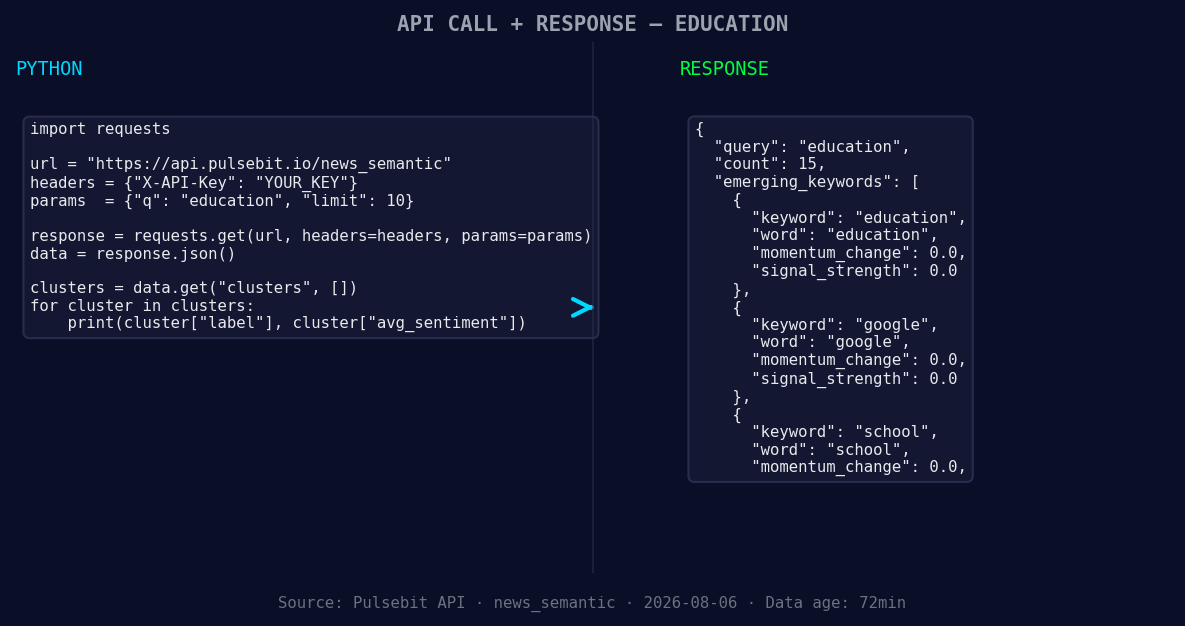
*Left: Python GET /news_semantic call for 'education'. Right: returned JSON response structure (clusters: 3). Source: Pulsebit /news_semantic.*
# Step 1: Fetching sentiment data for education from English sources
topic = 'education'
score = -0.058
confidence = 0.85
momentum = -0.353
url = 'https://api.pulsebit.com/sentiment'
# Query by language/country using param "lang": "en"
params = {
'topic': topic,
'lang': 'en',
'momentum': momentum
}
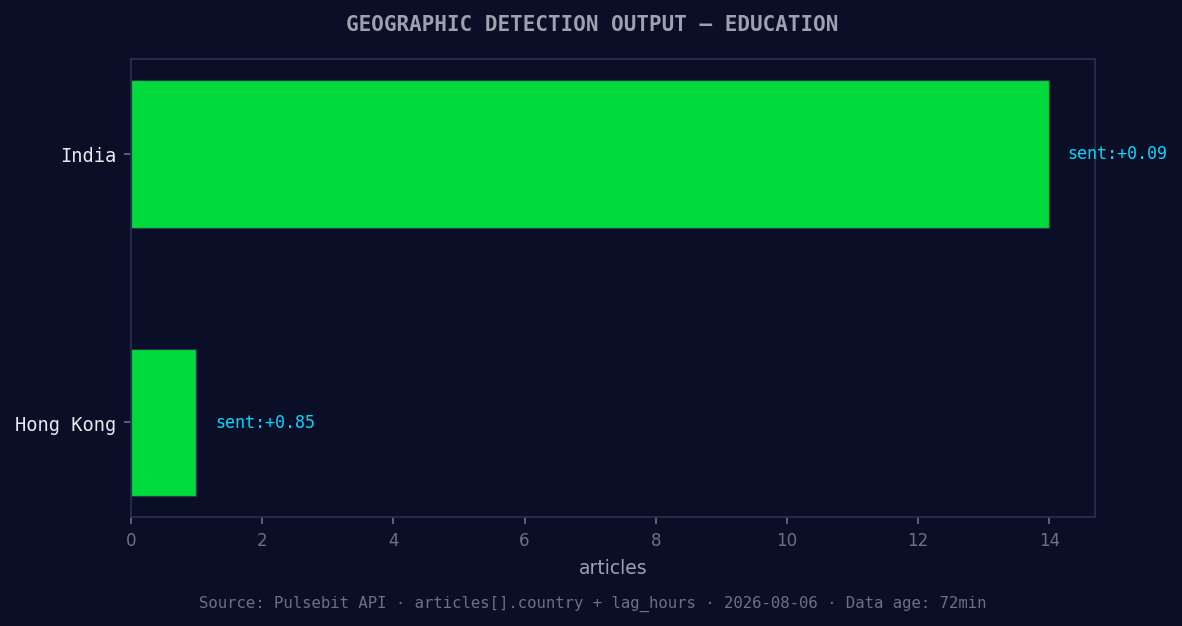
*Geographic detection output for education. India leads with 14 articles and sentiment +0.09. Source: Pulsebit /news_recent geographic fields.*
response = requests.get(url, params=params)
data = response.json()
print(data)
# Step 2: Running the cluster reason string back through POST /sentiment
cluster_reason = "Clustered by shared themes: educational, government, schools, inequality, vanish"
response_meta_sentiment = requests.post(url, json={'text': cluster_reason})
meta_sentiment_data = response_meta_sentiment.json()
print(meta_sentiment_data)
In this code, we first fetch sentiment data specifically for the education topic in English. This geo-filtering helps us pinpoint relevant sentiment trends that may otherwise be obscured. Next, we send the cluster reason string through our API to get a deeper understanding of how the narrative is framed, which is critical for contextualizing the sentiment we observe.
Now, what can you build with this newly uncovered pattern? Here are three specific ideas:
Geo-filtered Sentiment Dashboard: Create a real-time dashboard that uses our geo-filtering capabilities to track sentiment across different languages, specifically focusing on education-related topics. Set a threshold for momentum spikes of -0.3 or lower to trigger alerts for further investigation.
Meta-Sentiment Analyzer: Build a tool that continuously runs the meta-sentiment loop on clustered narratives. This could help identify emerging themes in educational sentiment while providing a confidence score, allowing you to prioritize which narratives to act on.
Forming Themes Tracker: Develop an endpoint that tracks forming themes around keywords like 'education', 'google', and 'school' compared to mainstream keywords such as 'educational', 'government', and 'schools'. Set up alerts when the sentiment score for these keywords diverges significantly from the mainstream, indicating potential shifts in public perception.
By leveraging our findings, you can ensure that your systems are not only capturing sentiment accurately but also staying ahead of emerging trends.
To get started, check out our documentation at pulsebit.lojenterprise.com/docs. You can copy-paste this code and run it in under 10 minutes to begin uncovering critical insights in your sentiment analysis.


Top comments (0)