

Your Pipeline Is 23.5h Behind: Catching Agriculture Sentiment Leads with Pulsebit
We recently uncovered a striking anomaly: a 24h momentum spike of +0.463 in agricultural sentiment. This spike is noteworthy, especially given the context of the current discussions around agriculture policies, led predominantly by English press coverage. This specific momentum surge signals an emerging trend that any developer or data analyst in the agricultural sector should be keen to catch.
The problem here is clear: if your pipeline isn't set up to handle multilingual origins or entity dominance, you might have missed this critical shift by 23.5 hours. With the English language leading the charge and the focus on figures like Agriculture Secretary Brooke Rollins, your model could be significantly out of sync. The risk is clear: without adapting to this dynamic landscape, your insights could lag behind, missing essential signals that could inform your strategies.

English coverage led by 23.5 hours. Italian at T+23.5h. Confidence scores: English 0.85, Spanish 0.85, French 0.85 Source: Pulsebit /sentiment_by_lang.
To catch this momentum spike, we can leverage our API to build a robust pipeline. Below is a Python code snippet that demonstrates how to filter for this specific sentiment spike:
import requests
# Set parameters for the API call
topic = 'agriculture'
score = +0.395
confidence = 0.85
momentum = +0.463
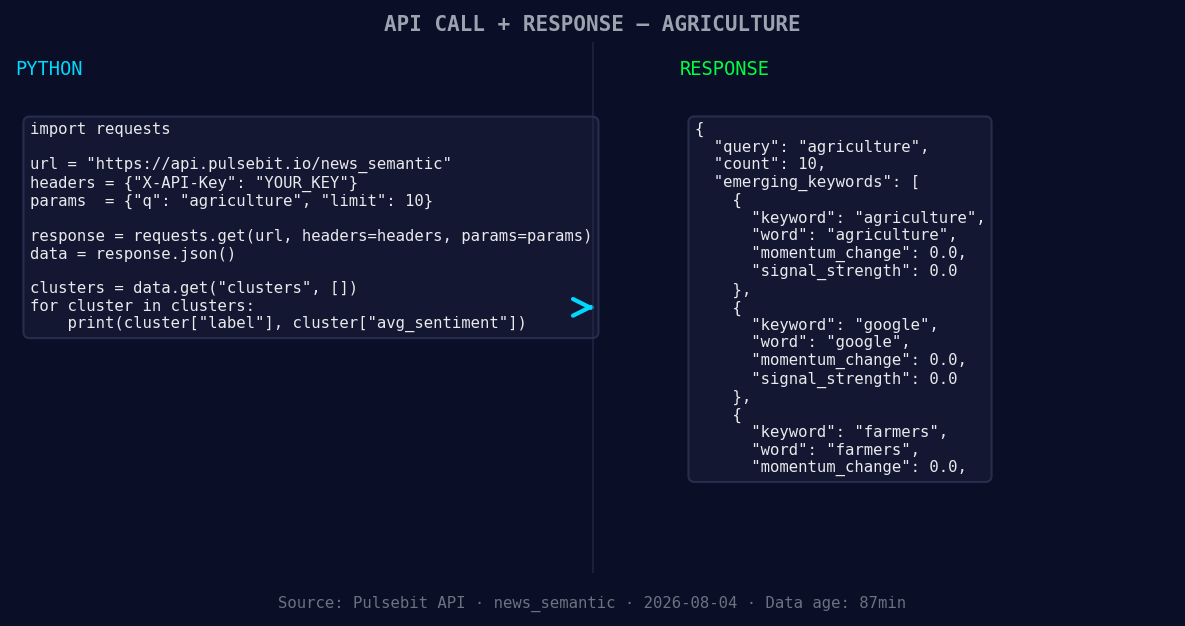
*Left: Python GET /news_semantic call for 'agriculture'. Right: returned JSON response structure (clusters: 3). Source: Pulsebit /news_semantic.*
# Geographic origin filter: query by language/country
url = "https://pulsebit.lojenterprise.com/api/v1/sentiment"
params = {
"topic": topic,
"lang": "en" # Filtering for English language sources
}
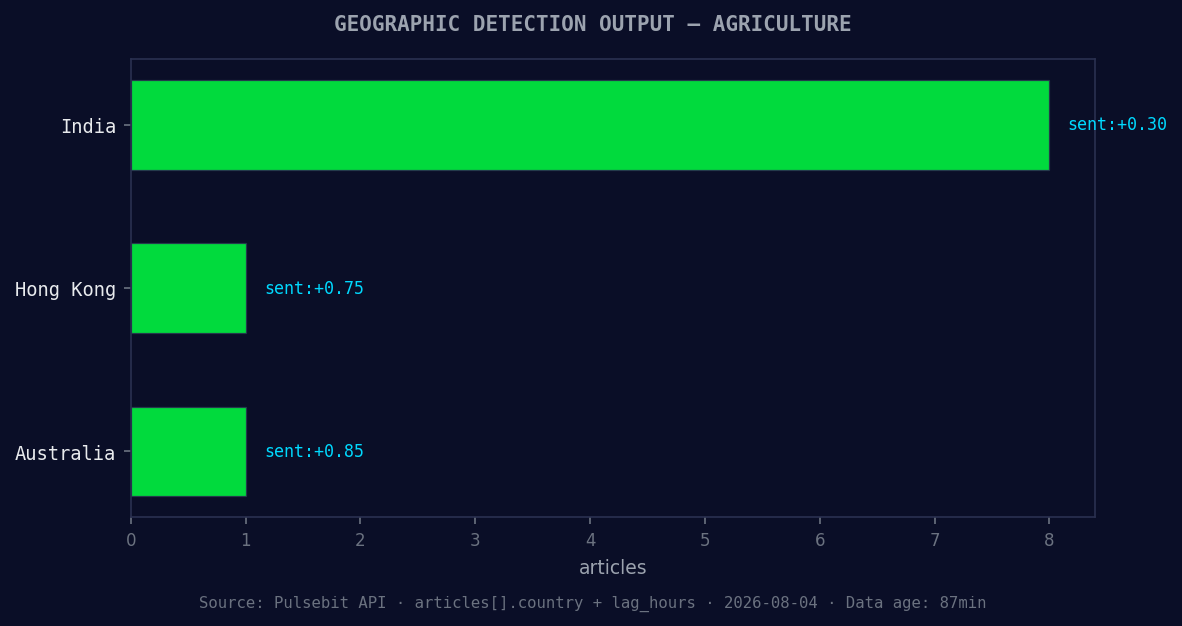
*Geographic detection output for agriculture. India leads with 8 articles and sentiment +0.30. Source: Pulsebit /news_recent geographic fields.*
response = requests.get(url, params=params)
data = response.json()
# Meta-sentiment moment: run the cluster reason string back through POST /sentiment
cluster_reason = "Clustered by shared themes: agriculture, secretary, brooke, rollins, announces."
meta_sentiment_url = "https://pulsebit.lojenterprise.com/api/v1/sentiment"
meta_response = requests.post(meta_sentiment_url, json={"text": cluster_reason})
meta_sentiment_data = meta_response.json()
print(meta_sentiment_data)
In this code, we first filter our query to focus on English-language articles discussing agriculture. This ensures we capture the most relevant sentiment data that could influence our strategies. Next, we take the narrative framing string and run it through our sentiment API to gauge its impact. This loop is crucial because it allows us to assess not just the raw data but the sentiment framing itself, providing a richer context for our findings.
Now, let’s explore three specific builds you can implement using this pattern:
Signal Monitoring Setup: Create a signal monitor for the
agriculturetopic with a threshold of +0.463 momentum. Set alerts to trigger when sentiment surpasses this threshold, ensuring you’re immediately informed of shifts in sentiment.Geo-Focused Dashboard: Develop a dashboard that utilizes the geographic origin filter. Track sentiment for
agriculturein English-speaking regions, allowing you to visualize trends and anomalies over time in real-time.Meta-Sentiment Analysis Tool: Build a tool that automates the meta-sentiment loop. Whenever a clustered narrative emerges, the tool should automatically run it through the sentiment scoring endpoint, providing immediate insights into how the narrative is perceived across different themes.
With these builds, you can ensure that your models remain agile and responsive to the ever-changing landscape of agricultural sentiment.
To get started, visit our documentation at pulsebit.lojenterprise.com/docs. You can copy-paste the code provided and run it in under 10 minutes to see the power of real-time sentiment analysis for yourself.


Top comments (1)
I found the discussion around leveraging the Pulsebit API to catch the 24h momentum spike in agricultural sentiment particularly insightful, especially the point about the potential 23.5-hour lag in pipelines not set up to handle multilingual origins. The code snippet demonstrating how to filter for this specific sentiment spike using the API is also well-explained, and I appreciate the inclusion of the geographic origin filter to query by language or country. One potential improvement to consider is incorporating additional natural language processing techniques to further refine the sentiment analysis, such as entity recognition or part-of-speech tagging, to provide even more nuanced insights into the emerging trends. How do you envision integrating such techniques with the Pulsebit API to enhance the accuracy of the sentiment analysis?