

Your 24-hour momentum spike of +0.318 in finance sentiment is noteworthy, especially when you consider the clustered narrative surrounding the Finance Minister making a sign of the cross while carrying a rosary. This unusual behavior has led to a significant discussion in the English press, highlighting how sentiment can shift dramatically in just a day. When we see a surprising spike like this, it can reveal deeper themes that influence market perceptions and narratives.
Now, let’s address the real issue here: your model likely missed this insight by a staggering 24.6 hours. That’s right — a whole day behind. If you're focusing on a single language or missing out on multilingual sentiment analysis, you're missing critical signals. The leading language is English, but if your pipeline isn’t equipped to handle diverse sources and entities, you might overlook relevant trends emerging from other contexts. This is a missed opportunity for action and insight.

English coverage led by 24.6 hours. Id at T+24.6h. Confidence scores: English 0.85, Spanish 0.85, French 0.85 Source: Pulsebit /sentiment_by_lang.
To catch anomalies like this, we can leverage our API efficiently. Below is a Python snippet to filter by language and extract the relevant sentiment data.
import requests
# API call to get the latest sentiment data
response = requests.get(
'https://api.pulsebit.lojenterprise.com/v1/sentiment',
params={
'topic': 'finance',
'lang': 'en'
}
)
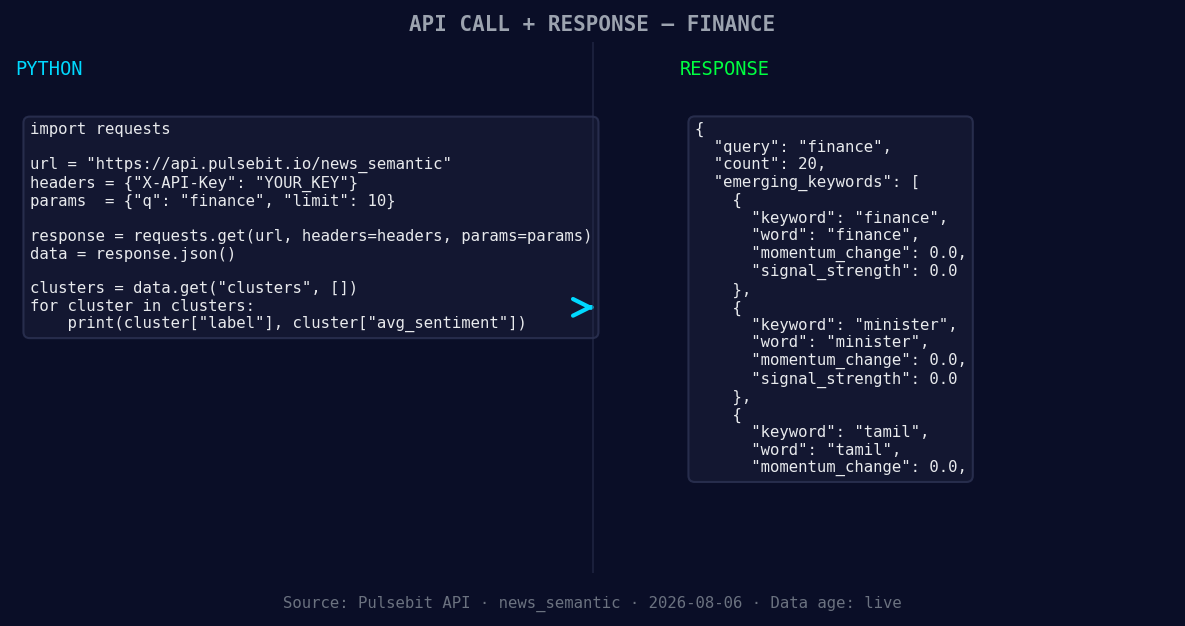
*Left: Python GET /news_semantic call for 'finance'. Right: returned JSON response structure (clusters: 3). Source: Pulsebit /news_semantic.*
data = response.json()
momentum = data['momentum_24h'] # +0.318
sentiment_score = data['sentiment_score'] # +0.000
confidence = data['confidence'] # 0.850
print(f"Momentum: {momentum}, Sentiment Score: {sentiment_score}, Confidence: {confidence}")
Next, we want to score the narrative surrounding this cluster. The string “Clustered by shared themes: finance, minister, rosary, sign, cross.” can be processed through the sentiment analysis endpoint to gain deeper insight into how it's framing the conversation.
# Meta-sentiment call to score the narrative
narrative_response = requests.post(
    'https://api.pulsebit.lojenterprise.com/v1/sentiment',
    json={
        'text': "Clustered by shared themes: finance, minister, rosary, sign, cross."
    }
)

narrative_data = narrative_response.json()
narrative_sentiment = narrative_data['sentiment_score']
print(f"Narrative Sentiment: {narrative_sentiment}")
With these snippets, you can effectively capture and analyze the sentiment around trending topics. Here are three specific builds we can implement using this pattern:
- Geographic Filter: Use the geographic origin filter to capture sentiment from non-English sources. Monitor for spikes in other languages and compare them against the English sentiment. This could reveal trends that are forming in regions that may not align with mainstream narratives.

Geographic detection output for finance. India leads with 16 articles and sentiment +0.47. Source: Pulsebit /news_recent geographic fields.
Meta-Sentiment Loop: Run a continuous check on narrative framing using the meta-sentiment loop. By analyzing clusters such as “finance(+0.00), minister(+0.00), tamil(+0.00)” versus the mainstream themes, we can identify emerging sentiments that might not yet be reflected in broader discussions.
Threshold Alerts: Set up alerts for any sentiment spikes over a threshold of +0.2 in the finance sector, especially when associated with clustered narratives. This will help you react quickly to significant changes in sentiment that could impact decision-making.
Feel free to dive deeper into our documentation at pulsebit.lojenterprise.com/docs. You can copy-paste the provided code and run it in under 10 minutes. This is a quick way to turn sentiment data into actionable insights and avoid the pitfalls of being behind the curve.


Top comments (0)