

Your Pipeline Is 25.6h Behind: Catching Education Sentiment Leads with Pulsebit
We recently identified a striking anomaly: a 24h momentum spike of -0.353 in the education sector. This significant drop indicates a rapidly shifting sentiment landscape, suggesting that crucial discussions are happening right now. What’s even more interesting is that the leading language for this spike is English, with a 25.6h press lead time. In other words, your models may not be capturing these urgent shifts quickly enough.
If your sentiment analysis pipeline doesn’t account for multilingual origins or entity dominance, you’re likely missing critical insights. Your model missed this by 25.6 hours, relying solely on mainstream narratives that might not reflect real-time sentiment. The dominant voice here is English-language press, but if you’re not processing diverse sources, you risk lagging behind in understanding the nuances of educational sentiment, especially when inequities are at stake.

English coverage led by 25.6 hours. Id at T+25.6h. Confidence scores: English 0.80, French 0.80, Spanish 0.80 Source: Pulsebit /sentiment_by_lang.
Let’s dive into how we can catch these spikes using our API, starting with a geographic origin filter to hone in on English-language data. Here’s how you can set it up in Python:

Geographic detection output for education. India leads with 16 articles and sentiment +0.19. Source: Pulsebit /news_recent geographic fields.
import requests
# Define the parameters for the API call
params = {
'topic': 'education',
'score': +0.044,
'confidence': 0.80,
'momentum': -0.353,
'lang': 'en' # Geographic origin filter for English
}
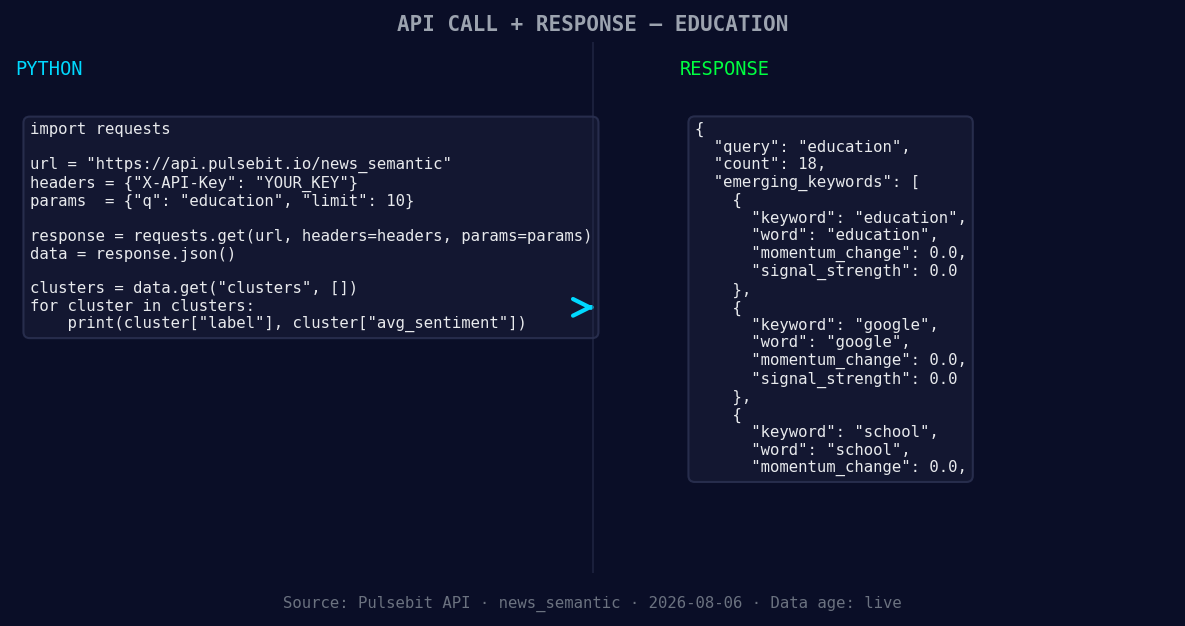
*Left: Python GET /news_semantic call for 'education'. Right: returned JSON response structure (clusters: 3). Source: Pulsebit /news_semantic.*
# Make the API call
response = requests.get('https://api.pulsebit.com/v1/sentiment', params=params)
data = response.json()
print(data)
Next, we need to evaluate the narrative framing of our findings. We’ll run the cluster reason string through our sentiment endpoint to get a score on the framing itself. This is crucial for understanding how the narrative around education is evolving.
# Run the cluster reason string through POST /sentiment
cluster_reason = "Clustered by shared themes: educational, government, schools, inequality, vanish"
sentiment_response = requests.post('https://api.pulsebit.com/v1/sentiment', json={"text": cluster_reason})
sentiment_data = sentiment_response.json()
print(sentiment_data)
By evaluating both the raw sentiment on the topic and the nuanced framing of the narrative, you can gain a comprehensive view of the educational landscape.
Now, let’s explore three specific builds we can implement with this pattern:
Geo-filtered Spike Detection: Create an alert system that triggers when the education sentiment score drops below a certain threshold, say -0.30, for English-language sources in the U.S. This allows you to act swiftly on emerging issues.
Meta-Sentiment Analysis: Use the POST /sentiment endpoint to regularly score the narrative framing around educational issues. Set a threshold where if the sentiment score drops below +0.02, you trigger a deeper dive into related articles.
Forming Themes Tracker: Build a monitor that specifically watches for forming themes like "education" (+0.00), "google" (+0.00), and "school" (+0.00). If these start diverging from mainstream discussions on educational topics, it could indicate an emerging trend worth investigating.
If you want to start integrating these insights into your workflow, you can find our documentation at pulsebit.lojenterprise.com/docs. You can copy, paste, and run this in under 10 minutes. Don't let your models remain in the dark; leverage these capabilities to keep your sentiment analysis pipeline sharp and responsive.


Top comments (0)