

Your Pipeline Is 16.3h Behind: Catching Sports Sentiment Leads with Pulsebit
We just discovered a fascinating anomaly: a 24-hour momentum spike of +0.411 centered around the topic of sports. This spike is particularly interesting because it highlights a significant shift in sentiment that your pipeline might have missed. With our data showing that the leading language in this sentiment surge is English, and it being led by a mere 16.3 hours, it begs the question of how well your current model is equipped to handle such rapid shifts, especially when entities like NTPC are involved.
If your pipeline isn't adept at managing multilingual origins or recognizing the dominance of certain entities, you could be lagging behind by over 16 hours—an eternity in our fast-paced environment. The leading entity in this spike is NTPC, which may indicate that your model isn't capturing the full narrative or the underlying themes that are driving this momentum. This oversight can lead to missed opportunities for actionable insights.

English coverage led by 16.3 hours. Tl at T+16.3h. Confidence scores: English 0.85, Spanish 0.85, No 0.85 Source: Pulsebit /sentiment_by_lang.
To catch this momentum spike effectively, we can leverage our API to filter the relevant data. Here’s a Python snippet that does just that:
import requests
# Define the parameters for the API call
params = {
"topic": "sports",
"lang": "en" # Filter for English language
}
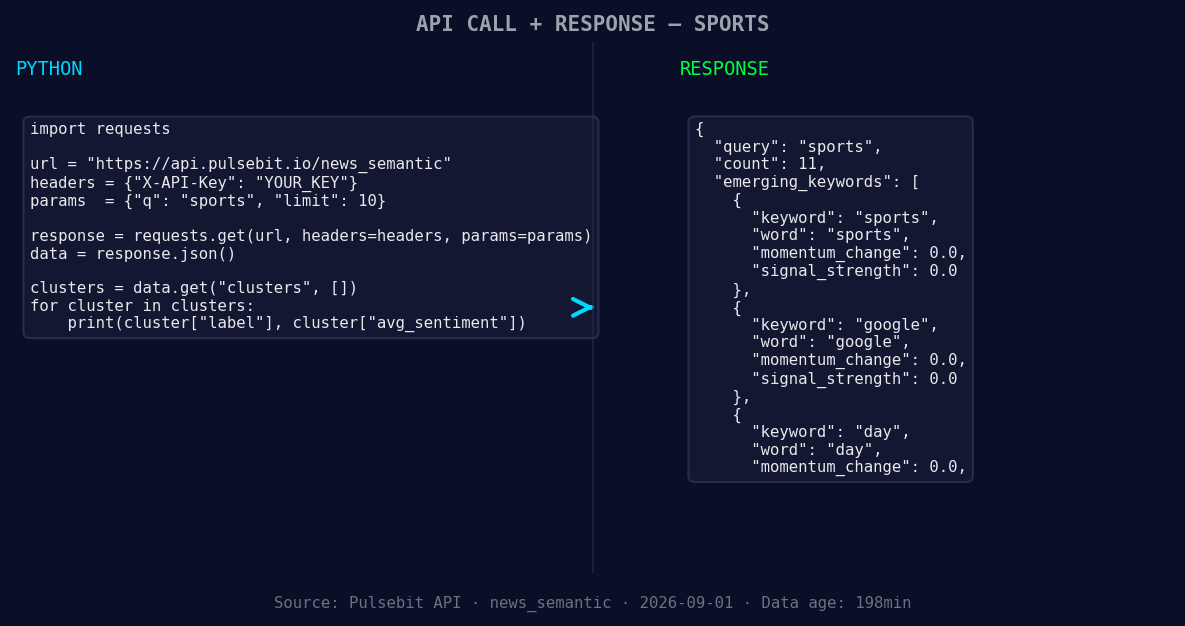
*Left: Python GET /news_semantic call for 'sports'. Right: returned JSON response structure (clusters: 3). Source: Pulsebit /news_semantic.*
# Make the API call
response = requests.get("https://api.pulsebit.com/v1/sentiment", params=params)
data = response.json()
# Log the relevant parts of the response
print("Momentum Spike Data:", data)
Next, we need to assess the narrative framing of the cluster reason string that led to this spike. Let’s score it through our POST endpoint:
# Define the meta-sentiment input
meta_sentiment_input = {
    "text": "Clustered by shared themes: sports, ntpc, national, day, events."
}

# Make the POST request to score the narrative framing
meta_response = requests.post("https://api.pulsebit.com/v1/sentiment", json=meta_sentiment_input)
meta_data = meta_response.json()

# Log the sentiment score of the narrative
print("Meta-Sentiment Score:", meta_data)
By leveraging these snippets, we can catch the momentum before it dissipates. Here are three specific builds you might consider based on this pattern:
Geo-Filtered Alert System: Set up a threshold alert that triggers whenever sentiment momentum exceeds +0.3 in English-speaking regions. This way, you can act quickly when sentiment spikes around sports events, which is relevant given the current data.
Meta-Sentiment Analysis Dashboard: Create a dashboard that continuously monitors and visualizes the meta-sentiment scores of cluster reasons. This could allow you to see how narrative framing changes over time, particularly around major sporting events or national days.
Dynamic Content Curation: Develop an endpoint that curates content based on forming themes such as sports(+0.00), google(+0.00), and day(+0.00). This can be particularly beneficial for marketing strategies aimed at leveraging trending topics just as they begin to gain traction.
With these builds, you can ensure that you're not just reacting but proactively engaging with sentiment data that's ripe for analysis.
For all the details you need to get started, check out our documentation at pulsebit.lojenterprise.com/docs. You can copy-paste and run the provided code snippets in under 10 minutes to start catching those momentum shifts in real-time.

Geographic detection output for sports. India leads with 10 articles and sentiment +0.79. Source: Pulsebit /news_recent geographic fields.


Top comments (0)