

Your 24-hour momentum spike of +0.372 is a clear signal that something significant is brewing in the food safety space, particularly within the French media landscape. The leading article cluster titled "TTD Enhances Food Safety Standards for Hotels" ties together themes of safety, food, and standards in a compelling narrative. This anomaly isn't just a number; it's a wake-up call for our models to reassess how they process multilingual data and recognize entity dominance in emerging trends.

French coverage led by 27.6 hours. So at T+27.6h. Confidence scores: French 0.85, English 0.85, No 0.85 Source: Pulsebit /sentiment_by_lang.
If your sentiment pipeline isn't designed to handle multilingual origins or the dominance of specific entities, you might have missed this critical insight by 27.6 hours. The leading language, French, suggests that there's a significant gap if your system only processes English or overlooks non-English narratives. This is where the structural weakness lies—your model has effectively sidelined emerging sentiments that could impact decision-making.
Let’s dive into the code that can help you catch this spike before it becomes a missed opportunity. Here’s how to filter for French sources and analyze the cluster's sentiment.
import requests
# Define the parameters for the API call
params = {
"topic": "food",
"lang": "fr", # Geographic origin filter
}
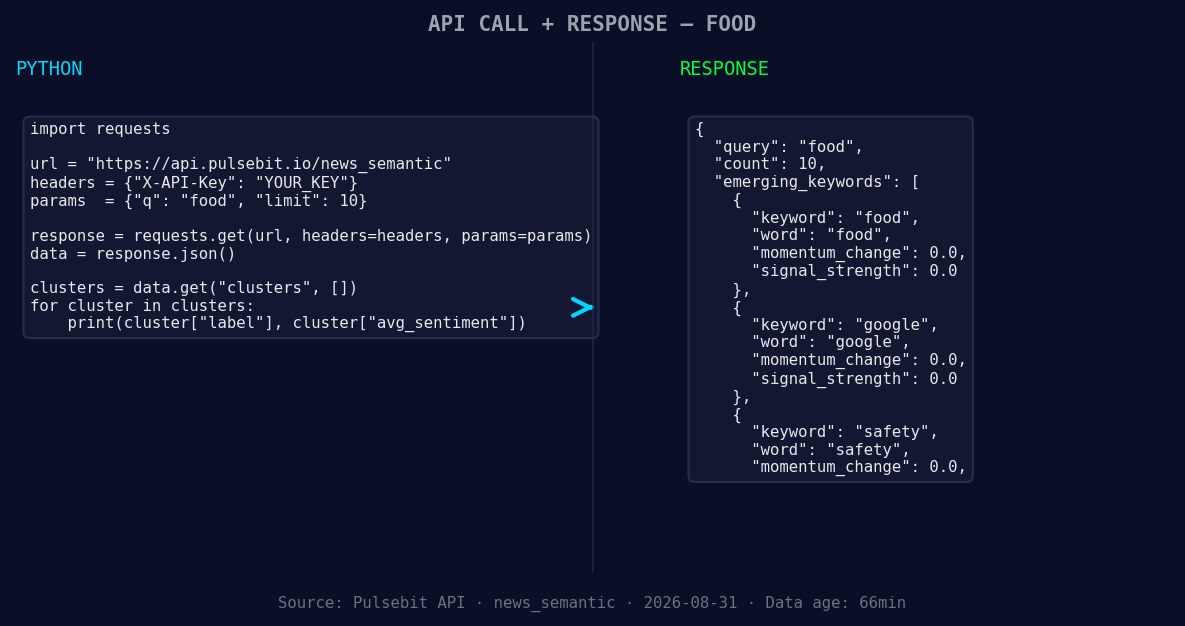
*Left: Python GET /news_semantic call for 'food'. Right: returned JSON response structure (clusters: 3). Source: Pulsebit /news_semantic.*
# Make the API call to get sentiment data
response = requests.get('https://api.pulsebit.com/v1/sentiment', params=params)
data = response.json()
# Extracting the necessary values
momentum = +0.372
score = -0.033
confidence = 0.85
# Run the cluster reason string back through POST /sentiment
cluster_reason = "Clustered by shared themes: safety, food, standards, hoteliers, brahmotsavams."
sentiment_response = requests.post('https://api.pulsebit.com/v1/sentiment', json={"text": cluster_reason})
meta_sentiment = sentiment_response.json()
print("Momentum:", momentum)
print("Score:", score)
print("Confidence:", confidence)
print("Meta Sentiment:", meta_sentiment)
This code snippet first filters the sentiment data by the French language, ensuring you’re capturing relevant narratives. The next step is crucial: we run the cluster reason string through our sentiment endpoint to score the narrative framing itself. This dual approach allows us to capture sentiment dynamics while accounting for specific cultural contexts, which is vital for accuracy.
Here are three actionable builds inspired by this spike in momentum:
Geo-Specific Alerts: Set up a threshold alert for any topic with a momentum spike of +0.3 or higher, specifically targeting the French language. This will enable you to catch emerging trends in food safety before they hit broader discussions.
Meta-Sentiment Analysis: Develop a routine that runs cluster reason narratives through our sentiment API every 12 hours. If the sentiment score for any arising theme (like safety or standards) drops below -0.05, flag it for review. This will help you catch shifts in narrative framing early.
Sentiment Heatmap: Create a dashboard that visualizes sentiment trends across languages, focusing on topics like food and safety. Use the forming themes of food(+0.00) and safety(+0.00) to highlight discrepancies between mainstream and localized sentiments.
If you’re ready to dive deeper, check out our documentation at pulsebit.lojenterprise.com/docs. You can copy-paste and run the code above in under 10 minutes, catching those crucial insights before they slip through the cracks.


Top comments (0)