

Your Pipeline Is 13.4h Behind: Catching World Sentiment Leads with Pulsebit
We recently discovered an intriguing anomaly in our sentiment analysis: a spike in sentiment at +0.12 and momentum at +0.07, with a leading language of English at 13.4 hours ahead, revealing a structural gap in how we handle multilingual origin and entity dominance. The data points to a significant rise in discussions around the "data state," specifically clustered by shared themes like rise, data, and state. This suggests that while we're tuned into the mainstream narrative, we might be missing the nuanced shifts happening in specific regions.

English coverage led by 13.4 hours. Ca at T+13.4h. Confidence scores: English 0.75, French 0.75, Spanish 0.75 Source: Pulsebit /sentiment_by_lang.
When you realize your model missed this by 13.4 hours, it raises an important concern. If your pipeline doesn't account for multilingual origins or entity dominance, you risk making decisions based on outdated information. In this case, the leading language is English, but there's more happening globally that your current setup might not capture effectively. You could be missing critical insights from emerging topics like "world," "China," or even the evolving narratives around data governance.
Here’s how we can catch that anomaly using our API effectively. We’ll start by querying sentiment data filtered by geographic origin, specifically focusing on English-speaking regions.

Geographic detection output for world. India leads with 28 articles and sentiment +0.36. Source: Pulsebit /news_recent geographic fields.
import requests
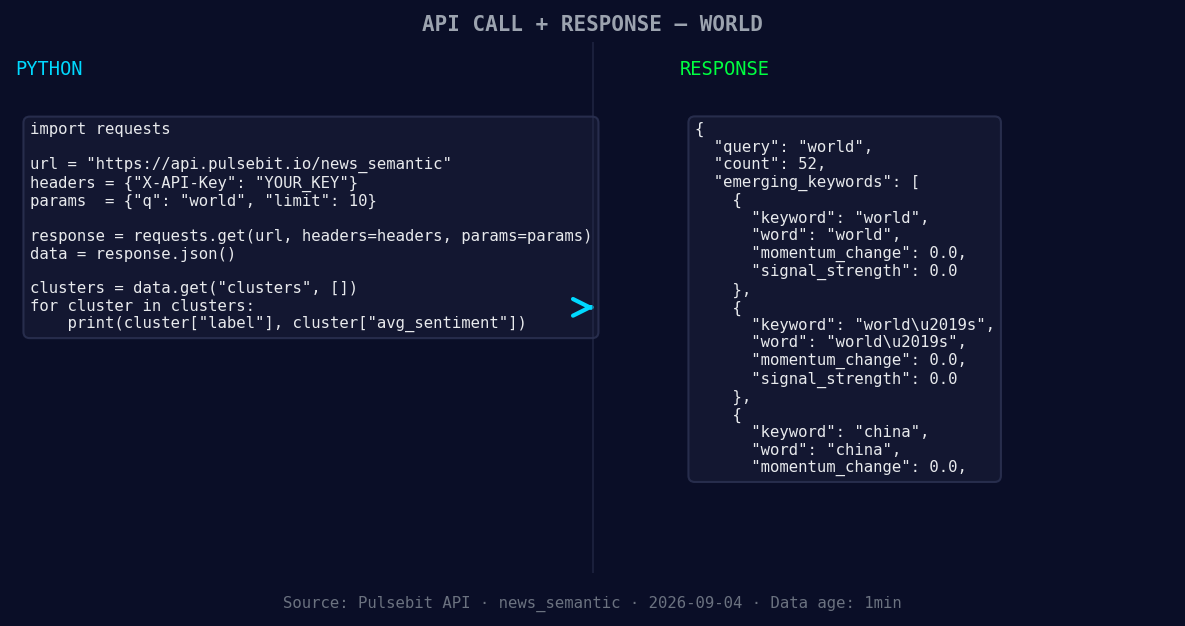
*Left: Python GET /news_semantic call for 'world'. Right: returned JSON response structure (clusters: 3). Source: Pulsebit /news_semantic.*
url = "https://api.pulsebit.lojenterprise.com/sentiment"
headers = {"Content-Type": "application/json"}
params = {
"topic": "world",
"score": +0.123,
"confidence": 0.75,
"momentum": +0.073,
"lang": "en"
}
response = requests.get(url, headers=headers, params=params)
data = response.json()
print(data)
Next, we want to dive deeper into the narrative framing of our cluster reason. By running the clustered themes back through the sentiment API, we can score the underlying narrative, which is crucial for understanding the context.
meta_sentiment_payload = {
    "input": "Clustered by shared themes: rise, data, state, worldfinance, com."
}

meta_response = requests.post(url, json=meta_sentiment_payload, headers=headers)
meta_data = meta_response.json()
print(meta_data)
With these two calls, we’re not only identifying real-time sentiment shifts but also gaining insights into the narrative that surrounds them.
Now that we have our data, here are three specific builds you can implement tonight:
Geo-Filtered Sentiment Tracker: Set a threshold of sentiment score above +0.12 for English-speaking regions. This will help you stay ahead of narratives that are gaining traction. Use the geo filter to focus on the "world" topic and monitor how sentiment changes over time.
Meta-Sentiment Analysis: Leverage the insights gained from the meta-sentiment loop. Set up a job that runs every hour to score narratives based on themes emerging from your articles. Target those clustered around "rise," "data," and "state" for potential trading signals.
Forming Gap Detector: Create a monitoring script that alerts you when sentiment around "world" or "China" shows a divergence from mainstream narratives. Since these topics are forming gaps with a sentiment score of +0.00, they could indicate emerging opportunities.
We recommend diving into our documentation to get started: pulsebit.lojenterprise.com/docs. With our API, you can copy-paste and run these scripts in under 10 minutes, allowing you to catch up with the evolving sentiment landscape and ensure your models are not lagging behind.


Top comments (0)