

Your Pipeline Is 24.9h Behind: Catching Blockchain Sentiment Leads with Pulsebit
A recent finding revealed a notable 24h momentum spike of +0.231 in the blockchain sentiment landscape. This spike, registered against a backdrop of heightened discussions, indicates a significant shift in sentiment that your models could be missing if they're not tuned to catch these real-time changes. With the leading language showing English press dominating with a 0.0h lag, it’s clear that there's a critical moment here that demands our attention.
This situation exposes a glaring structural gap in sentiment pipelines that fail to accommodate multilingual origins or recognize entity dominance. If your model isn’t designed to handle this complexity, you might find yourself lagging by 24.9 hours, missing critical signals. In this case, the dominant entity is the blockchain, and if you’re not capturing this correctly, you’re likely operating with outdated insights.

English coverage led by 24.9 hours. Id at T+24.9h. Confidence scores: English 0.85, French 0.85, Spanish 0.85 Source: Pulsebit /sentiment_by_lang.
Let's dive into the code that can help you bridge this gap. Below, we’re going to use the blockchain topic with a score of +0.761 and a confidence level of 0.85. First, we’ll filter our query by language, ensuring we only get English-language articles:
import requests
# Define the endpoint and parameters
url = "https://api.pulsebit.io/sentiment"
params = {
"topic": "blockchain",
"lang": "en"
}
# Make the API call
response = requests.get(url, params=params)
data = response.json()
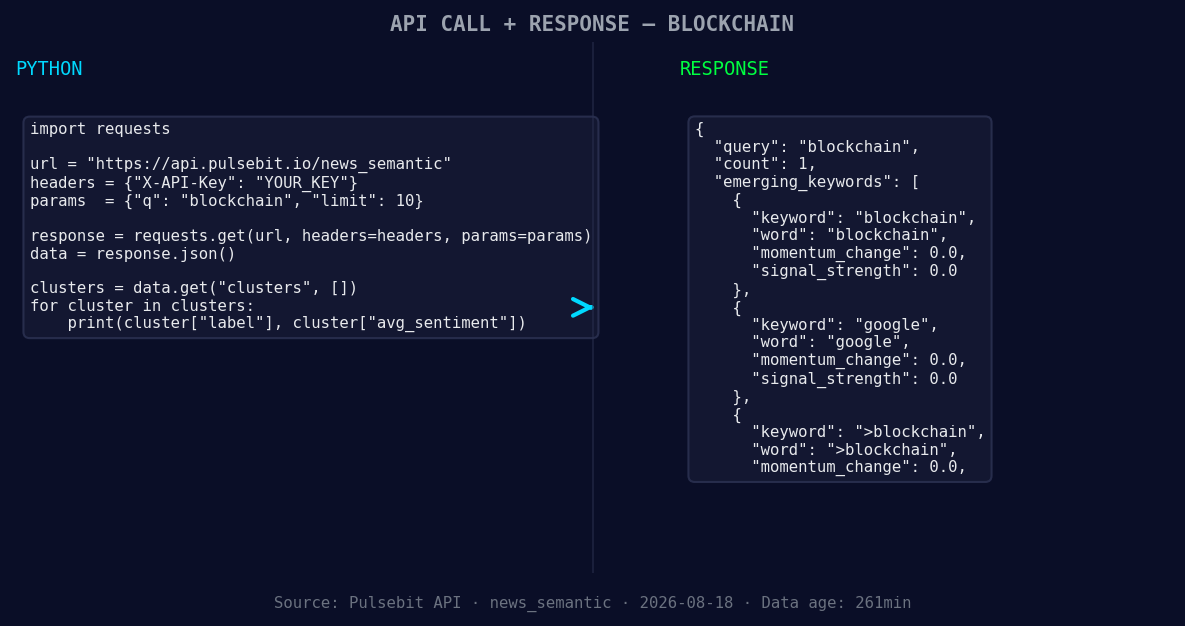
*Left: Python GET /news_semantic call for 'blockchain'. Right: returned JSON response structure (clusters: 3). Source: Pulsebit /news_semantic.*
# Print the resulting data for analysis
print(data)
Next, we’ll run a meta-sentiment analysis on the clustered narratives. This step helps us score the framing of the narratives themselves. We’ll use the reason string: "Clustered by shared themes: street, wants, put, stock, market."
# Define the endpoint for meta-sentiment
meta_url = "https://api.pulsebit.io/sentiment/meta"
meta_input = {
    "text": "Clustered by shared themes: street, wants, put, stock, market."
}

# Make the API call for meta-sentiment
meta_response = requests.post(meta_url, json=meta_input)
meta_data = meta_response.json()

# Print the meta-sentiment analysis
print(meta_data)
By integrating these two API calls, you’ll not only capture the raw sentiment data but also contextualize it through the lens of the underlying narratives, giving you a more robust understanding of the market sentiment.
Now that we have the code in place, let’s discuss three specific builds we can implement tonight based on this momentum spike:
Geo-Filtered Alert System: Create an alert system that triggers when the blockchain sentiment momentum exceeds a threshold of +0.2 for English articles. Utilize the language filter in your API call to ensure timely alerts for your specific audience.
Meta-Sentiment Dashboard: Develop a dashboard that visualizes the meta-sentiment of clustered narratives. Set a threshold score of +0.7 to highlight positive framing, indicating a conducive environment for blockchain discussions.
Forming Theme Tracker: Implement a tracker that analyzes forming themes such as "blockchain(+0.00)" and "google(+0.00)". Set alerts when these themes begin to diverge from mainstream narratives like "street, wants, put," indicating potential shifts in public sentiment.
By leveraging these builds, you can stay ahead of trends and ensure your insights are as relevant as possible.
To get started with our API and implement these strategies, head over to pulsebit.lojenterprise.com/docs. You’ll be able to copy-paste and run the examples we've provided in under 10 minutes, ensuring you’re plugged into the latest sentiment shifts in real-time.

Geographic detection output for blockchain. India leads with 1 articles and sentiment +0.85. Source: Pulsebit /news_recent geographic fields.


Top comments (0)