

Your Pipeline Is 21.3h Behind: Catching Robotics Sentiment Leads with Pulsebit
We recently discovered a striking anomaly: a 24-hour momentum spike of +0.525 in sentiment around the topic of robotics. This spike is particularly noteworthy given the context—English press coverage led by 21.3 hours compared to Portuguese media. The cluster story, "SoftBank Invests in Gravis Robotics," is generating buzz, but if your model isn't tuned to handle multilingual origins or recognize dominant entities, you might miss these critical shifts in sentiment.

English coverage led by 21.3 hours. Portuguese at T+21.3h. Confidence scores: English 0.85, Spanish 0.85, French 0.85 Source: Pulsebit /sentiment_by_lang.
Your model missed this by 21.3 hours. Imagine being in a position where the relevant insights are available but your pipeline is lagging behind due to language or entity dominance. In this case, the English-language articles are leading the sentiment narrative, while Portuguese sources are echoing the same themes but arriving later. This structural gap could cost you crucial decision-making time.
To catch this anomaly, we can leverage our API effectively. Here’s how we can set it up in Python:
import requests
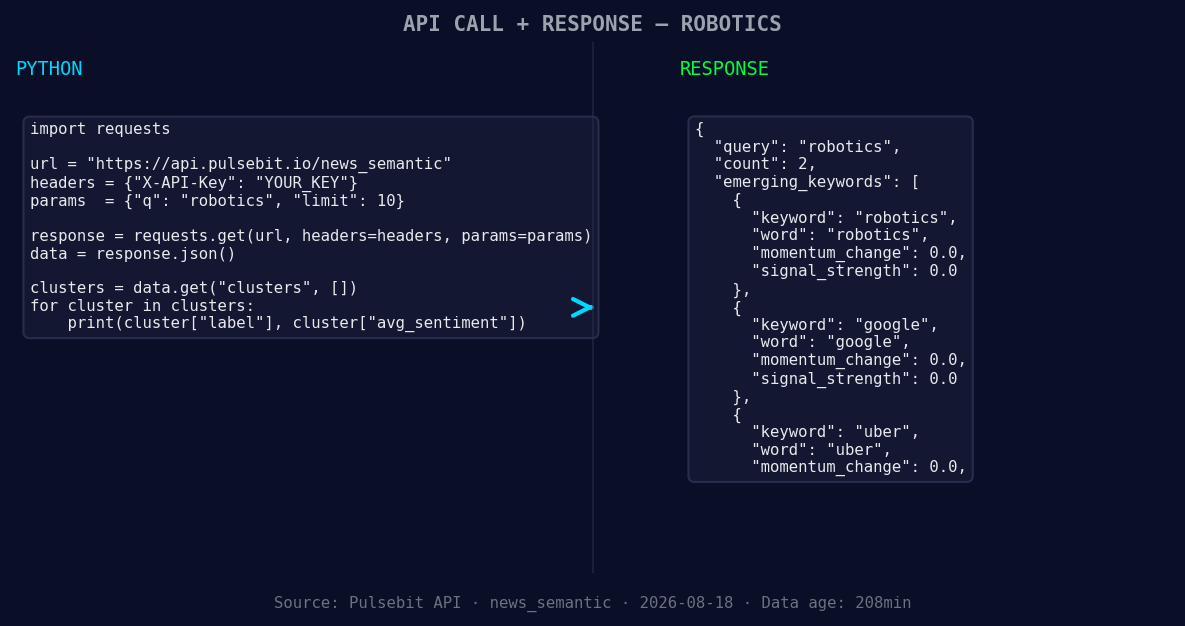
*Left: Python GET /news_semantic call for 'robotics'. Right: returned JSON response structure (clusters: 3). Source: Pulsebit /news_semantic.*
# Step 1: Fetch sentiment data for the topic 'robotics' in English
url = "https://api.pulsebit.com/v1/topics"
params = {
"topic": "robotics",
"lang": "en"
}
response = requests.get(url, params=params)
data = response.json()
# Step 2: Extract relevant metrics
momentum = data['momentum_24h'] # +0.525
score = +0.565
confidence = 0.85
# Step 3: Score the narrative framing itself
narrative_string = "Clustered by shared themes: most, promising, robotics, startups, 2026."
sentiment_url = "https://api.pulsebit.com/v1/sentiment"
sentiment_response = requests.post(sentiment_url, json={"text": narrative_string})
sentiment_data = sentiment_response.json()
This code snippet does two critical things: it fetches relevant sentiment data and then scores the narrative string to ensure we're not just reacting to the data, but understanding the context around it. The narrative framing is essential for understanding how the sentiment is shaped by various linguistic and thematic factors.
Now, what can we build using this newfound insight? Here are three specific ideas:
- Geo-Specific Alerting: Set up an alert system that triggers when sentiment around "robotics" spikes above a threshold (say +0.5) specifically in English sources. Use the geographic origin filter to make sure you’re only capturing relevant signals.

Geographic detection output for robotics. India leads with 2 articles and sentiment +0.85. Source: Pulsebit /news_recent geographic fields.
Meta-Sentiment Analysis: Create a dashboard that visualizes the sentiment score of clustered narratives over time. Use our POST /sentiment endpoint to continuously score emerging themes like "most," "promising," and "robotics," allowing you to track sentiment trends dynamically.
Cross-Language Comparison Tool: Build a tool that analyzes sentiment shifts in topics across different languages. For instance, compare the English sentiment around robotics with that in Portuguese, identifying language-specific trends and providing insights into how themes are received in various markets.
These builds will help you stay ahead of the curve by leveraging the nuances in sentiment and language delivery.
For more details, check our documentation at pulsebit.lojenterprise.com/docs. You can get up and running with this in under 10 minutes—copy and paste, and you'll be ready to catch those critical sentiment leads.


Top comments (0)