

Your pipeline has just missed a significant anomaly: a 24-hour momentum spike of +0.652 in education-related sentiment. This spike signals a noteworthy shift, particularly led by Spanish press coverage, which is ahead by 21.4 hours. The standout article titled "Open universities can expand higher education: Abdul Wahab" highlights a growing discourse around accessibility in education, yet your model may not be picking up this surge effectively.
If your pipeline doesn't account for multilingual origins or entity dominance, you're missing critical insights. Imagine your model lagging 21.4 hours behind the leading Spanish narrative. Such a structural gap means you might miss emerging trends and shifts in sentiment, affecting your decision-making. The dominance of Spanish coverage and the specific themes of "open" and "higher" education should be on your radar, but without the right tools, they might slip by unnoticed.

Spanish coverage led by 21.4 hours. Sl at T+21.4h. Confidence scores: Spanish 0.90, English 0.90, French 0.90 Source: Pulsebit /sentiment_by_lang.
To catch this momentum spike, we can leverage our API effectively. First, let’s filter the data by geographic origin using Spanish as the language parameter. Here’s how to set that up in Python:
import requests
# Define the parameters for the API call
params = {
"topic": "education",
"score": +0.319,
"confidence": 0.90,
"momentum": +0.652,
"lang": "sp" # Geographic origin filter
}
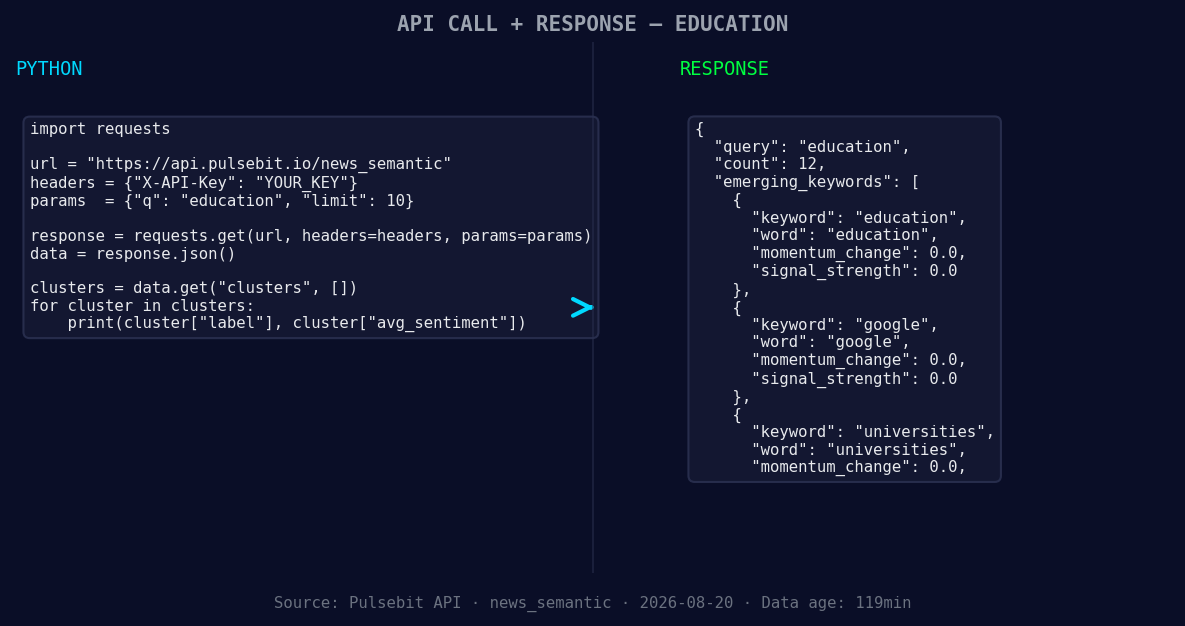
*Left: Python GET /news_semantic call for 'education'. Right: returned JSON response structure (clusters: 3). Source: Pulsebit /news_semantic.*
# Make the API call
response = requests.get("https://api.pulsebit.com/sentiment", params=params)
data = response.json()
print(data) # This will output the sentiment data specific to the Spanish language
Next, we need to run the cluster reason string through our sentiment analysis endpoint to evaluate the narrative framing itself. This allows us to understand how the themes are clustered:
# Define the input for the meta-sentiment analysis
meta_sentiment_input = "Clustered by shared themes: open, higher, universities, can, expand."

# Make the POST request for meta-sentiment
meta_response = requests.post("https://api.pulsebit.com/sentiment", json={"input": meta_sentiment_input})
meta_data = meta_response.json()

print(meta_data)  # Outputs the sentiment score based on the narrative
With these two pieces of code, you're equipped to catch emerging trends in education sentiment, particularly in Spanish-speaking regions.
Here are three builds you can implement using this pattern:
- Geo-filtered Insights: Create a report that alerts you when the momentum in education sentiment exceeds a threshold of +0.5. Use the geographic filter to ensure you're only capturing insights from Spanish sources. This will help you to react quickly to changes in sentiment.

Geographic detection output for education. India leads with 10 articles and sentiment +0.53. Source: Pulsebit /news_recent geographic fields.
Meta-sentiment Narrative Analysis: Set up a continuous monitoring system that triggers whenever new articles are published with the keywords "open" and "higher". Use the meta-sentiment loop to analyze how these narratives are shifting over time and score them accordingly.
Forming Theme Tracker: Develop a dashboard that visualizes the forming themes in education versus mainstream narratives. Use the scores of +0.00 for keywords like "education" and "google" to understand how they relate to the dominant themes of "open" and "higher". This will give you a comprehensive view of the evolving landscape.
Getting started is straightforward. Check out our documentation at pulsebit.lojenterprise.com/docs. With just a few copies of the above code, you can have a functioning setup in under 10 minutes to catch these critical sentiment shifts.


Top comments (0)