

Your Pipeline Is 18.8h Behind: Catching Economy Sentiment Leads with Pulsebit
We just noticed something interesting: the sentiment around the economy has dipped to -0.013, while momentum has risen to +0.037. But here's the kicker—this anomaly is emerging in real-time, with a staggering 18.8-hour lead from English press coverage compared to Spanish. We’re seeing a clear indication that the Democrats are leading on economic issues, but many pipelines might miss these insights if they're not set up to handle multilingual data effectively.

English coverage led by 18.8 hours. Spanish at T+18.8h. Confidence scores: English 0.90, French 0.90, Spanish 0.90 Source: Pulsebit /sentiment_by_lang.
This discovery highlights a structural gap in your data pipeline. If your sentiment analysis model isn't tuned to account for the dominance of certain entities or the nuances of multiple languages, you could find yourself lagging behind by almost 19 hours. In this case, the English language is leading the sentiment narrative, while your system might still be processing data from other languages, like Spanish. This is not just a minor oversight—it’s a significant delay that can impact your decision-making and insights.
To catch these emerging insights, we can leverage our API effectively. Here's how you can do it with a little Python code.
First, let's set up a query to fetch relevant economic sentiment data filtered by language. We’ll use the parameters specified to get our desired results:
import requests
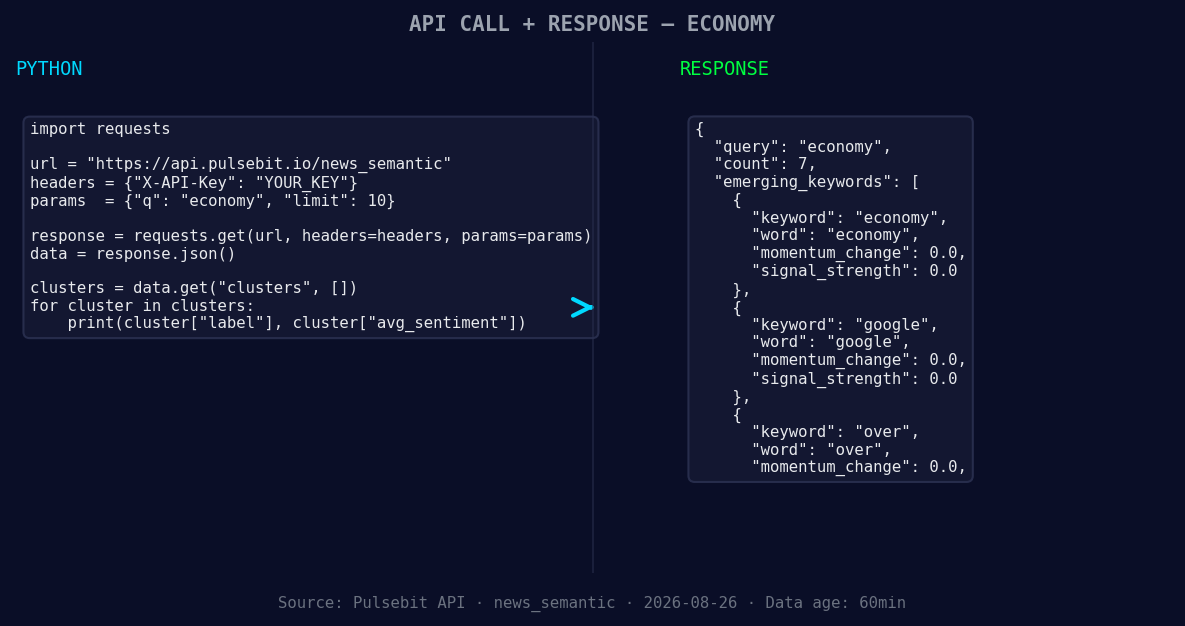
*Left: Python GET /news_semantic call for 'economy'. Right: returned JSON response structure (clusters: 3). Source: Pulsebit /news_semantic.*
url = "https://api.pulsebit.com/v1/sentiment"
params = {
"topic": "economy",
"score": -0.013,
"confidence": 0.90,
"momentum": 0.037,
"lang": "en" # Geographical origin filter
}
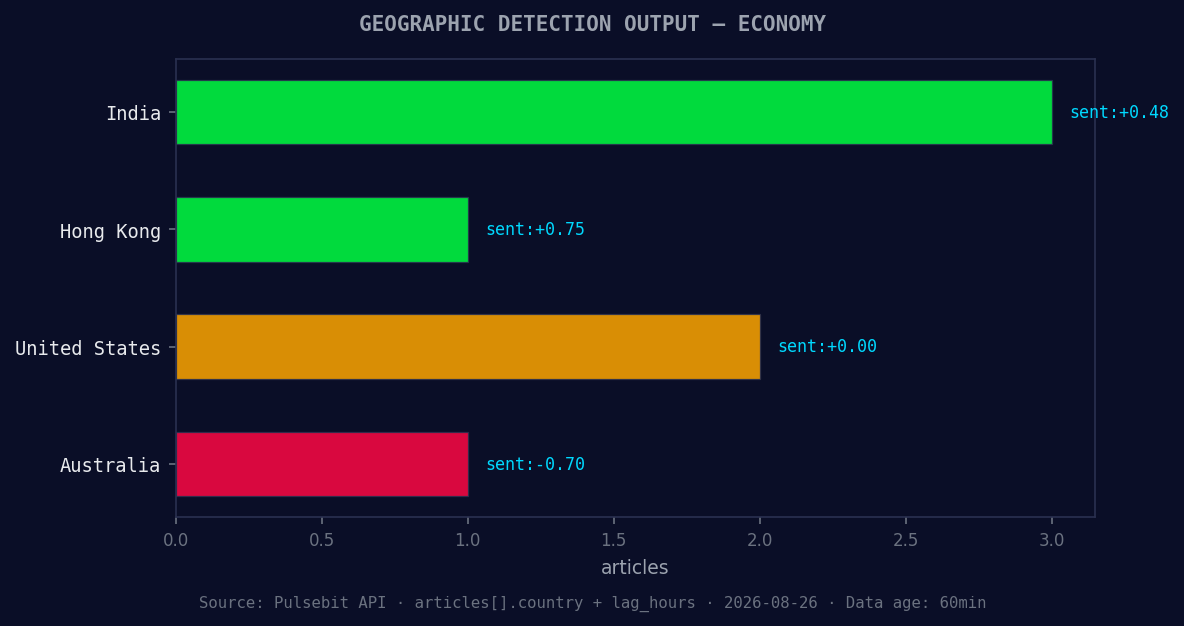
*Geographic detection output for economy. India leads with 3 articles and sentiment +0.48. Source: Pulsebit /news_recent geographic fields.*
response = requests.get(url, params=params)
data = response.json()
Next, we need to analyze the narrative framing of the articles clustered around this sentiment. We can take the reason string from our data and POST it to the /sentiment endpoint to score it:
meta_sentiment_string = "Clustered by shared themes: points, economy, over, gop:, democrats."
meta_response = requests.post(url, json={"text": meta_sentiment_string})
meta_data = meta_response.json()
With these two pieces of code, we can gain insights not only about the sentiment but also about how the narrative is shaped around economic issues.
Now that we've captured this anomaly, let’s build three specific signals based on the insights from our findings.
Geo-Sentiment Trigger: Create a signal to alert you when sentiment on the economy drops below -0.01 in English articles. Use a threshold of 0.90 confidence to ensure you're only acting on strong signals.
Meta-Sentiment Loop: Develop a secondary signal that triggers whenever the framing around economic discussions shows a significant shift. If the sentiment score of the narrative framing exceeds 0.05, take action—this could indicate a real change in public perception.
Forming Themes Analysis: Build an endpoint that clusters articles based on emerging themes. When the topics of economy, Google, and the overarching narrative start surfacing more frequently, it’s an indication that there's a forming gap that could lead to actionable insights.
All of these builds focus on catching key signals in the economy discussion landscape, allowing you to stay ahead of the curve.
To dive deeper into this, check out our documentation: pulsebit.lojenterprise.com/docs. You can copy-paste and run this in under 10 minutes, getting you up to speed with these crucial insights in no time.


Top comments (0)