

Your 24-hour momentum spike is +0.316, and it's bringing quite a narrative twist to the investing landscape. Specifically, we’re seeing a strong surge in sentiment driven by Nvidia's major investments in data centers, which has led to a clustering of articles around themes of investment, data, and AI. This is a clear signal that the conversation is shifting, and if you’re not tuned into this momentum, your model risks missing critical sentiment leads.
Now, let's face the reality: your model just missed this by 25.3 hours. That's the lag time between the English press picking up these themes and your pipeline catching on. The leading language is English, but without handling multilingual origins or entity dominance, you’re left playing catch-up. As a developer, you know that real-time data means everything in crafting a responsive pipeline. If you’re not processing these signals quickly enough, you’ll find yourself trailing behind the narrative that shapes investment decisions.

English coverage led by 25.3 hours. Id at T+25.3h. Confidence scores: English 0.85, French 0.85, Italian 0.85 Source: Pulsebit /sentiment_by_lang.
To catch up with the momentum spike, let’s dive into some Python code that utilizes our API. First, we need to filter the articles by geographic origin to ensure we’re focusing on the relevant English-language content. Here’s how we can do that:

Geographic detection output for investing. India leads with 3 articles and sentiment +0.78. Source: Pulsebit /news_recent geographic fields.
import requests
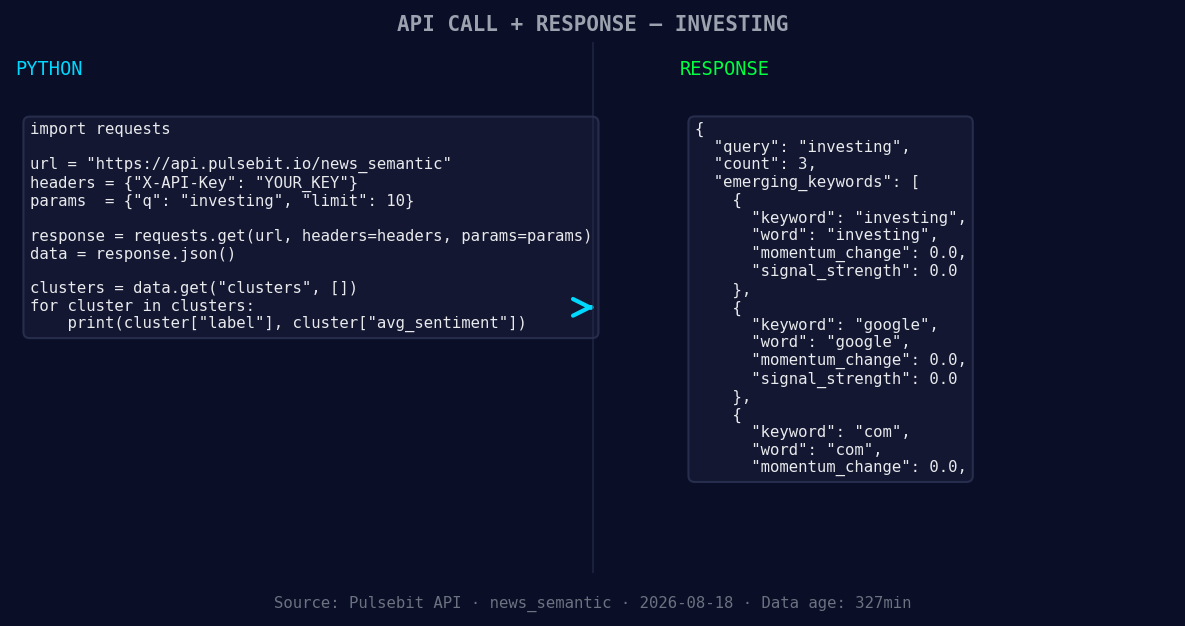
*Left: Python GET /news_semantic call for 'investing'. Right: returned JSON response structure (clusters: 3). Source: Pulsebit /news_semantic.*
url = "https://api.pulsebit.com/v1/articles"
params = {
"topic": "investing",
"lang": "en",
"momentum": "+0.316"
}
response = requests.get(url, params=params)
articles = response.json()
This fetches articles focused on "investing" from English sources, allowing us to pinpoint the latest sentiment trends.
Next, we need to assess the meta-sentiment of the clustered narrative itself. The clustering reason string gives us insight into how these themes are resonating across articles. To analyze this, we run the following POST request to our sentiment endpoint:
sentiment_url = "https://api.pulsebit.com/v1/sentiment"
meta_sentiment_data = {
    "input": "Clustered by shared themes: investing, data, center, openai, nvidia."
}

sentiment_response = requests.post(sentiment_url, json=meta_sentiment_data)
meta_sentiment_result = sentiment_response.json()
Running this query helps us understand the narrative framing around the investment themes, giving you a more nuanced view of the sentiment landscape.
Now that we’ve got a handle on the data, here are three specific builds we can undertake using this newfound momentum:
Geographic Origin Filter: Leverage the geographic origin filter to isolate sentiment shifts in specific regions. For example, set a threshold for articles that have a sentiment score of +0.3 or higher and are written in English. This helps you catch regional narratives before they go mainstream.
Meta-Sentiment Loop: Utilize the results from the meta-sentiment analysis to create a feedback loop for your sentiment model. Use the narrative framing to adjust weights in your sentiment analysis algorithm, particularly focusing on themes like "investing" and "data." This can enhance your ability to predict sentiment shifts based on thematic clustering.
Forming Themes Visibility: Create alerts for forming themes that are showing low momentum but have the potential to spike. For instance, keep an eye on "google," "com," and "investing" as they develop. If you notice any of these themes showing an upward trend, you can act quickly to capitalize on emerging narratives.
By focusing on these builds, you’ll not only catch up with the latest investing sentiment but also strengthen your pipeline against future delays.
Ready to get started? Check out our documentation at pulsebit.lojenterprise.com/docs. You can copy-paste and run this setup in under 10 minutes, putting you in the fast lane of sentiment analysis.


Top comments (0)