

Your pipeline is 25.4h behind: catching software sentiment leads with Pulsebit
We just stumbled upon a compelling anomaly: a 24h momentum spike of -0.180 in the sentiment surrounding the software sector. This negative shift caught our attention, especially given that the leading language for the related news was English, with a 25.4h lead time. To make matters more interesting, Reuters dominated the conversation with an 8% share of voice and a positive sentiment score of +0.725. This insight begs the question: how did our pipeline miss such an impactful signal?
The problem here is straightforward. If your pipeline isn’t equipped to handle multilingual origins and entity dominance, you risk missing critical insights. Your model missed this by 25.4 hours, potentially allowing competitors to seize the opportunity to adjust their strategies or investments. The leading content in English, driven by Reuters, is a clear signal that you need to recalibrate how you process and prioritize sentiment data.

English coverage led by 25.4 hours. Italian at T+25.4h. Confidence scores: English 0.90, Af 0.90, Spanish 0.90 Source: Pulsebit /sentiment_by_lang.
Let’s dive into the code that allows us to catch this anomaly effectively. We can leverage our API to filter by language, ensuring we’re focusing on the right content. Here’s how you can set this up using Python:
import requests
# Define the parameters for the API call
params = {
"topic": "software",
"lang": "en",
}
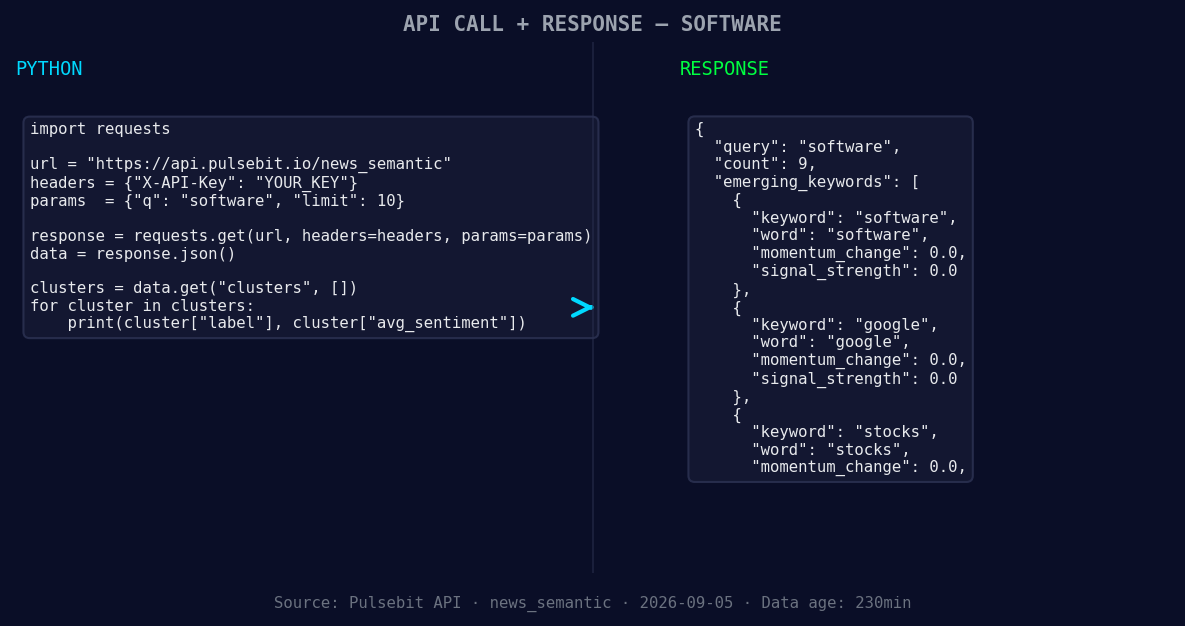
*Left: Python GET /news_semantic call for 'software'. Right: returned JSON response structure (clusters: 3). Source: Pulsebit /news_semantic.*
# Make the API call to fetch the relevant articles
response = requests.get('https://api.pulsebit.com/articles', params=params)
articles = response.json()
# Print the fetched articles
print(articles)
Next, we need to evaluate the sentiment of the narrative framing itself. We’ll run the cluster reason string through our sentiment endpoint to score it. Here’s how we can do this:
# Define the meta-sentiment input string
meta_sentiment_input = "Clustered by shared themes: court, karnataka, high, directs, state."

# Make the API call to score the narrative framing
sentiment_response = requests.post('https://api.pulsebit.com/sentiment', json={"text": meta_sentiment_input})
sentiment_score = sentiment_response.json()

# Print the sentiment score of the narrative
print(sentiment_score)
With these two code snippets, we can effectively filter for relevant content and assess the sentiment framing surrounding it.
Now, let's discuss three specific things you can build using this pattern.
Sentiment Alerting System: Implement an alert that triggers when the sentiment score for the topic "software" drops below a certain threshold, say -0.100. This is crucial, especially when the leading language is English. You could set this up with a scheduled job that runs every hour.
Meta-Sentiment Dashboard: Create a dashboard that visualizes the sentiment of clustered narratives in real-time. Use the results from our meta-sentiment call to create a running score for specific themes. This will allow you to monitor how discussions around "court," "karnataka," and "high" evolve over time.
Entity Dominance Tracking: Build a feature that tracks the share of voice of dominant entities like Reuters. Use the sentiment scores alongside the share of voice data to create a composite score that alerts you when a particular entity's sentiment diverges significantly from its typical baseline.
For each of these builds, the geo filter and meta-sentiment loop are essential. They ensure that you’re not only reacting to sentiment shifts but also understanding the context in which they occur.
If you want to get started, check out our documentation at pulsebit.lojenterprise.com/docs. You can copy-paste these snippets and have them running in under ten minutes. Happy coding!

Geographic detection output for software. India leads with 9 articles and sentiment +0.29. Source: Pulsebit /news_recent geographic fields.


Top comments (0)