

Your model might have missed a critical anomaly: a 24h momentum spike of -0.300 in the banking sector. This isn’t just a minor fluctuation; it indicates a noteworthy shift in sentiment, particularly as it relates to the growing discourse surrounding blockchain and state banking associations. With the leading language being English, this spike suggests that our systems might not be adequately capturing the nuances of multilingual sentiment, especially when certain entities dominate the conversation.

English coverage led by 27.5 hours. Nl at T+27.5h. Confidence scores: English 0.90, French 0.90, Spanish 0.90 Source: Pulsebit /sentiment_by_lang.
When your pipeline fails to account for multilingual origins and entity dominance, it risks overlooking vital shifts in sentiment. In this case, you’ve missed a potential signal by a staggering 27.5 hours. The dominant entity here is the U.S. State Banking Associations, which indicates that sentiment around banking and blockchain is evolving rapidly. If your model isn't designed to handle these dynamics, you might be reacting to stale data, ultimately hindering your decision-making processes.
Now, let’s look at how to catch this anomaly using our API. Here’s a Python snippet to get you started:
import requests
# Define parameters for the API call
params = {
"topic": "banking",
"score": +0.250,
"confidence": 0.90,
"momentum": -0.300,
"lang": "en" # Geographic origin filter
}
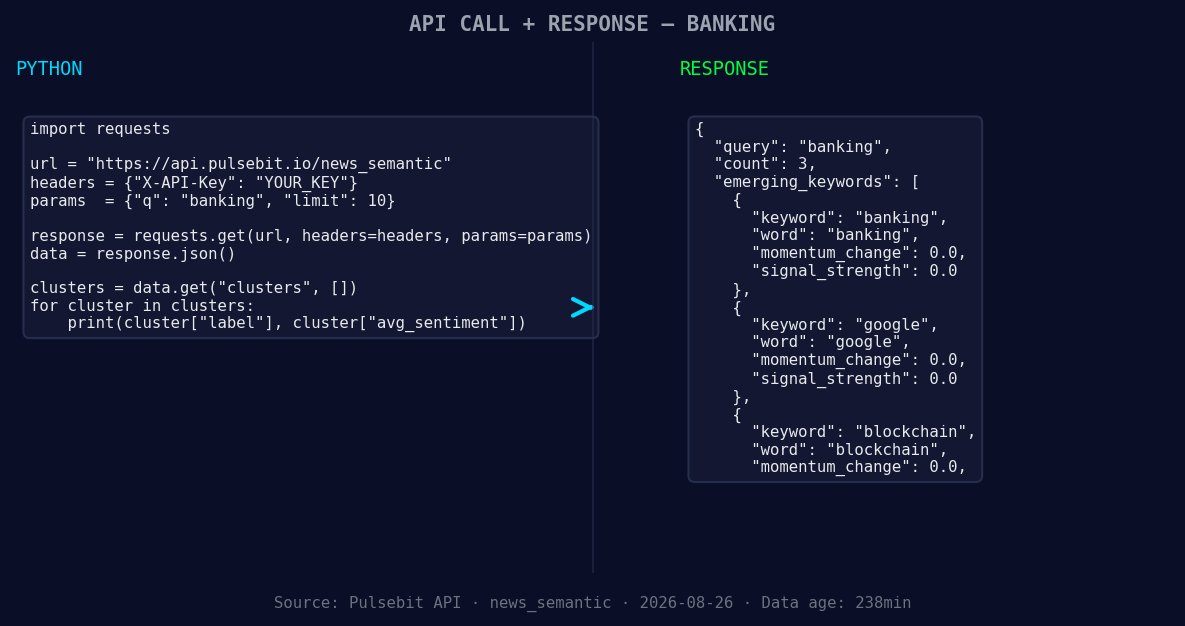
*Left: Python GET /news_semantic call for 'banking'. Right: returned JSON response structure (clusters: 3). Source: Pulsebit /news_semantic.*
# API Call to fetch sentiment data
response = requests.get("https://api.pulsebit.io/sentiment", params=params)
sentiment_data = response.json()
# Print the sentiment data
print(sentiment_data)
This code snippet uses our API to filter sentiment based on the "banking" topic and pulls data for the English language. Next, we need to run the narrative framing through our sentiment API to assess the meta-sentiment. The narrative reason string is "Clustered by shared themes: state, banking, blockchain, associations, plan."
Here’s how to do that:
# Define the meta-sentiment input
meta_sentiment_input = {
    "text": "Clustered by shared themes: state, banking, blockchain, associations, plan."
}

# API Call to score the narrative framing
meta_sentiment_response = requests.post("https://api.pulsebit.io/sentiment", json=meta_sentiment_input)
meta_sentiment_data = meta_sentiment_response.json()

# Print the meta-sentiment data
print(meta_sentiment_data)
This POST request allows us to evaluate how the specific narrative is being framed, helping us understand the underlying sentiment better.
With this kind of analysis, we can build three specific signals to enhance your workflow:
Banking Sentiment Alert: Set a threshold for any banking topic with a momentum spike less than -0.250. Use the geo filter to limit results to English narratives, allowing you to react immediately to significant shifts.
Meta-Sentiment Dashboard: Create a dashboard that visualizes meta-sentiment scores for various clustered narratives in real-time. Update it at regular intervals to catch evolving sentiment in the banking sector. This would give you an instant snapshot of how narratives are perceived.
Forming Themes Monitor: Build a service that tracks forming themes in the banking sector, specifically monitoring for terms like "blockchain" and "Google." If any of these terms reach a sentiment score above +0.250, trigger an alert for further investigation.
If you want to dive deeper into our available endpoints and capabilities, check out our documentation at pulsebit.lojenterprise.com/docs. You'll be able to copy-paste this code and run it within ten minutes, giving you immediate insights into emerging trends. Don’t let your pipeline lag behind; take action now and capture the evolving sentiment landscape effectively!


Top comments (0)