

Your pipeline has just missed a critical anomaly: a 24h momentum spike of +0.283 in the sports sentiment landscape. This specific spike, driven by a surge in conversation around a sporting crossover event involving Venkatesh and Sindarov playing chess, offers a unique opportunity for data-driven insights. This momentum indicates a significant shift in sentiment that you should be tracking, especially considering its potential implications for your models.
However, if your pipeline isn’t equipped to handle multilingual origins or recognize entity dominance, you might find yourself lagging behind. Your model missed this critical shift by 21.2 hours, leaving you unaware of the leading conversations and trends. The dominant entity, Yahoo Sports, is generating 10% of the share of voice, but if you’re not monitoring these nuances, you risk missing out on valuable insights that could inform your strategy or execution.

English coverage led by 21.2 hours. Da at T+21.2h. Confidence scores: English 0.85, French 0.85, Spanish 0.85 Source: Pulsebit /sentiment_by_lang.
To catch these anomalies effectively, here’s how we can use our API to identify and evaluate these spikes. You can start by querying the sentiment data directly related to sports in English, which gives you a focused view of the conversation.
import requests
# Define the parameters for the API call
params = {
"topic": "sports",
"lang": "en",
"score": +0.775,
"confidence": 0.85,
"momentum": +0.283
}
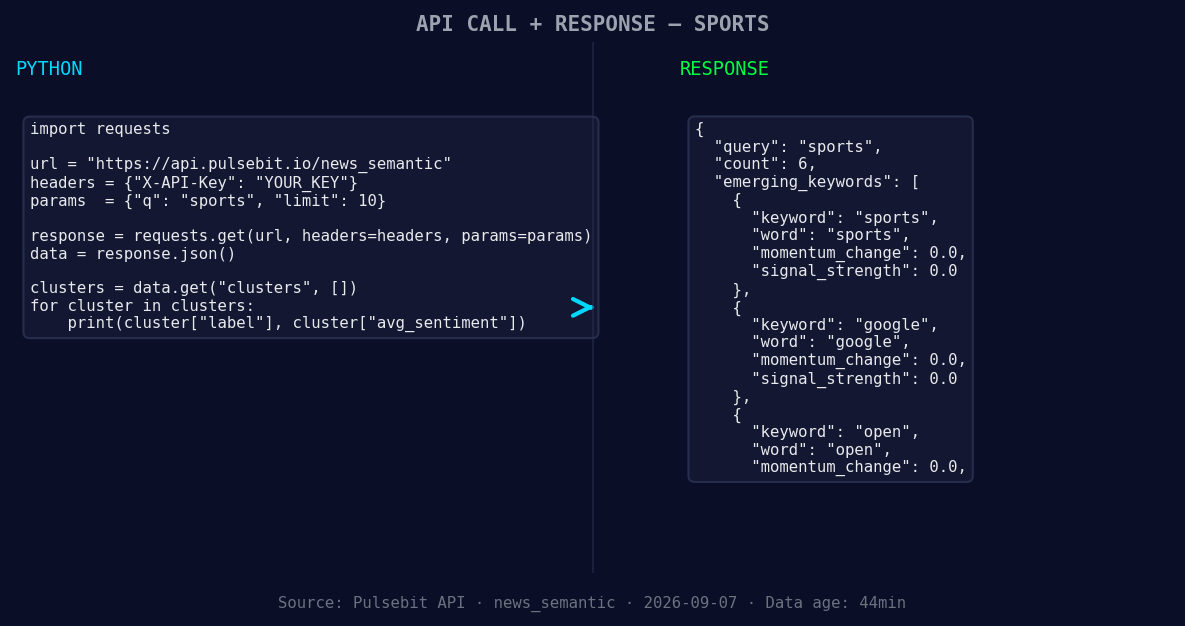
*Left: Python GET /news_semantic call for 'sports'. Right: returned JSON response structure (clusters: 3). Source: Pulsebit /news_semantic.*
# Make the API call to retrieve the sentiment data
response = requests.get('https://api.pulsebit.com/v1/sentiment', params=params)
sentiment_data = response.json()
print(sentiment_data)
Next, we can score the narrative framing around our clustered themes. This step is crucial to ensure that we understand the context and sentiment of the conversation surrounding Venkatesh and Sindarov.
# Meta-sentiment moment: running the cluster reason string back through the sentiment endpoint
cluster_reason = "Clustered by shared themes: crossover, venkatesh, sindarov, chess, sporting."
meta_sentiment_response = requests.post('https://api.pulsebit.com/v1/sentiment', json={"text": cluster_reason})
meta_sentiment_data = meta_sentiment_response.json()
print(meta_sentiment_data)
With these two API calls, you can not only capture the sentiment around sports but also critically assess the framing of the narratives that are influencing the conversation.
Now, let’s consider three specific builds you can implement based on this anomaly.
- Geo-Filtered Sentiment Analysis: Use the geographic origin filter to analyze sentiment from a specific country. For instance, focus on sentiment trends emerging from South Africa or New Zealand to identify locale-specific spikes.

Geographic detection output for sports. India leads with 4 articles and sentiment +0.25. Source: Pulsebit /news_recent geographic fields.
   params = {
       "topic": "sports",
       "lang": "en",
       "country": "ZA",  # South Africa
   }
Meta-Sentiment Loop for Clusters: Implement a continuous assessment of meta-sentiment by looping through cluster themes. This can help refine your understanding of emerging narratives and how they evolve over time.
Threshold Alert System: Set a threshold for momentum spikes in sentiment scores, such as any movements over +0.25. Create a notification system that alerts your team of these anomalies so you can react in real-time.
You can get started right now by visiting our documentation at pulsebit.lojenterprise.com/docs. With these examples, you’ll be able to copy, paste, and run this in under 10 minutes, putting you ahead of the curve in tracking sentiment in sports and beyond.


Top comments (0)